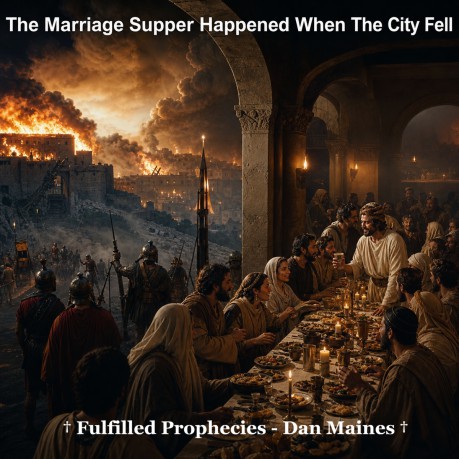
The
Marriage Supper Happened When The City Fell Introduction
Matthew 22:1-7
Luke 14:16-24 Revelation
19:7-9 Revelation
11:8 Matthew
8:11-12 Revelation
21:2, 9-10 Historical References How it applies to us
today Q and A Appendix † This is the fulfilled
perspective we proclaim at Fulfilled Prophecies † Source Index
By Dan Maines
†
Most people have been taught that the marriage supper is still
future, but Jesus already told us when it would happen, and He tied
it directly to the destruction of a city (Matthew 22:7).
†
When we let Scripture interpret Scripture, the timeline becomes
clear, the invitation goes out, it's rejected, judgment falls, and
then the wedding proceeds (Luke 14:16-24; Revelation 19:7-9).
†
The "wow" moment is seeing that the burning of the city is
not separate from the wedding, it's part of the sequence that leads
into it (Matthew 22:7; Revelation 19:2).
Jesus
spoke to them again in parables, saying, "The kingdom of heaven
is like a king who held a wedding feast for his son. And he sent his
slaves to call those who had been invited to the wedding feast, and
they were unwilling to come. Again he sent other slaves, saying,
'Tell those who have been invited, "Behold, I have prepared my
dinner; my oxen and my fattened cattle are all butchered and
everything is ready. Come to the wedding feast!"' But they paid
no attention and went their separate ways, one to his own farm,
another to his business, and the rest seized his slaves and treated
them abusively, and then killed them. Now the king was angry, and he
sent his armies and destroyed those murderers and set their city on
fire.
†
The invitation went first to those who were already called, that's
Israel, the covenant people who had the promises and the prophets
(Romans 9:4-5).
†
They rejected the invitation and killed the messengers, just like
Jesus said they would, filling up the measure of their fathers
(Matthew 23:34-36).
†
The king's response was not a future event thousands of years later,
he sent his armies and burned their city, that's a direct reference
to the destruction of Jerusalem in AD 70 (Luke 21:20-22).
†
The burning of the city is placed inside the wedding parable, not
after it, not separate from it, but as part of the transition into
the marriage feast (Matthew 22:7-10).
But
He said to him, "A man was giving a big dinner, and he invited
many; and at the dinner hour he sent his slave to tell those who had
been invited, 'Come, because everything is ready now.' And yet they
all alike began to make excuses. The first one said to him, 'I
purchased a field and I need to go out to look at it; please consider
me excused.' And another one said, 'I bought five yoke of oxen, and I
am going to try them out; please consider me excused.' And another
one said, 'I took a woman as my wife, and for that reason I cannot
come.' And the slave came back and reported this to his master. Then
the head of the household became angry and said to his slave, 'Go out
at once into the streets and lanes of the city and bring in here
those who are poor, those with disabilities, those who are blind, and
those who are limping.' And later the slave said, 'Master, what you
commanded has been done, and still there is room.' And the master
said to the slave, 'Go out into the roads and the hedges and press
upon them to come in, so that my house will be filled. For I tell
you, none of those men who were invited shall taste my dinner.'"
†
Again we see the same pattern, the originally invited guests refuse,
and the invitation shifts outward (Acts 13:46).
†
The supper is ready in their lifetime, Jesus says all things are now
ready, not thousands of years later (Mark 1:15).
†
Those first invited are completely excluded, none of them shall taste
of my supper, which shows a covenant shift from Israel to the nations
(Matthew 8:11-12).
†
This lines up perfectly with Matthew 22, rejection, judgment, then
expansion to others (Luke 14:21-23).
Let's
rejoice and be glad and give the glory to Him, because the marriage
of the Lamb has come, and His bride has prepared herself." It
was given to her to clothe herself in fine linen, bright and clean;
for the fine linen is the righteous acts of the saints.
Then he
said to me, "Write: 'Blessed are those who are invited to the
wedding feast of the Lamb.'" And he said to me, "These are
the true words of God."
†
The marriage has come, not it will come, the timing is tied to the
judgment Babylon just received in the same chapter (Revelation
19:2).
†
Babylon's fall immediately precedes the marriage supper, showing the
destruction and the wedding are connected events (Revelation 18:8-10;
Revelation 19:1-2).
†
If Babylon is Jerusalem, the great city where the Lord was crucified,
then the timing matches perfectly with AD 70 (Revelation 11:8).
†
The bride is ready after judgment falls, because the old covenant
system has been removed, making way for the fully revealed bride, the
church (Hebrews 12:22-24).
And their
dead bodies will lie on the street of the great city which
spiritually is called Sodom and Egypt, where also their Lord was
crucified.
†
This identifies the great city as the place where the Lord was
crucified, that's Jerusalem, not Rome or a future system (Luke
13:33).
†
This connects directly to Babylon in Revelation, proving the city
judged before the marriage supper is Jerusalem (Revelation 18:10;
Revelation 19:2).
†
That means the destruction tied to the wedding in Revelation 19 is
the same city Jesus said would be burned in Matthew 22 (Matthew
22:7).
And I
say to you that many will come from east and west, and recline at the
table with Abraham, Isaac, and Jacob in the kingdom of heaven; but
the sons of the kingdom will be thrown out into the outer darkness;
in that place there will be weeping and gnashing of teeth."
†
Jesus already said Gentiles would sit at the table while the original
heirs would be cast out, that's the marriage supper transition (Luke
13:28-29).
†
This is the same shift seen in Matthew 22 and Luke 14, invitation
rejected, others brought in (Acts 13:46).
†
The seating at the table is not future, it's part of the already
established kingdom reality (Colossians 1:13).
And
I saw the holy city, new Jerusalem, coming down out of heaven from
God, prepared as a bride adorned for her husband.
Then one of
the seven angels who had the seven bowls, full of the seven last
plagues, came and spoke with me, saying, "Come here, I will show
you the bride, the wife of the Lamb."
And he carried me
away in the Spirit to a great and high mountain, and showed me the
holy city, Jerusalem, coming down out of heaven from God,
†
The bride is identified as the city, not a future physical place but
a covenant people (Hebrews 12:22-23).
†
This happens immediately after Babylon falls, again tying the
destruction of Jerusalem to the revealing of the bride (Revelation
18:2; Revelation 21:2).
†
The marriage supper and the bride being revealed are part of the same
fulfilled transition (Revelation 19:7-9).
†
Josephus records that Jerusalem was burned by the Roman armies in AD
70, exactly matching the language Jesus used about the king burning
their city (Josephus, Wars of the Jews, Book 6).
†
Eusebius confirms that the destruction of Jerusalem fulfilled the
warnings of Christ and marked the end of that covenant system
(Eusebius, Ecclesiastical History, Book 3).
†
Tacitus also records the Roman destruction of Jerusalem, showing this
was a real historical judgment, not symbolic of something future
(Tacitus, Histories 5.13).
†
Clement of Alexandria speaks of the gospel going to the nations after
the fall of Jerusalem, confirming the shift seen in the parables
(Clement of Alexandria, Stromata, Book 6).
†
Lactantius connects the judgment of Jerusalem with the vindication of
Christ's followers, aligning with the marriage imagery after judgment
(Lactantius, Divine Institutes, Book 4).
† We're
not waiting for the marriage supper, we're living in it, the kingdom
has been established and the invitation has already gone out to the
nations (Hebrews 12:28).
†
The rejection of Israel shows that being invited isn't enough, we
must respond, the gospel call still goes out, and people can still
reject it (2 Corinthians 6:2).
†
The destruction of Jerusalem proves that Jesus keeps His word, every
judgment He spoke came to pass in that generation (Matthew 24:34).
†
We now live as part of the bride, in covenant union with Christ, not
waiting for a future wedding, but walking in a present reality
(Ephesians 2:19-22).
Q
If the marriage supper already happened, why do people still think
it's future?
A
Because they separate Revelation from Jesus' own timeline, but Jesus
already placed the judgment and the wedding sequence in the first
century (Matthew 22:7; Matthew 24:34).
Q
Who were the originally invited guests?
A
Israel, they had the covenants and promises but rejected the
invitation (Romans 9:4-5; Matthew 21:43).
Q
When did the city get burned?
A
In AD 70 when Rome destroyed Jerusalem, exactly as Jesus said (Luke
21:20-22).
Q
Who are the guests at the marriage supper now?
A
The nations, those brought in after the original invitation was
rejected (Luke 14:23; Acts 13:46).
Q
How do we know Revelation 19 is not future?
A
Because it follows the fall of Babylon, and Babylon is identified as
the city where the Lord was crucified, placing it in the first
century (Revelation 11:8; Revelation 19:1-2).
Q
Why is the burning of the city part of the wedding timeline?
A
Because Jesus placed it there in the parable, the city is destroyed
before the wedding guests are gathered, showing judgment comes before
the full inclusion of the nations (Matthew 22:7-10).
Q
How do we know the marriage supper isn't still future?
A
Because the destruction tied to it already happened in AD 70, and
Revelation places the marriage immediately after that judgment
(Revelation 19:1-9; Luke 21:20-22).
Q
What replaced those who were originally invited?
A
The nations were brought in, filling the house after Israel rejected
the invitation (Luke 14:21-23; Acts 13:46).
Q
If the marriage supper happened then, why does Revelation say
"blessed are those invited"?
A
Because the invitation was going out during that transition period,
and those who responded were entering the fulfilled kingdom at that
time (Revelation 19:9; 2 Corinthians 6:2).
Q
What does the burning of the city actually represent?
A
It represents covenant judgment on Jerusalem for rejecting Christ and
killing the prophets, exactly as Jesus warned (Matthew 23:37-38; Luke
21:20-22).
Q
Why would a wedding be connected to judgment?
A
Because the old covenant system had to be removed before the bride
could be fully revealed, judgment cleared the way for the new
(Hebrews 8:13; Hebrews 12:26-28).
Q
Is the bride different from the guests?
A
The imagery shifts, but both describe the same redeemed people, the
church, brought into covenant union with Christ (Ephesians 5:25-27;
Revelation 21:9-10).
Q
Why does Jesus say "many are called but few are chosen"?
A
Because Israel as a whole was called, but only a remnant responded,
and then the invitation opened to others (Matthew 22:14; Romans
11:5).
Q
How do we know this all happened in their generation?
A
Because Jesus said all these things would come upon that generation,
including the judgment tied to the rejected invitation (Matthew
23:36; Matthew 24:34).
Q
What is the significance of the supper being ready?
A
It shows completion, everything was prepared in Christ's work, and
the kingdom was ready to be entered at that time (John 19:30; Mark
1:15).
Q
Why were the original guests unwilling to come?
A
Because they were focused on earthly concerns and rejected the call
of God, just as the prophets had warned (Luke 14:18-20; Isaiah
65:2).
Q
What does it mean that the house had to be filled?
A
It shows God's purpose would not fail, the kingdom would be filled
with people from all nations (Luke 14:23; Genesis 22:18).
Q
Are we still being invited today?
A
The invitation went out then and brought in the nations, and now we
live in the result of that fulfilled kingdom reality (Colossians
1:13; Hebrews 12:28).
©
Fulfilled Prophecies - Dan Maines.
†
Matthew 22:1-7; Luke 14:16-24; Revelation 19:7-9; Revelation 11:8;
Matthew 8:11-12; Revelation 21:2, 9-10; Matthew 23:34-36; Luke
21:20-22; Acts 13:46; Mark 1:15; Matthew 8:11-12; Luke 14:21-23;
Revelation 18:8-10; Revelation 19:1-2; Hebrews 12:22-24; Luke 13:33;
Revelation 18:10; Luke 13:28-29; Colossians 1:13; Hebrews 12:22-23;
Revelation 18:2; Hebrews 12:28; 2 Corinthians 6:2; Matthew 24:34;
Ephesians 2:19-22; Romans 9:4-5; Matthew 21:43
†
Josephus, Wars of the Jews, Book 6; Eusebius, Ecclesiastical History,
Book 3; Tacitus, Histories 5.13; Clement of Alexandria, Stromata,
Book 6; Lactantius, Divine Institutes, Book 4
Links