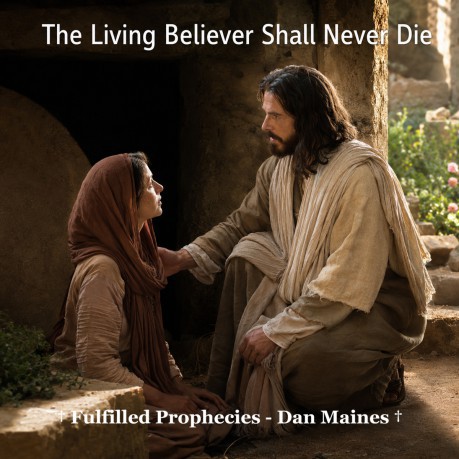
The
Living Believer Shall Never Die Introduction John
11:25-26 John 5:24 Colossians
3:3-4 1
John 5:11-12 John
14:6 Hebrews
9:12 John
6:39-40
Acts 3:19-21 Acts
3:22-23 John
3:3 Historical References How It Applies To Us
Today Q & A Appendix †This is the fulfilled
perspective we proclaim at Fulfilled Prophecies † Source Index
By Dan Maines
†
One of the most misunderstood statements Jesus ever made is, "
the one who believes on me shall never die." Many assume Christ
was teaching that believers possess an immortal soul that leaves the
body at death and immediately enters heaven while awaiting a future
resurrection or rapture. Yet Jesus' words must be understood in
harmony with the rest of Scripture, not through later theological
traditions. The Bible teaches that life is found in Christ Himself,
and those who have the Son possess that life continually. The promise
isn't about escaping physical death, it's about never being separated
from the life that is in Christ.
Jesus
said to her, "I am the resurrection and the life; the one who
believes in Me will live, even if he dies, and everyone who lives and
believes in Me will never die. Do you believe this?"
†
Jesus acknowledged that believers still experience physical death
when He said, though he die, yet shall he live. He then declared that
those who live and believe in Him will never lose the life He gives
because eternal life remains secure in Him. (John 5:24; 1 John
5:11-13)
†
Christ wasn't teaching that people possess an immortal soul that
naturally survives death apart from Him. He was declaring that
eternal life is found only in Him and remains unbroken for those who
belong to Him. (John 6:47; Colossians 3:3-4)
†
Lazarus had physically died only moments before. Christ's point
wasn't to deny physical death but to demonstrate His authority over
death and His power to give everlasting life. (John 11:43-44; John
17:2-3)
Truly,
truly, I say to you, the one who hears My word, and believes Him who
sent Me, has eternal life, and does not come into judgment, but has
passed out of death into life.
†
Jesus said believers have already passed from death into life. This
wasn't merely a future promise but a present covenant reality for
those who believe in Him. (Ephesians 2:4-6; Colossians 2:13)
†
Eternal life begins in Christ, not at physical death. Those united
with Christ already possess the life He promised. (1 John 5:11-13)
†
The believer's relationship with Christ is never interrupted because
our life is hidden with Christ in God. (Colossians 3:3-4)
For you
have died, and your life is hidden with Christ in God. When Christ,
who is our life, is revealed, then you also will be revealed with Him
in glory.
†
Paul didn't say Christ gives us a separate immortal life. He said
Christ Himself is our life. (John 14:6)
†
Our life is secure because it is hidden with Christ. Believers never
lose that life because it remains in Him. (John 10:27-30)
†
This passage perfectly agrees with Jesus' promise that whoever lives
and believes in Him will never die. (John 11:25-26)
And
the testimony is this, that God has given us eternal life, and this
life is in His Son. The one who has the Son has the life; the one who
does not have the Son of God does not have the life.
†
Scripture never says that people possess life independently. Life
exists only in Christ.
†
This passage doesn't describe an immortal soul by nature. It teaches
that continual life is found in Christ because He Himself is our
life. (John 14:6; Colossians 3:4)
†
Outside of Christ there is no life. Eternal life is His gift, not
something people naturally possess. (Romans 6:23)
Jesus said
to him, I am the way, and the truth, and the life; no one comes to
the Father except through Me.
†
Jesus didn't merely give life, He declared that He is the life.
Outside of Christ there is no eternal life.
†
Eternal life isn't something people possess independently. It exists
only through union with Jesus Christ. (1 John 5:11-12)
†
Every promise of life begins and ends with Christ because He alone
conquered death and grants everlasting life. (John 5:26)
and not
through the blood of goats and calves, but through His own blood, He
entered the holy place once for all time, having obtained eternal
redemption.
†
Scripture says Christ obtained eternal redemption. It doesn't say
redemption would remain unfinished until a future rapture.
†
His sacrifice completely accomplished what the Old Covenant
sacrifices could never accomplish. (Hebrews 10:11-14)
†
Believers live in the blessings of that completed redemption because
Christ finished His work once for all. (John 19:30)
And
this is the will of Him who sent Me, that of everything that He has
given Me I will lose nothing, but will raise it up on the last day.
For this is the will of My Father, that everyone who sees the Son and
believes in Him will have eternal life, and I Myself will raise him
up on the last day.
†
The "last day" was the last day of the Old Covenant age,
the very age Jesus came to fulfill. (Hebrews 8:13)
†
Jesus wasn't pointing thousands of years into the future. He
repeatedly told His disciples these things would occur in their
generation. (Matthew 24:34)
†
The resurrection promises reached their covenant fulfillment through
Christ at the close of the Old Covenant age, exactly as He promised.
(Daniel 12:1-2; Luke 21:22)
Therefore
repent and return, so that your sins may be wiped away, in order that
times of refreshing may come from the presence of the Lord; and that
He may send Jesus, the Christ appointed for you, whom heaven must
receive until the period of restoration of all things, about which
God spoke by the mouths of His holy prophets from ancient times.
†
Peter never mentioned a future rapture in this passage. He was
speaking about the restoration of everything God promised through His
prophets.
†
The restoration was the fulfillment of God's covenant promises
through Christ, reaching its completion with the end of the Old
Covenant age. (Luke 21:22; Hebrews 8:13)
†
Reading a future rapture into Acts 3 adds an idea that Peter never
taught. The passage is about covenant fulfillment, not an end-time
removal of the church from the earth. (Matthew 5:17-18)
Moses
said, 'The
Lord God will raise up for you a prophet like me from your
countrymen; to
Him you shall listen
regarding everything He says to you. And it shall be that every soul
that does not listen to that prophet shall be utterly destroyed from
among the people.'
†
Peter wasn't warning people about missing a future rapture. He was
warning first-century Israel to listen to the Prophet whom Moses
promised, Jesus Christ. (Deuteronomy 18:15-19)
†
Those who rejected Christ faced covenant judgment exactly as Moses
foretold. This warning reached its fulfillment in the destruction of
Jerusalem and the end of the Old Covenant age. (Luke 19:41-44; Luke
21:20-24)
†
The passage is about covenant accountability, not a future removal of
believers from the earth. Peter's audience was the generation
standing before him. (Acts 2:40; Matthew 23:36)
Jesus
responded and said to him, "Truly, truly, I say to you, unless
someone is born again he cannot see the kingdom of God."
†
Being born again was the entrance into God's New Covenant Kingdom
through faith in Christ, not a requirement for participating in a
future rapture. (2 Corinthians 5:17; Titus 3:5)
†
Jesus was calling people into the new life that He alone provides.
Those who are born again receive eternal life in Him. (John 3:16;
John 5:24)
†
The new birth brings people into God's kingdom now because Christ
fulfilled everything necessary to establish His everlasting covenant.
(Hebrews 9:15; Hebrews 12:22-24)
†
Josephus recorded the destruction of Jerusalem exactly as Jesus
foretold, confirming the fulfillment of the covenant judgment upon
that generation.
†
Eusebius recorded that the Christians fled Jerusalem before its
destruction, demonstrating that Christ's warnings were fulfilled in
the first century rather than pointing to a future worldwide rapture.
† Our
confidence isn't based on a future escape from the earth but on the
life we already possess in Christ.
†
We don't fear physical death because Christ is our life, and nothing
can separate us from Him.
†
We continue proclaiming the completed work of Christ, knowing He
fulfilled every covenant promise exactly as He said.
Q:
Does John 11:26 teach that believers never physically die?
A:
No. Jesus acknowledged physical death when He said, though he die,
yet shall he live. His promise is that those in Christ never lose the
life He gives. (John 11:25-26; John 5:24; 1 John 5:11-12)
Q:
Does Acts 3:19-21 teach a future rapture?
A:
No. Peter was speaking about the restoration of everything promised
by the prophets through Christ. Nothing in the passage mentions a
future rapture. (Acts 3:19-21; Luke 21:22; Hebrews 8:13)
Q:
Does John 11:26 teach that people have an immortal soul?
A:
No. Jesus taught that life is found only in Him. Scripture never says
people possess immortality by nature. Whoever has the Son has the
life, and whoever does not have the Son does not have the life. (John
11:25-26; John 14:6; 1 John 5:11-12; Romans 6:23)
Q:
Where is eternal life found?
A:
Eternal life is found only in Jesus Christ. Whoever has the Son has
the life. (1 John 5:11-12; John 14:6)
©
Fulfilled Prophecies - Dan Maines.
†
John 11:25-26, John 5:24, 1 John 5:11-12, Acts 3:19-21, John 3:3
†
Josephus, Eusebius
Links