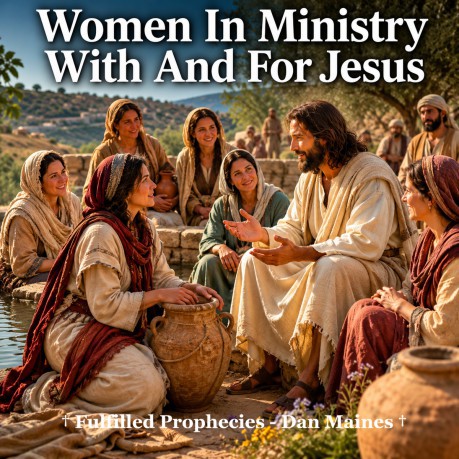
Women
In Ministry With And For Jesus Introduction Luke
8:1-3 John
4:28-30 John 4:39 Matthew
28:10 John
20:17-18 Acts
2:17-18 1
Corinthians 11:5 Acts
18:26 Acts
21:8-9 Romans
16:1-2
Romans 16:3-5 Romans
16:7 Philippians
4:2-3 Galatians
3:28 1
Timothy 2:12 1
Corinthians 14:34-35 Historical References How It Applies To Us
Today Q & A Appendix † This is the fulfilled
perspective we proclaim at Fulfilled Prophecies † Source Index
By Dan Maines
†
Many people assume women were silent spectators in the ministry of
Jesus, but the scriptures present a very different picture.
†
Women followed Jesus, supported His ministry, learned from Him,
proclaimed His message, and were entrusted with important
responsibilities in advancing the gospel.
†
If Jesus commissioned women to proclaim the good news, we must
carefully examine whether scripture permits women to teach and preach
the gospel today.
Soon
afterward, Jesus began going around from one city and village to
another, proclaiming and preaching the kingdom of God. The twelve
were with Him, and also some women who had been healed of evil
spirits and sicknesses: Mary who was called Magdalene, from whom
seven demons had gone out, and Joanna the wife of Chuza, Herod's
steward, and Susanna, and many others who were contributing to their
support out of their private means.
†
Women were not merely observers of Christ's ministry, they actively
participated in it.
†
These women traveled with Jesus and supported the proclamation of the
kingdom.
†
Scripture presents them as valuable co-laborers in the work being
accomplished. (Luke 8:1-3)
So the
woman left her waterpot and went into the city, and said to the
people, "Come, see a Man who told me all the things that I have
done; this is not the Christ, is He?" They left the city and
were coming to Him.
†
Jesus revealed Himself to the Samaritan woman and she immediately
became a messenger of that truth.
†
She did not keep the message private, she went into the city and
publicly proclaimed what she had learned. (John 4:28-30)
†
The result of her testimony was that people came to Christ. (John
4:30)
Now
from that city many of the Samaritans believed in Him because of the
word of the woman who testified, "He told me all the things that
I have done."
†
Scripture specifically states that many believed because of the word
of the woman.
†
This is evangelism in its simplest form, proclaiming Christ so others
may believe.
†
If leading people to Christ is ministry, then the Samaritan woman was
clearly engaged in ministry. (John 4:39)
Then
Jesus said to them, "Do not be afraid; go, bring word to My
brothers to leave for Galilee, and there they will see Me."
†
After His resurrection, Jesus instructed women to carry His message
to others.
†
The first witnesses of the resurrection were women, and Christ
entrusted them with announcing that truth. (Matthew 28:10)
†
The risen Lord was not reluctant to use women as messengers of His
gospel.
Jesus
said to her, "Stop clinging to Me, for I have not yet ascended
to the Father; but go to My brothers and say to them, 'I am ascending
to My Father and your Father, and My God and your God.'" Mary
Magdalene came and announced to the disciples, "I have seen the
Lord," and that He had said these things to her.
†
Mary Magdalene was sent by Jesus Himself to deliver His message.
†
She proclaimed the resurrection to the disciples before they saw the
risen Christ themselves.
†
If proclaiming the risen Christ is preaching the gospel, Mary was
entrusted with that responsibility. (John 20:17-18)
'And
it shall be in the last days,'
God says,
'That
I will pour out My Spirit on all
mankind;
And
your sons and your daughters will prophesy,
And
your young men will see visions,
And
your old men will have
dreams;
And
even on My male and female
servants
I
will
pour out My Spirit in those days,
And
they will prophesy.
†
God's Spirit was poured out on both men and women.
†
The prophecy specifically says daughters and handmaidens would
prophesy.
†
God did not restrict His Spirit's gifts to men alone. (Acts 2:17-18)
But
every woman who has her head uncovered while praying or prophesying
disgraces her head, for it is one and the same as the woman whose
head is shaved.
†
Paul acknowledged women praying and prophesying in the assembly.
†
His concern in this passage was conduct and order, not silence.
†
A woman cannot be both prophesying and completely silent at the same
time. (1 Corinthians 11:5)
and he
began speaking boldly in the synagogue. But when Priscilla and Aquila
heard him, they took him aside and explained the way of God more
accurately to him.
†
Priscilla participated in teaching Apollos, one of the most gifted
preachers in the New Testament.
†
Scripture records her involvement without criticism or correction.
†
The focus is on accurate instruction, not on gender restrictions.
(Acts 18:26)
On the
next day we left and came to Caesarea, and we entered the house of
Philip the evangelist, who was one of the seven, and stayed with him.
Now this man had four virgin daughters who were prophetesses.
†
Philip's daughters are specifically identified as women who
prophesied.
†
Scripture presents this as a gift from God, not as a violation of
God's will.
†
Their ministry is recorded as a normal part of the New Covenant
church. (Acts 21:8-9)
I
recommend to you our sister Phoebe, who is a servant of the church
which is at Cenchrea, that you receive her in the Lord in a manner
worthy of the saints, and that you help her in whatever matter she
may have need of you; for she herself has also been a helper of many,
and of myself as well.
†
Phoebe is commended by Paul as a servant of the church.
†
She was trusted and respected among believers.
†
Paul encouraged the church to assist her in her ministry work.
(Romans 16:1-2)
Greet
Prisca and Aquila, my fellow workers in Christ Jesus, who risked
their own necks for my life, to whom not only do I give thanks, but
also all the churches of the Gentiles; also greet the church that is
in their house. Greet Epaenetus, my beloved, who is the first convert
to Christ from Asia.
†
Priscilla is called a fellow worker in Christ Jesus.
†
Paul placed her among those actively laboring in gospel ministry.
†
Her contribution to the church is openly honored. (Romans 16:3-5)
Greet
Andronicus and Junia, my kinsfolk and my fellow prisoners, who are
outstanding in the view of the apostles, who also were in Christ
before me.
†
Junia is presented as a respected and well-known believer among the
apostles.
†
Her faithful service was recognized by the early church.
†
This passage demonstrates the significant role women held among the
first Christians. (Romans 16:7)
I urge
Euodia and I urge Syntyche to live in harmony in the Lord. Indeed,
true companion, I ask you also, help these women who have shared my
struggle in the cause of the gospel, together with Clement as well as
the rest of my fellow workers, whose names are in the book of life.
†
Paul described these women as laboring with him in the gospel.
†
He placed them alongside fellow workers in gospel ministry.
†
Their work was not insignificant, they were active participants in
spreading the message of Christ. (Philippians 4:2-3)
There is
neither Jew nor Greek, there is neither slave nor free, there is
neither male nor female; for you are all one in Christ Jesus.
†
Under the New Covenant, all believers share equally in Christ.
†
The gospel commission is not limited by ethnicity, social status, or
gender.
†
The focus of ministry is faithfulness to Christ and His message.
(Galatians 3:28)
But
I do not allow a woman to teach or to exercise authority over a man,
but to remain quiet.
†
This verse is often quoted without considering its historical
setting.
†
Paul's letters addressed specific first-century congregational
problems during the transition from Old Covenant Judaism into the New
Covenant age. (1 Timothy 1:3-7)
†
A local corrective instruction should not be used to overturn the
many examples of women proclaiming God's truth throughout scripture.
the
women are to keep silent in the churches; for they are not permitted
to speak, but are to subject themselves, just as the Law also says.
If they desire to learn anything, let them ask their own husbands at
home; for it is improper for a woman to speak in church.
†
This passage must be understood alongside Paul's earlier
acknowledgment that women prayed and prophesied. (1 Corinthians
11:5)
†
The context of 1 Corinthians 14 is orderly worship and the correction
of disruptions within the assembly.
†
Paul cannot be forbidding all speech from women while simultaneously
regulating how women prophesy publicly.
†
Miriam served as a prophetess in Israel and publicly declared God's
works. (Exodus 15:20-21)
†
Deborah judged Israel and delivered God's word to the nation. (Judges
4:4-5)
†
Huldah the prophetess instructed the leaders of Judah concerning the
Book of the Law. (2 Kings 22:14-20)
†
Eusebius recorded numerous faithful Christian women who served the
church during the first centuries after Christ.
†
Early Christian history contains accounts of women who taught,
evangelized, suffered persecution, and faithfully proclaimed Christ.
†
Every believer should use the gifts God has given them for the
benefit of the body of Christ.
†
The Samaritan woman did not wait for permission from religious
leaders before telling others about Jesus.
†
Mary Magdalene faithfully delivered the message Christ gave her.
†
God poured out His Spirit on sons and daughters alike.
†
If God has gifted a woman to teach scripture accurately and proclaim
Christ faithfully, we should evaluate her message by scripture, not
by her gender.
†
The church is strengthened when all believers use their gifts to
glorify Christ and spread the gospel.
Q:
Was the Samaritan woman a missionary?
A:
Yes. She was sent from her encounter with Christ into her city where
she proclaimed Him and many believed because of her testimony. (John
4:28-30; John 4:39)
Q:
Are women allowed to spread the gospel?
A:
Yes. Jesus sent women to announce His message, including the news of
His resurrection. (Matthew 28:10; John 20:17-18)
Q:
How is spreading the gospel different from preaching?
A:
At its core, preaching is proclaiming God's message. When the
Samaritan woman, Mary Magdalene, and other women publicly proclaimed
Christ, they were communicating God's truth to others. (John 4:39;
John 20:18)
Q:
Did God give spiritual gifts only to men?
A:
No. God's Spirit was poured out on sons and daughters, and both
prophesied. (Acts 2:17-18)
Q:
What about "let your women keep silence in the churches"?
A:
The same letter acknowledges women praying and prophesying publicly.
The context of 1 Corinthians 14 is orderly worship and the correction
of disruptions, not a universal prohibition against women speaking.
(1 Corinthians 11:5; 1 Corinthians 14:34-35)
Q:
If women could proclaim Christ publicly, why would preaching today be
forbidden?
A:
Scripture repeatedly shows women proclaiming God's truth to men and
women alike. The burden of proof rests on anyone claiming Christ
approved women proclaiming the gospel publicly but forbids it in the
assembly of believers.
©
Fulfilled Prophecies - Dan Maines.
†
Luke 8:1-3; John 4:28-30, 39; Matthew 28:10; John 20:17-18; Acts
2:17-18; 1 Corinthians 11:5; Acts 18:26; Acts 21:8-9; Romans 16:1-2;
Romans 16:3-5; Romans 16:7; Philippians 4:2-3; Galatians 3:28; 1
Timothy 2:12; 1 Corinthians 14:34-35
†
Miriam; Deborah; Huldah; Eusebius
Links