The
Thousand Years Of Revelation 20 And The Myth Of A Future Millennium Introduction Revelation
20:1-3 Matthew
12:28-29 Luke
10:17-18 John
12:31-32 Colossians
2:15 Hebrews
2:14
Acts 2:32-36
1 Corinthians 15:24-26 Revelation 11:15
Revelation 20:4-6
Revelation 20:7-10 Revelation
1:1-3 Revelation 22:10 Historical References How It Applies To Us
Today Q:
Does the Bible ever use the word millennium? † This is the fulfilled
perspective we proclaim at Fulfilled Prophecies † Source Index
By Dan Maines
†
Many Christians have heard the word millennium their entire lives,
yet the Bible never uses that word.
†
The term millennium comes from the Latin word for one thousand, but
Scripture simply speaks of the thousand years in Revelation 20.
†
The question is not whether Revelation 20 mentions a thousand years.
It does. The question is when those thousand years occurred and what
they represented.
†
The fulfilled perspective understands the thousand years as Christ's
first-century reign leading up to the judgment of apostate Israel and
the full establishment of the New Covenant kingdom.
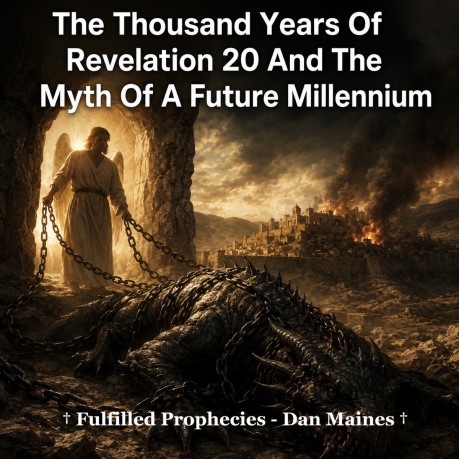
Then I
saw an angel coming down from heaven, holding the key of the abyss
and a great chain in his hand. And he took hold of the dragon, the
serpent of old, who is the devil and Satan, and bound him for a
thousand years; and he threw him into the abyss and shut it and
sealed it over him, so that he would not deceive the nations any
longer, until the thousand years were completed; after these things
he must be released for a short time.
†
Revelation is a book filled with symbols. No one believes Satan is
literally a dragon or that a spirit being can be restrained with a
physical chain.
†
The binding represents a restriction placed upon Satan's ability to
deceive the nations as he had done before Christ's victory. (Matthew
12:29)
†
Christ's earthly ministry marked the beginning of Satan's defeat.
(Luke 10:18)
†
The binding allowed the gospel to go beyond Israel and reach the
nations. (Matthew 28:18-20)
†
The thousand years appears only in Revelation 20, a highly symbolic
chapter filled with signs and imagery.
†
No New Testament writer ever instructed believers to look forward to
a future millennium.
†
The emphasis throughout the New Testament is Christ reigning in the
present tense. (Acts 2:36; Ephesians 1:20-23)
But if
I cast out the demons by the Spirit of God, then the kingdom of God
has come upon you. Or, how can anyone enter the strong man's house
and carry off his property, unless he first ties up the strong man?
And then he will plunder his house.
†
Jesus connected the arrival of the kingdom with the binding of the
strong man.
†
He did not say the binding would occur thousands of years later.
†
The kingdom had already arrived in His generation. (Luke 17:20-21)
†
Christ was actively plundering Satan's house during His earthly
ministry.
Now
the seventy-two returned with joy, saying, "Lord, even the
demons are subject to us in Your name!" And He said to them, "I
watched Satan fall from heaven like lightning.
†
Jesus described Satan's fall as something already taking place during
His ministry.
†
This is consistent with the binding imagery found in Revelation 20.
†
Christ was already exercising authority over the kingdom of darkness.
(Matthew 28:18)
Now
judgment is upon this world; now the ruler of this world will be cast
out. And I, if I am lifted up from the earth, will draw all people to
Myself.
†
Jesus said now was the judgment of that world.
†
He said the ruler of that world would be cast out through His
redemptive work.
†
The defeat of Satan was connected to the cross, not a distant future
age.
†
Revelation 20 builds upon this victory already accomplished by
Christ.
When He
had disarmed the rulers and authorities, He made a public display of
them, having triumphed over them through Him.
†
Paul described Christ's victory as an accomplished fact.
†
The powers of darkness had already been defeated through the cross.
†
This fits perfectly with the symbolic binding of Satan described in
Revelation 20.
Therefore,
since the children share in flesh and blood, He Himself likewise also
partook of the same, so that through death He might destroy the one
who has the power of death, that is, the devil,
†
Jesus defeated the devil through His death.
†
The writer does not place this victory thousands of years into the
future.
†
Christ's triumph had already begun in the first century.
It
is this Jesus whom God raised up, a fact to which we are all
witnesses. Therefore, since He has been exalted at the right hand of
God, and has received the promise of the Holy Spirit from the Father,
He has poured out this which you both see and hear. For it was not
David who ascended into heaven, but he himself says: 'The
Lord said to my Lord,
"Sit
at My right hand,
Until
I make Your enemies a footstool for Your feet."'
Therefore
let all the house of Israel know for certain that God has made Him
both Lord and Christ - this Jesus whom you crucified."
†
Peter declared that Jesus was already enthroned at the right hand of
God.
†
Christ was not waiting for a future kingdom to begin.
†
The reign of Christ was a present reality in the first century.
†
This perfectly fits the thousand years as a present reign rather than
a future one.
then
comes the end, when He hands over the kingdom to our God and Father,
when He has abolished all rule and all authority and power. For He
must reign until He has put all His enemies under His feet. The last
enemy that will be abolished is death.
†
Paul said Christ must reign until all enemies were placed under His
feet.
†
Notice that Christ was already reigning when Paul wrote.
†
The kingdom was not postponed.
†
The thousand years must be understood within Christ's ongoing reign.
Then
the seventh angel sounded; and there were loud voices in heaven,
saying,
"The kingdom of the world has become the kingdom of
our Lord and of His Christ; and He will reign forever and ever."
†
Revelation itself presents Christ as reigning.
†
The kingdom is not portrayed as something delayed for thousands of
years.
†
The focus is on Christ's victory and authority.
†
This harmonizes with the rest of the New Testament.
Then
I saw thrones, and they sat on them, and judgment was given to them.
And I saw the souls of those who had been beheaded because of their
testimony of Jesus and because of the word of God, and those who had
not worshiped the beast or his image, and had not received the mark
on their foreheads and on their hands; and they came to life and
reigned with Christ for a thousand years. The rest of the dead did
not come to life until the thousand years were completed. This is the
first resurrection. Blessed and holy is the one who has a part in the
first resurrection; over these the second death has no power, but
they will be priests of God and of Christ, and will reign with Him
for a thousand years.
†
John saw souls reigning with Christ, not physical bodies ruling from
an earthly throne.
†
The scene is heavenly in nature.
†
The first resurrection is associated with life and reign in Christ.
†
Those participating in this reign are protected from the second
death.
When
the thousand years are completed, Satan will be released from his
prison, and will come out to deceive the nations which are at the
four corners of the earth, Gog and Magog, to gather them together for
the war; the number of them is like the sand of the seashore. And
they came up on the broad plain of the earth and surrounded the camp
of the saints and the beloved city, and fire came down from heaven
and devoured them. And the devil who deceived them was thrown into
the lake of fire and brimstone, where the beast and the false prophet
are also; and they will be tormented day and night forever and ever.
†
The release of Satan demonstrates that the binding was never absolute
inactivity.
†
Satan was restrained for a purpose and later released for a short
time.
†
The focus remains on God's sovereignty over the entire process.
†
Christ's victory is complete and final.
The
Revelation of Jesus Christ, which God gave Him to show to His
bond-servants, the things which must soon take place; and He sent and
communicated it by His angel to His bond-servant John, who testified
to the word of God and to the testimony of Jesus Christ, everything
that he saw. Blessed is the one who reads, and those who hear the
words of the prophecy and keep the things which are written in it;
for the time is near.
†
Revelation was written about things that would shortly come to
pass.
†
The time was at hand for its original audience.
†
A future millennium thousands of years later ignores the book's own
time statements.
†
The first-century churches were expected to understand and benefit
from this prophecy.
And
he said to me, "Do not seal up the words of the prophecy of this
book, for the time is near.
†
The same message appears at the end of the book.
†
The events of Revelation were near when John wrote.
†
The thousand years must be understood within that first-century
context.
†
Scripture repeatedly points us to fulfillment within the generation
that received the prophecy.
†
Josephus recorded the events leading to the destruction of Jerusalem
in AD 70 and described the judgment that ended the Old Covenant
age.
†
Eusebius preserved accounts of Christians fleeing Jerusalem before
its destruction in obedience to Christ's warnings.
†
Early church history confirms the first-century significance of the
events surrounding Jerusalem's fall.
†
The fulfilled perspective sees Revelation's judgments culminating in
those covenantal events.
†
Christ is reigning now and His kingdom is not waiting to begin.
(Ephesians 1:20-23)
†
We do not need to fear future prophetic timetables because Christ has
already fulfilled His promises. (Matthew 24:34)
†
The victory over Satan belongs to Christ and His people today.
(Romans 16:20)
†
We live in the reality of the New Covenant kingdom established
through Christ's completed work. (Hebrews 12:22-24)
A:
No. The Bible speaks of the thousand years in Revelation 20 but never
uses the word millennium.
Q:
Was Satan completely inactive during the thousand years?
A:
No. The binding restricted his ability to deceive the nations as
before, allowing the gospel to spread among all nations. (Revelation
20:3; Matthew 12:29)
Q:
When did Christ begin reigning?
A:
Christ began reigning following His resurrection and ascension. (Acts
2:32-36)
Q:
Why is the thousand years understood symbolically?
A:
Revelation is a symbolic book filled with signs, symbols, beasts,
dragons, horns, and numbers. The thousand years fits that symbolic
context. (Revelation 1:1)
Q:
If the thousand years is literal, should the chain, key, dragon,
abyss, and pit also be literal?
A:
The context is symbolic throughout. The thousand years appears among
symbols and should be interpreted consistently with the surrounding
imagery. (Revelation 20:1-3)
Q:
Where does the Bible say the thousand years begins?
A:
The Bible never gives a starting date for the thousand years.
However, Jesus spoke of binding the strong man during His earthly
ministry, and the New Testament repeatedly presents Christ as already
reigning in the first century. (Matthew 12:28-29; Acts 2:32-36)
Q:
If Christ is reigning now, what kingdom is He ruling?
A:
Christ is ruling the kingdom He received from the Father. The New
Testament consistently presents Him as King, Lord, and reigning at
God's right hand. (Acts 2:34-36; Ephesians 1:20-23)
Q:
Does Revelation 20 teach an earthly kingdom headquartered in
Jerusalem?
A:
Revelation 20 never says Christ reigns from earthly Jerusalem. The
passage speaks of souls reigning with Christ and places the scene
within the symbolic imagery of Revelation. (Revelation 20:4-6)
Q:
Why don't the other New Testament writers teach a future
millennium?
A:
The thousand years is mentioned only in Revelation 20. The rest of
the New Testament focuses on Christ's present reign, His kingdom, and
the fulfillment that was approaching in their generation. (1
Corinthians 15:24-26; Hebrews 1:3)
Q:
What is the strongest argument against a future millennium?
A:
Revelation repeatedly states that its prophecies would shortly come
to pass and that the time was at hand. Any interpretation must begin
with those time statements. (Revelation 1:1-3; Revelation 22:10)
Q:
Is the thousand years the main focus of Revelation 20?
A:
No. The main focus is Christ's victory over Satan, the reign of the
saints, and God's final triumph. The thousand years is simply the
timeframe used within that larger message.
Q:
Why does today's traditional church teach a future millennium where
everything is peaceful and ideal?
A: Much of
today's teaching comes from later prophetic systems that read
Revelation 20 as a future earthly kingdom. However, the New Testament
repeatedly presents Christ as already reigning, His kingdom already
established, and the fulfillment of prophecy as near to the
first-century audience. (Acts 2:32-36; Revelation 1:1-3; Revelation
22:10) The fulfilled perspective seeks to begin with those time
statements and understand the thousand years within that
first-century context.
©
Fulfilled Prophecies - Dan Maines.
†
Revelation 20:1-3, 4-6, 7-10; Matthew 12:28-29; Luke 10:17-18; John
12:31-32; Colossians 2:15; Hebrews 2:14; Acts 2:32-36; 1 Corinthians
15:24-26; Revelation 11:15; Revelation 1:1-3; Revelation 22:10
†
Historical Writers: Josephus, Eusebius
Links