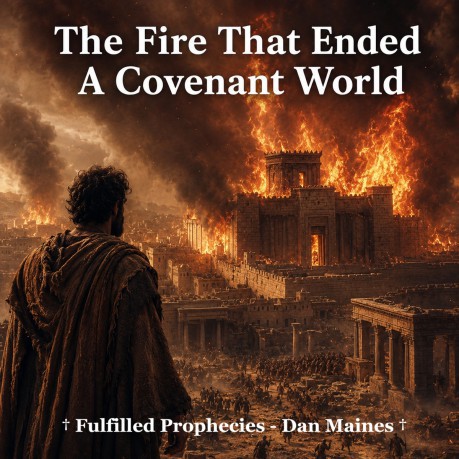
The
Fire That Ended A Covenant World Introduction Deuteronomy
4:11 Deuteronomy
32:22 Isaiah
13:9-10 Isaiah
34:4 Malachi 4:1 Matthew
3:10-12 "As
for me, I baptize you with water for repentance, but He who is coming
after me is mightier than I, and I am not fit to remove His sandals;
He will baptize you with the Holy Spirit and fire. His winnowing fork
is in His hand, and He will thoroughly clear His threshing floor; and
He will gather His wheat into the barn, but He will burn up the chaff
with unquenchable fire." Luke
21:20-22 2 Peter 3:10-13
Since all these things are to be
destroyed in this way, what sort of people ought you to be in holy
conduct and godliness, looking for and hastening the coming of the
day of God, because of which the heavens will be destroyed by
burning, and the elements will melt with intense heat! But according
to His promise we are looking for new heavens and a new earth, in
which righteousness dwells.
Hebrews 12:26-28 Historical References How It Applies To Us
Today Q & A Appendix Q:
Does 2 Peter 3 teach the destruction of the physical universe? A:
No. Peter used Old Testament covenant judgment language already used
by Isaiah and the prophets. The context points to the passing of the
Old Covenant world and the arrival of the New Covenant order. (Isaiah
13:9-10; Isaiah 51:15-16; Hebrews 8:13) Q:
Why does Peter use such dramatic fire language? A:
Because the prophets always used dramatic cosmic and fire imagery
when speaking of national and covenant judgment. Babylon, Egypt,
Edom, and Israel were all described this way. (Isaiah 13:9-10;
Ezekiel 32:7-8) Q:
What are the elements in 2 Peter 3? A:
The elements refer to the rudiments and foundational principles of
the Old Covenant system. Paul used the same language concerning the
Law covenant. (Galatians 4:3; Colossians 2:20) Q:
What was actually destroyed in AD 70? A:
The temple, priesthood, sacrifices, genealogical system, and the
entire Old Covenant order centered in Jerusalem were destroyed
exactly as Jesus prophesied. (Matthew 24:1-2; Hebrews 8:13) Q:
If the earth in 2 Peter 3 is literal planet Earth, why didn't
Isaiah's heavens and earth language destroy the universe when Babylon
and Edom were judged? A:
Because prophetic destruction language represented covenantal and
governmental collapse, not the annihilation of the physical cosmos.
Peter used the same prophetic language pattern already established
throughout the Old Testament. (Isaiah 13:9-10; Isaiah 34:4) Q:
Why do some people believe we're not to be here on earth after His
coming? A:
Many people were taught that Christ's coming meant the destruction of
the physical world and the removal of believers from Earth. But
scripture shows His coming was covenant judgment against Old Covenant
Israel and the full establishment of His kingdom. The New Testament
never says believers would stop living on Earth after His coming.
Instead, it says His kingdom would fill the world and never end.
(Daniel 2:44; Luke 1:32-33; Ephesians 3:21) Q:
Did Jesus come to destroy the planet or to end the Old Covenant age? A:
Jesus came in judgment against the covenant system that rejected Him.
He specifically warned about the destruction of the temple,
Jerusalem, and that generation. (Matthew 23:36-38; Matthew 24:1-3;
Luke 21:20-22) The physical planet continued exactly as expected, but
the Old Covenant world passed away. Q:
If the kingdom is fully established, why does evil still exist? A:
The kingdom of Christ is spiritual and unshakable, but people still
have free will and nations still rebel against God. The existence of
evil does not mean Christ failed to establish His kingdom. Scripture
says Christ reigns until all enemies are placed under His feet. (1
Corinthians 15:24-26) His kingdom continues growing throughout the
world. † This is the fulfilled
perspective we proclaim at Fulfilled Prophecies † © Fulfilled Prophecies - Dan Maines. Source Index
By Dan Maines
†
Many people read fire language in the Bible and immediately think of
planet Earth exploding into flames at the end of time. But throughout
scripture, God repeatedly used fire imagery to describe covenant
judgment against nations, cities, kingdoms, and especially Israel.
†
The prophets used decreation language, melting heavens and earth
language, shaking language, and consuming fire language long before
the first century. None of those judgments destroyed the physical
planet. They described the fall of covenant systems and
political-religious worlds.
†
Jesus, Peter, and the writer of Hebrews continued using the same Old
Testament judgment language. The fire they warned about was the
coming destruction of Old Covenant Israel and the temple system that
reached its end in AD 70.
You came
forward and stood at the foot of the mountain, and the mountain was
burning with fire to the heart of the heavens: darkness, cloud, and
thick gloom.
†
From the very beginning of the covenant at Sinai, God associated
covenant dealings and judgment with fire.
†
Fire represented God's presence, holiness, and covenant authority
over Israel.
†
The same covenant that began with fire would later end in covenant
fire judgment upon an apostate nation.
For a
fire has flared in My anger,
And it burns to the lowest part of
Sheol,
And devours the earth with its yield,
And sets on
fire the foundations of the mountains.
†
Moses used massive destruction language concerning covenant judgment
against Israel.
†
Yet nobody believes the literal planet burned in the days of Moses.
†
The earth and mountains language represented the destruction and
collapse of Israel's covenant world.
Behold,
the day of the Lord
is coming,
Cruel, with fury and burning anger,
To make the
land a desolation;
And He will exterminate its sinners from
it.
For the stars of heaven and their constellations
Will
not flash their light;
The sun will be dark when it rises
And
the moon will not shed its light.
†
Isaiah was speaking about the judgment of Babylon, not the end of
planet Earth.
†
The language of the sun, moon, and stars going dark was covenant and
kingdom judgment imagery used by the prophets. (Ezekiel 32:7-8)
†
Nobody believes the literal universe collapsed when Babylon fell. The
language represented the destruction of a ruling world and its
authority structure.
†
This proves that prophetic fire and cosmic language was symbolic
covenant judgment language long before the New Testament.
And all
the heavenly lights will wear away,
And the sky will be rolled
up like a scroll;
All its lights will also wither away
As a
leaf withers from the vine,
Or as one withers from the fig tree.
†
Isaiah used nearly identical language to what Peter later used in 2
Peter 3.
†
Yet Isaiah 34 was speaking about judgment upon Edom, not the
destruction of the physical universe.
†
This establishes the prophetic pattern for understanding dissolving
heavens language throughout scripture.
†
Peter was not inventing a brand new end-of-the-world doctrine. He was
using familiar covenant judgment language from the prophets.
"For
behold, the day is coming, burning like a furnace; and all the
arrogant and every evildoer will be chaff; and the day that is coming
will set them ablaze," says the Lord
of armies, "so that it will leave them neither root nor
branches.
†
Malachi was speaking to Israel under the Law covenant.
†
John the Baptist later connected this very judgment to his own
generation standing before the coming wrath. (Matthew 3:7-12)
†
The burning furnace language was directed toward covenant breakers in
Israel who rejected their Messiah.
†
Jesus Himself warned that their house would be left desolate within
their generation. (Matthew 23:36-38)
And the
axe is already laid at the root of the trees; therefore, every tree
that does not bear good fruit is being cut down and thrown into the
fire.
†
John wasn't warning China, America, or the modern world.
†
He was speaking directly to first century Israel and the religious
leaders standing before him. (Matthew 3:7)
†
The axe was already laid at the root, meaning the judgment was near
and imminent.
†
The unquenchable fire referred to unstoppable covenant judgment, not
endless literal flames consuming the universe.
†
Unquenchable fire in scripture means a fire that cannot be stopped
until it fully consumes its target. (Jeremiah 17:27)
†
Jerusalem was later burned by the Romans in AD 70 exactly as Jesus
warned. (Matthew 22:7)
"But
when you see Jerusalem surrounded by armies, then recognize that her
desolation is near. Then those who are in Judea must flee to the
mountains, and those who are inside the city must leave, and those
who are in the country must not enter the city; because these are
days of punishment, so that all things which have been written will
be fulfilled.
†
Jesus directly connected the coming judgment to Jerusalem surrounded
by armies.
†
This was not a global end-of-time event. It was a local covenant
judgment upon Israel.
†
Jesus said all things written concerning that judgment would be
fulfilled in those days.
†
AD 70 was the climax of covenant wrath against the nation that
rejected its Messiah.
But
the day of the Lord will come like a thief, in which the heavens will
pass away with a roar and the elements will be destroyed with intense
heat, and the earth and its works will be discovered.
†
The phrase heavens and earth often represented covenant Israel and
its world order. (Isaiah 51:15-16)
†
The elements refers to the rudiments and foundational principles of
the Old Covenant system. (Galatians 4:3, Colossians 2:20)
†
Peter said the last days audience he wrote to was already standing in
the time when the end of all things was at hand. (1 Peter 4:7)
†
The passing away of the old heavens and earth was the end of the Old
Covenant age and the full establishment of the New Covenant world in
Christ.
And
His voice shook the earth then, but now He has promised, saying, "Yet
once more I will shake not only the earth,
but
also the heaven."
This expression, "Yet once more," denotes the removing of
those things which can be shaken, as of created things, so that those
things which cannot be shaken may remain. Therefore, since we receive
a kingdom which cannot be shaken, let's show gratitude, by which we
may offer to God an acceptable service with reverence and awe;
†
Hebrews directly explains the meaning of the shaking language.
†
God was removing the Old Covenant system so the unshakable kingdom of
Christ would remain.
†
The temple, priesthood, sacrifices, and covenant order were about to
vanish away. (Hebrews 8:13)
†
This wasn't about the destruction of the physical universe. It was
about the removal of the covenant world that was ready to
disappear.
†
The New Covenant kingdom remains because it cannot be shaken or
destroyed.
†
The writer said they were already receiving the kingdom, present
tense, proving the covenant transition was already happening in their
lifetime.
†
Josephus described the destruction of Jerusalem in AD 70 with massive
fire consuming the temple and city, Wars of the Jews, Book 6.
†
Eusebius connected the destruction of Jerusalem with the fulfillment
of Christ's warnings concerning judgment upon that generation,
Ecclesiastical History, Book 3.
†
Lactantius spoke of the end of the Jewish age and the removal of the
old order after Christ's coming judgment.
†
Early Christian writers consistently connected Christ's judgment
sayings with the destruction of Jerusalem and the end of the Old
Covenant order.
†
We don't live in fear of the planet being destroyed because Christ
already fulfilled His covenant judgment warnings exactly when He said
He would.
†
We live in the unshakable kingdom of Christ right now.
†
The Old Covenant world passed away, but the New Covenant kingdom
continues forever.
†
We can trust every time statement Jesus gave because history proved
His words true.
†
The fire of judgment fell upon the covenant system that rejected
Christ, but believers were brought into the everlasting kingdom.
†
Deuteronomy 4:11; Deuteronomy 32:22; Isaiah 13:9-10; Isaiah 34:4;
Malachi 4:1; Matthew 3:10-12; Luke 21:20-22; 2 Peter 3:10-13; Hebrews
12:26-28
†
Josephus, Wars of the Jews, Book 6; Eusebius, Ecclesiastical History,
Book 3; Lactantius, Divine Institutes
Links