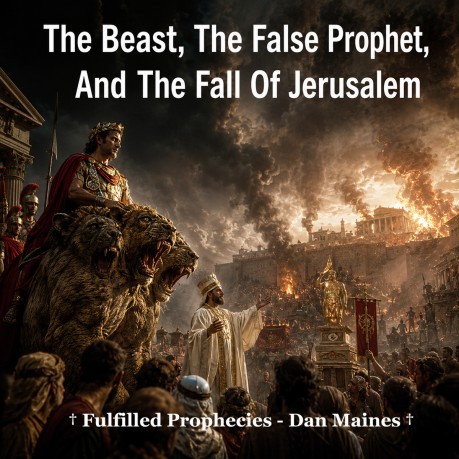
The
Beast, The False Prophet, And The Fall Of Jerusalem Introduction † Many people
have been taught that Revelation speaks about a future revived Roman
Empire, a future antichrist system, and events thousands of years
beyond the days of the apostles. But Revelation was written to real
churches facing a real crisis that was about to come upon their
generation. (Revelation 1:1-3; Revelation 22:6-10) † John was
told repeatedly that the things written in Revelation would shortly
come to pass and that the time was near. The book was not written to
people living two thousand years later. It was written to first
century believers living under Roman rule and under pressure from
apostate Judaism. (Revelation 1:1-3; Revelation 22:6-10) † I think we
should go through those references one section at a time, Revelation
13, 16, 17, 19, and see how the beast, the image, the mark, the false
prophet, and the harlot all connect in the first century. (Revelation
13:1-18; Revelation 16:13-14; Revelation 17:1-18; Revelation
19:19-20) † Revelation
13 onward reveals the judgment of the beastly Roman ruler system, the
corrupt Jewish leadership that worked with Rome, and the destruction
of the old covenant world centered in Jerusalem. (Revelation 13:1-18;
Revelation 17:1-18; Matthew 23:35-38) † When the
symbols are compared carefully with scripture and history, the beast,
the false prophet, the image, the mark, and the harlot all fit the
first century setting perfectly. (Revelation 1:1-3; Revelation 17:10;
Matthew 24:34) Revelation 1:9 I, John, your brother and fellow
participant in the tribulation and kingdom and perseverance in Jesus,
was on the island called Patmos because of the word of God and the
testimony of Jesus.
† John said he
was already a partaker in the tribulation. (Revelation 1:9) † The
tribulation was already underway in the first century church.
(Revelation 1:9; Matthew 24:9-13) † This
completely contradicts the idea that the tribulation was thousands of
years future from John's lifetime. (Revelation 1:1-3; Revelation
22:10) † The churches
receiving Revelation were living through the persecution and
pressures connected to the beast system. (Revelation 2:9-10;
Revelation 13:7) Revelation 13:1-2 and he stood upon the sand of the sea.
And I saw a beast coming up out of the sea, having ten horns and
seven heads, and on his horns ten diadems, and upon his heads names
of blasphemy. and the beast which I saw was like unto a leopard, and
his feet were as the feet of a bear, and his mouth as the mouth of a
lion: and the dragon gave him his power, and his throne, and great
authority. † The beast
rising from the sea points directly back to Daniel's beast kingdoms.
Daniel saw Babylon, Medo Persia, Greece, and Rome pictured as beasts.
Revelation combines those beast features into one final persecuting
power. (Daniel 7:3-7) † Rome was the
ruling beast power in John's day. Rome ruled the nations, persecuted
the saints, and exercised authority over the known world. (Luke 2:1;
Daniel 7:7; Revelation 13:7) † The dragon
gave authority to the beast because Satan was working through pagan
Rome to destroy the church. (Revelation 12:9-17; Revelation 13:2) † The seven
heads are later explained as kings and mountains. Rome was famously
built upon seven hills, and the Caesars ruled from that seat of
power. (Revelation 17:9-10) Revelation 13:3
I saw one of his heads as if it had been fatally wounded, and his
fatal wound was healed. And the whole earth was amazed and followed
after the beast; † This wounded
head fits Nero Caesar and the crisis that struck Rome after his death
in AD 68. (Revelation 13:3; Revelation 17:10-11) † Nero's death
brought the empire into chaos during the Year of the Four Emperors.
Civil war spread across Rome and many believed the empire itself was
collapsing. (Revelation 13:3; Revelation 17:8) † The healing
of the wound fits the restoration of stability through the Flavian
dynasty beginning with Vespasian and continuing through Titus and
Domitian. (Revelation 13:3; Revelation 17:10-11) † Revelation
does not say the beast died and resurrected thousands of years later.
It says one of the heads received a deadly wound and the beast
continued. (Revelation 13:3; Revelation 17:8-11) † The beast
system survived the Nero crisis and regained its authority, causing
the world to marvel after it. (Revelation 13:3-4) Revelation 13:11-12
Then I saw another beast coming up out of the earth; and he had two
horns like a lamb, and he spoke as a dragon. He exercises all the
authority of the first beast in his presence. And he makes the earth
and those who live on it worship the first beast, whose fatal wound
was healed. † The second
beast appears lamb like outwardly, but speaks as a dragon. This
points to deceptive religious authority. (Revelation 13:11; Matthew
7:15) † This fits
the corrupt Jewish leadership that claimed to represent God while
rejecting Christ and persecuting His followers. (John 8:44; Matthew
23:29-36) † The chief
priests openly aligned themselves with Caesar against Christ. They
declared, We have no king but Caesar. (John 19:15) † The false
prophet worked in the presence of the first beast because apostate
Jerusalem cooperated with Roman authority against the church.
(Revelation 13:12; Revelation 17:3; Acts 4:1-3) † Jesus had
already warned that false prophets and deceivers would arise in that
generation. (Matthew 24:11; Matthew 24:24) † Revelation
later directly identifies the second beast as the false prophet.
(Revelation 19:20) Revelation 13:14-17
And he deceives those who live on the earth because of the signs
which it was given him to perform in the presence of the beast,
telling those who live on the earth to make an image to the beast who
had the wound of the sword and has come to life. And it was given to
him to give breath to the image of the beast, so that the image of
the beast would even speak and cause all who do not worship the image
of the beast to be killed. And he causes all, the small and the
great, the rich and the poor, and the free and the slaves, to be
given a mark on their right hands or on their foreheads, and he
decrees that no one will be able to buy or to sell, except the one
who has the mark, either the name of the beast or the number of his
name. † The image of
the beast connects directly to emperor worship in the Roman Empire.
(Revelation 13:14-15) † Images and
statues of Caesar were used throughout the empire as symbols of
loyalty and submission to Roman authority. (Revelation 13:14-15;
Daniel 3:1-6) † Refusing
emperor worship could bring persecution, exclusion from trade, and
even death. (Revelation 13:15-17; Revelation 2:10) † The false
prophet promoted worship of the beast just as apostate religious
leadership pushed the people toward compromise with Rome. (Revelation
13:12-15; John 19:15) † The mark of
the beast symbolized allegiance and identification with the beastly
system. (Revelation 13:16-17) † This imagery
reflects covenant language already found in the Old Testament where
God's people were marked symbolically in the hand and forehead
through covenant loyalty. (Deuteronomy 6:6-8; Exodus 13:9) † Revelation
presents two groups, those sealed by God and those marked by the
beast. (Revelation 7:3; Revelation 14:1; Revelation 13:16-17) Revelation 13:18
Here is wisdom. Let him who has understanding calculate the number of
the beast, for the number is that of a man; and his number is six
hundred and sixty-six. † The number
666 fits Nero Caesar when written in Hebrew letters and calculated
through gematria. (Revelation 13:18) † Early
Christians connected Nero directly with the beast because he was the
first emperor to launch massive persecution against believers.
(Revelation 13:7; Revelation 17:10-11) † Nero
murdered Christians brutally and became a symbol of satanic
opposition to Christ and His people. (Revelation 13:7; Revelation
12:17) † John said
the number belonged to a man, not a future computer system or
barcode. (Revelation 13:18) Revelation 16:13-14
And I saw coming out of the mouth of the dragon, and out of the mouth
of the beast, and out of the mouth of the false prophet, three
unclean spirits like frogs; for they are spirits of demons,
performing signs, which go out to the kings of the entire world, to
gather them together for the war of the great day of God, the
Almighty. † Here the
dragon, beast, and false prophet are shown working together in
complete unity against God's people. (Revelation 16:13-14) † Satan worked
through Rome and apostate Judaism to resist Christ and persecute the
church. (Revelation 12:9-17; Revelation 13:11-12) † The false
prophet is still connected to the beast system, proving this was an
active first century alliance. (Revelation 16:13; Revelation 19:20) † These
unclean spirits symbolize deception, propaganda, false religion, and
spiritual corruption spreading throughout the land. (1 Timothy 4:1;
Revelation 16:13-14) Revelation 17:10
and they are seven kings; five have fallen, one is, the other has not
yet come; and when he comes, he must remain a little while. † The text
says one king "is" during John's lifetime. (Revelation
17:10) † That alone
destroys the idea that the beast was thousands of years future.
(Revelation 1:1-3; Revelation 22:10) † John was
living during the reign of the beast system. (Revelation 17:10) † The sixth
king fits Nero Caesar, while the short reign afterward fits the chaos
following Nero's death. (Revelation 17:10-11) Revelation 17:3-6
And he carried me away in the Spirit into a wilderness; and I saw a
woman sitting on a scarlet beast, full of blasphemous names, having
seven heads and ten horns. The woman was clothed in purple and
scarlet, and adorned with gold, precious stones, and pearls, holding
in her hand a gold cup full of abominations and of the unclean things
of her sexual immorality, and on her forehead a name was written, a
mystery: "BABYLON THE GREAT, THE MOTHER OF PROSTITUTES AND OF
THE ABOMINATIONS OF THE EARTH." And I saw the woman drunk with
the blood of the saints, and with the blood of the witnesses of
Jesus. When I saw her, I wondered greatly. † The harlot
woman represents apostate Jerusalem. (Revelation 11:8; Revelation
17:18) † Jerusalem
was the city that killed the prophets and persecuted the righteous.
(Matthew 23:34-37; Luke 13:33-34) † Revelation
later identifies the great city as the place where the Lord was
crucified. (Revelation 11:8) † The harlot
rode the beast because Jerusalem worked together with Roman authority
against Christ and the church. (John 19:15; Revelation 17:3) † Jesus warned
Jerusalem that judgment was coming upon that generation for the blood
of the prophets. (Matthew 23:35-36) † The
destruction of Jerusalem in AD 70 fulfilled those warnings exactly.
(Matthew 24:1-2; Luke 21:20-22) Revelation 18:24
And in her was found the blood of prophets and of saints, and of all
who have been slaughtered on the earth. † Revelation
places the bloodguilt upon the harlot city. (Revelation 18:24) † Jesus placed
the bloodguilt of the prophets upon Jerusalem in that generation.
(Matthew 23:35-36) † This
strongly identifies apostate Jerusalem as the harlot of Revelation.
(Revelation 11:8; Revelation 17:18) † The judgment
against the harlot fulfilled Christ's warnings concerning Jerusalem's
coming destruction. (Matthew 22:7; Luke 21:20-24) Revelation 19:19-20 And I saw
the beast and the kings of the earth and their armies, assembled to
make war against Him who sat on the horse, and against His army. And the beast was seized, and with him
the false prophet who performed the signs in his presence, by which
he deceived those who had received the mark of the beast and those
who worshiped his image; these two were thrown alive into the lake of
fire, which burns with brimstone.
† The beast
and false prophet are judged together because they worked together
against Christ and His people. (Revelation 13:11-17; Revelation
19:20) † The image,
the mark, the false prophet, and the beast are all connected
throughout Revelation as one united persecuting system. (Revelation
13:14-18; Revelation 16:13; Revelation 19:20) † Rome
supplied the military and political power while apostate Judaism
supplied religious pressure and persecution. (John 19:15; Acts 4:1-3;
Revelation 17:3) † The judgment
language reflects the complete overthrow of the persecuting old
covenant order and the beastly powers behind it. (Hebrews 8:13;
Matthew 24:34) † The lake of
fire imagery points to divine judgment and complete destruction of
their authority. (Revelation 19:20; Revelation 20:14) † Rome and
apostate Jerusalem stood against Christ, but both systems were judged
exactly as Revelation foretold. (Matthew 24:1-34; Revelation 1:1-3) Historical References † Josephus
recorded the horrors surrounding the fall of Jerusalem, the civil
war, famine, false prophets, and destruction that came upon the city
in AD 70. (Matthew 24:19-22; Luke 21:20-24) † Tacitus
described the instability of Rome after Nero's death and the violent
struggle for imperial power during the Year of the Four Emperors.
(Revelation 13:3; Revelation 17:10-11) † Eusebius
wrote that believers remembered Christ's warnings and fled Jerusalem
before the destruction came. (Matthew 24:15-18) † Early
Christian writers repeatedly connected Nero with persecution against
the church and viewed the Roman power as the beastly enemy of the
saints. (Revelation 13:7; Revelation 17:10-11) How It Applies To Us
Today † Revelation
reminds us that Christ already reigns over the kings of the earth.
(Revelation 1:5; Ephesians 1:20-22) † Believers
are not waiting for a future beast empire to suddenly appear because
the beast judgment belonged to the first century covenant transition.
(Revelation 1:1-3; Revelation 17:10) † The old
covenant world passed away exactly as Jesus promised. Christ's
kingdom remains. (Hebrews 8:13; Matthew 24:34-35) † We must
never compromise with political or religious systems that oppose
Christ and persecute truth. (Romans 12:2; Revelation 18:4) † The church
belongs to the Lamb, not to the beastly systems of men. (Revelation
17:14; Revelation 19:7-9) Q & A Appendix Q:
Why do many people believe Revelation is still future? A:
Many approach Revelation without considering its time statements,
audience relevance, and Old Testament background. Revelation says the
events would shortly come to pass and that the time was near. Jesus
also placed these judgments within the generation then living.
(Revelation 1:1-3; Matthew 24:34) Q:
Does the wounded head prove a future resurrected Roman Empire? A:
No. Revelation says one of the heads were wounded, not that Rome
disappeared for thousands of years and returned later. The Nero
crisis and the rise of the Flavian dynasty fit the text naturally
within first century history. (Revelation 13:3; Revelation 17:10-11) Q:
Why identify the false prophet with apostate Judaism? A:
The false prophet promoted worship of the beast and worked alongside
Roman authority. The Jewish leadership rejected Christ, pressured the
people, persecuted believers, and aligned themselves with Caesar
against Jesus and His followers. (John 19:15; Acts 4:1-3; Revelation
13:11-12) Q:
Was the mark of the beast a physical object? A:
The mark symbolized loyalty and submission to the beastly system.
Scripture already used hand and forehead imagery for covenant
allegiance long before Revelation. (Deuteronomy 6:6-8; Revelation
13:16-17) Q:
Why is Jerusalem identified as the harlot? A:
Jerusalem was guilty of killing the prophets and persecuting the
saints. Revelation identifies the great city as the place where the
Lord was crucified. Jesus declared that judgment for righteous blood
would come upon that generation. (Revelation 11:8; Matthew 23:35-36) † This is the fulfilled
perspective we proclaim at Fulfilled Prophecies † © Fulfilled Prophecies - Dan Maines. Source Index † Revelation
1:9; Revelation 13:1-3, 11-18; Revelation 16:13-14; Revelation
17:3-10; Revelation 18:24; Revelation 19:19-20 † Josephus,
Wars of the Jews Book 6; Tacitus, Histories Book 1-2; Eusebius,
Ecclesiastical History Book 3.
By Dan Maines
Links