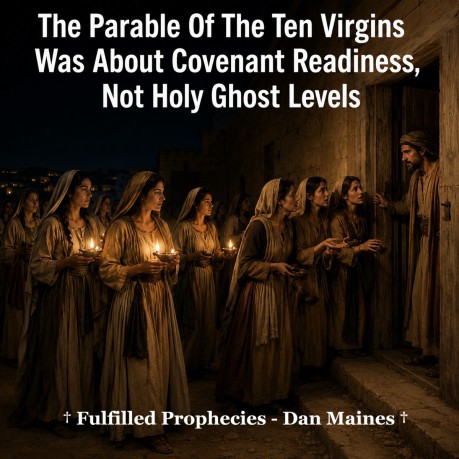
The
Parable Of The Ten Virgins Was About Covenant Readiness, Not Holy
Ghost Levels Introduction † Many people
were taught that the parable of the ten virgins was teaching that
believers must stay spiritually charged up with enough Holy Ghost oil
before Jesus can physically return. But that interpretation creates
major problems with the actual text. (Matthew 25:1-13) † All ten
virgins slept and slumbered. If sleeping represents spiritual
failure, then every single one failed equally. Yet five entered the
wedding feast and five were shut out. The issue was never about who
slept and who stayed awake physically. (Matthew 25:5-12) † The parable
was about covenant readiness during the last days of the old covenant
age before the judgment coming of Christ against Jerusalem in AD 70.
It was directed toward Israel and those awaiting the kingdom
fulfillment. (Matthew 24:1-34; Luke 21:20-22) † Jesus was
warning His generation to be prepared for the coming transition
between the old covenant world and the fully established new covenant
kingdom. (Matthew 24:34; Hebrews 8:13) Matthew 25:1-13
"Then the kingdom of heaven will be comparable to ten virgins,
who took their lamps and went out to meet the groom. Five of them
were foolish, and five were prudent. For when the foolish took their
lamps, they did not take extra oil with them; but the prudent ones
took oil in flasks with their lamps. Now while the groom was
delaying, they all became drowsy and began to sleep. But at midnight
there finally was a shout: 'Behold, the groom! Come out to meet him.'
Then all those virgins got up and trimmed their lamps. But the
foolish virgins said to the prudent ones, 'Give us some of your oil,
because our lamps are going out.' However, the prudent ones answered,
'No, there most certainly would not be enough for us and you too; go
instead to the merchants and buy some for yourselves.' But while they
were on their way to buy the oil, the groom came, and those who were
ready went in with him to the wedding feast; and the door was shut.
Yet later, the other virgins also came, saying, 'Lord, lord, open up
for us.' But he answered, 'Truly I say to you, I do not know you.' Be
on the alert then, because you do not know the day nor the hour. † Jesus gave
this parable directly in the Olivet Discourse context where He was
warning about the coming judgment upon that generation. (Matthew
24:1-34) † The
statement Then shall the kingdom of heaven be likened connects this
parable directly to the events He had just described in Matthew 24
concerning Jerusalem's destruction and His coming in judgment.
(Matthew 24:1-3) † The wise
virgins represent those who were spiritually prepared and faithful to
Christ during the transition out of the old covenant age. The foolish
virgins represent those connected outwardly to the covenant people
but lacking true readiness. (Romans 2:28-29) † Oil was
often connected to consecration, light, and covenant blessing, but
the parable never says the oil was the Holy Spirit itself. That's an
assumption added later into the story. (Psalm 119:105; Zechariah
4:1-6) † If oil
represented a fluctuating amount of the Holy Spirit, then the wise
virgins would've been selfish for refusing to share. But the point
was covenant preparedness, something that couldn't be transferred at
the last moment. (Ezekiel 18:20) † All ten
virgins slept and slumbered because the delay tested everyone. The
issue wasn't whether they slept. The issue was whether they were
ready when the bridegroom arrived. (Matthew 25:5-10) † Jesus had
already warned repeatedly that many in Israel appeared outwardly
ready while inwardly unprepared. (Matthew 7:21-23) † The cry at
midnight pictures the sudden arrival of covenant judgment. Those
prepared entered into the blessings of the kingdom while the
unprepared were shut out. (Matthew 24:37-44) † The closed
door echoes the shutting of Noah's ark before judgment fell upon the
old world. (Genesis 7:16; Matthew 24:37-39) † Lord, Lord
parallels Matthew 7:21-23 where many claimed covenant association
with Christ but were rejected because they were not truly known by
Him. (Matthew 7:21-23) † The command
to watch was not directed to people thousands of years later. It was
directed to the first century audience facing the end of their
covenant age. (Matthew 24:42-44) Matthew 24:34
Truly I say to you, this generation will not pass away until all
these things take place. † Jesus placed
the fulfillment of these warnings within the lifetime of His own
generation. (Matthew 24:34) † The ten
virgins parable cannot be disconnected from the timing statements
surrounding it. (Matthew 24:32-34) † Futurism
removes the parable from its original audience and turns it into a
warning for people living thousands of years later, even though Jesus
specifically said These things would happen before that generation
passed away. (Matthew 24:34) Hebrews 8:13
When He said, "A new covenant," He has made the first
obsolete. But whatever is becoming obsolete and growing old is about
to disappear. † At the time
Hebrews was written, the old covenant system was still standing but
nearing its end. (Hebrews 8:13) † The parable
fits perfectly into this transition period where faithful believers
were waiting for the full removal of the old covenant order. (Hebrews
12:26-28) † The
destruction of Jerusalem and the temple in AD 70 publicly confirmed
that the old covenant age had ended. (Luke 21:20-22) Luke 21:20-22
"But when you see Jerusalem surrounded by armies, then recognize
that her desolation is near. Then those who are in Judea must flee to
the mountains, and those who are inside the city must leave, and
those who are in the country must not enter the city; because these
are days of punishment, so that all things which have been written
will be fulfilled. † Jesus
connected the fulfillment of prophecy with the judgment upon
Jerusalem. (Luke 21:22) † The parable
of the ten virgins belongs within this same prophetic framework.
(Matthew 24:1-34) † The wise
were those who listened to Christ's warnings and remained prepared
during the approaching days of vengeance. (Luke 21:36) Revelation 19:7-9 Let's
rejoice and be glad and give the glory to Him, because the marriage
of the Lamb has come, and His bride has prepared herself." It
was given to her to clothe herself in fine linen, bright and clean;
for the fine linen is the righteous acts of the saints. Then he
*said to me, "Write: 'Blessed are those who are invited to the
wedding feast of the Lamb.'" And he *said to me, "These are
the true words of God."
† This
connects the marriage imagery directly to covenant fulfillment and
the prepared bride. (Revelation 19:7-9) † The wise
virgins were ready for the arrival of the bridegroom and entrance
into the marriage feast. (Matthew 25:10) † Revelation
shows the bride prepared and the marriage fully arrived in the first
century fulfillment context. (Revelation 1:1; Revelation 22:6) Romans 9:6
But it is not as though the word of God has failed. For they are not
all Israel who are descended from Israel; † Physical
covenant association did not guarantee acceptance. (Romans 9:6-8) † The foolish
virgins looked outwardly connected but lacked true readiness.
(Matthew 25:1-12) † Jesus
consistently warned that outward covenant membership alone could not
save Israel from coming judgment. (Matthew 3:7-10) Luke 13:24-28
"Strive to enter through the narrow door; for many, I tell you,
will seek to enter and will not be able. Once the head of the house
gets up and shuts the door, and you begin standing outside and
knocking on the door, saying, 'Lord, open up to us!' and He then will
answer and say to you, 'I do not know where you are from.' Then you
will begin saying, 'We ate and drank in Your presence, and You taught
in our streets!' And yet He will say, 'I do not know where you are
from; leave Me, all
you evildoers.'
In that place there will be weeping and gnashing of teeth when you
see Abraham, Isaac, Jacob, and all the prophets in the kingdom of
God, but yourselves being thrown out. † Jesus used
the same shut door imagery elsewhere concerning Israel's coming
judgment. (Luke 13:24-28) † This wasn't
about missing a future rapture event, it was about exclusion from
covenant blessing during the transition judgment. (Matthew 8:11-12) † Many in
Israel assumed covenant privilege guaranteed entrance, but Jesus
warned otherwise. (Romans 9:30-33) Historical References † Eusebius
recorded that believers in Christ fled Jerusalem before its
destruction, showing that faithful disciples understood and responded
to Jesus' warnings. (Luke 21:20-22) † Josephus
described the horror of Jerusalem's fall in AD 70, matching Jesus'
warnings concerning tribulation and judgment upon that generation.
(Matthew 24:21-22) † Early
Christian writers consistently connected Matthew 24 with the
destruction of Jerusalem rather than a distant end of the physical
universe. (Matthew 24:34) How It Applies To Us
Today † This parable
reminds us that outward association with God's people isn't enough.
Covenant faithfulness matters. (Romans 2:28-29) † Readiness
cannot be borrowed from someone else at the last minute. (Matthew
25:8-9) † Jesus
fulfilled His warnings exactly as He said He would within that
generation, proving His words are trustworthy. (Matthew 24:34) † We now live
in the fully established new covenant kingdom where Christ reigns and
His people walk in covenant life through Him. (Hebrews 12:28;
Ephesians 2:19-22) † The focus of
the parable was never about maintaining enough supernatural oil
levels before a future physical return. It was about being faithful
during the covenant transition that was coming upon first century
Israel. (Matthew 24:1-34) Q & A Appendix Q:
If all ten virgins slept, why were only five rejected? A:
Because sleeping was not the issue. The issue was readiness when the
bridegroom arrived. The foolish virgins were outwardly associated
with the wedding party but were unprepared for the coming moment of
fulfillment. (Matthew 25:10-12) Q:
Does oil represent the Holy Spirit in this parable? A:
The text never says that. Oil was commonly associated with blessing,
light, and consecration, but the parable's point was covenant
readiness that couldn't be transferred at the last minute. (Romans
2:28-29) Q:
Why did Jesus say I know you not? A:
Because many in Israel claimed covenant standing while rejecting true
obedience and faithfulness. Jesus used similar language in Matthew
7:21-23 regarding those who claimed association with Him but were not
truly His. (Matthew 7:21-23) Q:
Was this parable written mainly for people living today? A:
No. Jesus connected these warnings to His own generation and the
coming destruction of Jerusalem. (Matthew 24:34; Luke 21:20-22) Q:
Why did Jesus say no man knows the day or the hour if it was
fulfilled in that generation? A:
Because knowing the general generation is different from knowing the
exact day and hour. Jesus told them the season, the signs, and the
generation, but not the precise moment. (Matthew 24:32-36) † This is the fulfilled
perspective we proclaim at Fulfilled Prophecies † © Fulfilled Prophecies - Dan Maines. Source Index † Matthew
25:1-13; Matthew 24:34; Hebrews 8:13; Luke 21:20-22; Revelation
19:7-9; Romans 9:6; Luke 13:24-28 † Eusebius,
Ecclesiastical History Book 3; Josephus, Wars of the Jews Book 6
By Dan Maines
Links