The
Real Meaning Of Armageddon Introduction Revelation
1:1-3 Revelation
16:16 Judges
5:19-20 Zechariah
14:1-2 Matthew
23:35-36 Matthew
22:7 Matthew
24:28
Revelation 6:12-17 Revelation
11:8 Luke
21:20-22 Revelation
17:18 Revelation
18:24
Hebrews 12:26-28 Historical References How It Applies To Us
Today Q & A Appendix † This is the fulfilled
perspective we proclaim at Fulfilled Prophecies † Source Index
By Dan Maines
†
Most people have been taught that Armageddon is a future nuclear war
or the end of the physical planet. Movies, books, and prophecy
teachers turned it into a global battlefield still waiting to happen.
But the Bible never says Armageddon would happen thousands of years
later. Revelation was written to seven real churches facing events
that were "at hand" and "near." Armageddon was
covenant judgment against apostate Israel, culminating in the
destruction of Jerusalem in AD 70.
†
The battle of Armageddon was not about Russia, China, helicopters, or
modern warfare. It was about God's judgment against the city that
rejected and killed the prophets, crucified the Messiah, and
persecuted the saints. Jesus warned that their generation would face
this judgment exactly as He said. (Matthew 23:34-36; Matthew 24:34)
†
Revelation uses Old Testament covenant language throughout the book.
Armageddon follows the same prophetic pattern seen in the destruction
of Babylon, Edom, Egypt, and Jerusalem in the Old Testament. It's
symbolic judgment language connected to the fall of the old covenant
world. (Isaiah 13:1, 9-10; Ezekiel 32:7-8)
†
The English word "Armageddon" is not actually found in the
Bible text. Revelation says "Har-Magedon," a Hebrew term
filled with Old Testament covenant imagery. Modern prophecy systems
turned it into "Armageddon" and built an end-of-the-world
doctrine around it, even though John was using symbolic Hebrew
judgment language connected to Israel's history. (Revelation 16:16)
†
"Har-Magedon" appears only one time in the entire Bible,
Revelation 16:16, yet entire future prophecy systems have been built
around one symbolic Hebrew term while ignoring the repeated time
statements that the events were near and about to happen. (Revelation
1:1-3)
The
Revelation of Jesus Christ, which God gave Him to show to His
bond-servants, the things which must soon take place; and He sent and
communicated it by His angel to His bond-servant John, who testified
to the word of God and to the testimony of Jesus Christ, everything
that he saw. Blessed is the one who reads, and those who hear the
words of the prophecy and keep the things which are written in it;
for the time is near.
†
Revelation opens by saying the events would "shortly come to
pass" and that "the time is at hand." Those words have
meaning. John was not warning people about events thousands of years
away.
†
The word "signified" means the message was communicated
through signs and symbols. Revelation is filled with symbolic imagery
drawn from the Old Testament prophets. (Ezekiel 17:1-3; Daniel
7:1-7)
†
The original audience was expected to understand and keep the
prophecy because the events were near to them. This destroys the
futurist idea that Armageddon is still future to us today.
And they
gathered them together to the place which in Hebrew is called
Har-Magedon.
†
Revelation says the name is given "in Hebrew," immediately
pointing us back to Old Testament imagery and covenant symbolism.
John was not introducing a future military map for modern nations. He
was using prophetic language familiar to Israel. (Revelation 1:1;
Revelation 1:3)
†
"Har-Magedon" means Mount Megiddo. The problem is there is
no literal mountain called Megiddo. Megiddo was a plain famous for
decisive covenant battles and national judgment in Israel's history.
John uses the symbol to represent final covenant destruction coming
upon apostate Jerusalem. (Judges 5:19; 2 Kings 23:29)
†
Megiddo was associated with the death of King Josiah and national
mourning in Israel. It became symbolic of disaster and judgment upon
the nation. Revelation draws from this imagery to describe the
collapse of old covenant Israel in AD 70. (2 Chronicles 35:22-25;
Zechariah 12:10-11)
"The
kings came and fought;
Then the kings of Canaan fought
At
Taanach near the waters of Megiddo;
They took no plunder in
silver.
The stars fought from heaven,
From their paths they
fought against Sisera.
†
This is one of the Old Testament passages connected to Megiddo, and
it uses symbolic heavenly warfare language. The stars fighting from
heaven was not literal astronomy, it was prophetic judgment
imagery.
†
Revelation follows this same prophetic style. Armageddon was not a
literal modern battlefield with tanks and missiles, it was symbolic
covenant judgment language. (Isaiah 34:4-5)
†
The Bible consistently used cosmic and military imagery to describe
national judgment and covenant collapse. Revelation continues that
same language pattern. (Joel 2:1-2, 10)
Behold,
a day is coming for the Lord
when the spoils taken from you will be divided among you. For I will
gather all the nations against Jerusalem to battle, and the city will
be taken, the houses plundered, the women ravished ,
and half of the city exiled, but the rest of the people will not be
eliminated from the city.
†
Futurists often use Zechariah 14 for a future Armageddon battle, but
the chapter describes Jerusalem being surrounded, invaded, and
judged.
†
Rome gathered soldiers from many nations throughout the empire
against Jerusalem in AD 70. Josephus records troops coming from
across the Roman world for the siege of the city. (Josephus, Wars of
the Jews, Book 3)
†
In prophetic language, "all nations" often refers to the
known covenant or Roman world, not every nation on the modern globe.
(Luke 2:1)
so
that upon you will fall the guilt of all the righteous blood shed on
earth, from the blood of righteous Abel to the blood of Zechariah,
the son of Berechiah, whom you murdered between the temple and the
altar. Truly I say to you, all these things will come upon this
generation.
†
Jesus directly placed the coming judgment upon "this
generation," not a future race thousands of years later. The
blood guilt of the prophets was about to come upon Jerusalem.
Armageddon was part of that judgment. (Matthew 24:34)
†
Jesus said Jerusalem would be held accountable for all righteous
bloodshed. Revelation describes the exact same judgment against the
great city where the prophets and saints were killed. (Revelation
18:20; Revelation 18:24)
†
This is why Revelation constantly points back to Jerusalem. The city
that rejected Christ became the target of covenant wrath. Armageddon
was not the end of planet Earth, it was the end of the old covenant
age centered in Jerusalem and the temple system. (Hebrews 8:13)
Now the
king was angry, and he sent his armies and destroyed those murderers
and set their city on fire.
†
Jesus foretold the destruction and burning of Jerusalem before it
happened. The Roman armies became God's instrument of covenant
judgment against the city that rejected His Son.
†
This matches the judgment imagery throughout Revelation where God
uses armies, fire, destruction, and wrath against the covenant city.
(Luke 19:41-44)
†
Jerusalem was literally burned in AD 70 exactly as Jesus warned. This
was covenant judgment, not the end of the physical universe.
(Josephus, Wars of the Jews, Book 6)
Wherever
the corpse is, there the vultures will gather.
†
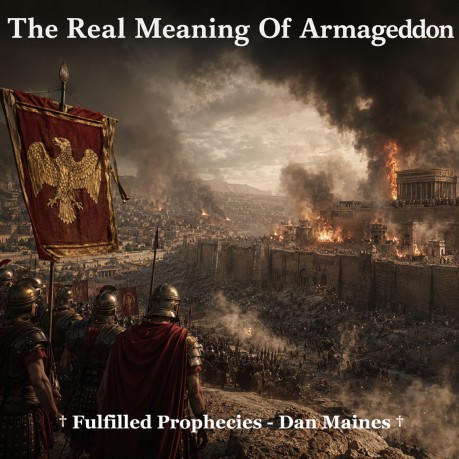
Jesus connected judgment imagery with eagles gathering around a
corpse. The Roman armies carried eagle standards and surrounded
spiritually dead Jerusalem during the siege.
†
This fits the same covenant judgment imagery later seen in
Revelation. Jerusalem became the carcass judged by God through the
Roman armies. (Luke 21:20-22)
†
Christ was warning His first century audience about the coming
destruction of their city and temple system. (Matthew 24:34)
And
I looked when He broke the sixth seal, and there was a great
earthquake; and the sun became as black as sackcloth made of hair,
and the whole moon became like blood; and the stars of the sky fell
to the earth, as a fig tree drops its unripe figs when shaken by a
great wind. The sky was split apart like a scroll when it is rolled
up, and every mountain and island was removed from its place. Then
the kings of the earth and the eminent people, and the commanders and
the wealthy and the strong, and every slave and free person hid
themselves in the caves and among the rocks of the mountains; and
they said to the mountains and the rocks, "Fall on us and hide
us from the sight of Him who sits on the throne, and from the wrath
of the Lamb; for the great day of Their wrath has come, and who is
able to stand?"
†
Futurists treat this as the destruction of the universe, but the
prophets used this exact language for national judgment long before
Revelation was written.
†
Isaiah used the same sun, moon, and stars language against Babylon.
Ezekiel used it against Egypt. This was covenant collapse imagery,
not literal cosmic destruction. (Isaiah 13:10; Ezekiel 32:7-8)
†
Revelation was describing the fall of old covenant Israel and the
terror surrounding Jerusalem's destruction in AD 70.
And their
dead bodies will lie on the street of the great city which
spiritually is called Sodom and Egypt, where also their Lord was
crucified.
†
Revelation identifies the great city spiritually as Sodom and Egypt,
but physically as the place where Jesus was crucified, Jerusalem.
This establishes the main judgment target throughout the book. (Luke
13:33-34)
†
Jerusalem had become spiritually corrupt like Sodom and oppressive
like Egypt. The covenant city had turned against God and His Messiah.
The judgment language in Revelation reflects Old Testament prophetic
judgments against covenant breakers. (Isaiah 1:10; Jeremiah 22:5)
†
The Roman armies became the instrument God used to bring covenant
judgment upon the city, exactly as Jesus warned. (Luke 21:20-22)
"But
when you see Jerusalem surrounded by armies, then recognize that her
desolation is near. Then those who are in Judea must flee to the
mountains, and those who are inside the city must leave, and those
who are in the country must not enter the city; because these are
days of punishment, so that all things which have been written will
be fulfilled.
†
Jesus connected the surrounding of Jerusalem by armies with the
fulfillment of prophecy. He did not place these events thousands of
years later. He said "these are days of vengeance."
Armageddon belongs within this same covenant judgment context.
†
Christ warned believers in Judea to flee because a real historical
destruction was coming upon Jerusalem. Christians escaped before the
city's fall because they listened to Jesus' warning. (Eusebius,
Ecclesiastical History 3.5)
†
Jesus said "all things which are written may be fulfilled."
That includes the judgment imagery later seen in Revelation. The
destruction of Jerusalem was the climax of covenant judgment foretold
throughout the prophets. (Daniel 9:26-27)
The woman
whom you saw is the great city, which reigns over the kings of the
earth."
†
Revelation 16 presents the judgment imagery of Har-Magedon, then
Revelation 17 and 18 explain who the judged city actually was.
†
The harlot city in Revelation was called "the great city."
Revelation already identified that city as Jerusalem where the Lord
was crucified. This was not Rome being destroyed in AD 70, it was
apostate Jerusalem facing covenant judgment. (Revelation 11:8)
†
Jerusalem ruled spiritually over the covenant world. Israel was
entrusted with the covenants, temple, priesthood, and law. The city
claimed covenant authority while rejecting the Messiah. (Romans
9:4-5)
†
The harlot imagery comes directly from Old Testament passages where
Jerusalem and Israel were called harlots for covenant unfaithfulness.
(Isaiah 1:21; Ezekiel 16:2, 15)
And in
her was found the blood of prophets and of saints, and of all who
have been slaughtered on the earth."
†
Revelation says the blood of the prophets and saints was found in the
great city. Jesus said the exact same thing about Jerusalem. (Matthew
23:35-36)
†
This is one of the clearest proofs that Babylon the Great was
apostate Jerusalem, not a future worldwide empire or modern nation.
†
The judgment connected to Armageddon was aimed at the city guilty of
killing the prophets and persecuting the saints. (Luke 11:49-51)
And
His voice shook the earth then, but now He has promised, saying, "Yet
once more I will shake not only the earth,
but
also the heaven."
This expression, "Yet once more," denotes the removing of
those things which can be shaken, as of created things, so that those
things which cannot be shaken may remain. Therefore, since we receive
a kingdom which cannot be shaken, let's show gratitude, by which we
may offer to God an acceptable service with reverence and awe;
†
The shaking of heaven and earth was covenant language for the removal
of the old covenant system. The temple, priesthood, sacrifices, and
old covenant order were about to vanish. (Hebrews 8:13)
†
Armageddon represents this covenant collapse. The old world of Israel
was removed and Christ's unshakable kingdom remained. This was not
the destruction of the physical universe. (Matthew 24:35)
†
The kingdom believers received could not be shaken because Christ
fulfilled and replaced the old covenant system completely. (Ephesians
2:14-15)
†
Josephus recorded the horrific destruction of Jerusalem in AD 70,
describing famine, civil war, mass slaughter, and the burning of the
temple exactly as Jesus warned. (Josephus, Wars of the Jews, Book
5-6)
†
Josephus also recorded that Roman legions from many nations under the
empire participated in the siege against Jerusalem, matching the
prophetic gathering of nations against the city. (Josephus, Wars of
the Jews, Book 3)
†
Eusebius recorded that Christians fled Jerusalem before its
destruction because they remembered Jesus' warnings about the coming
judgment upon the city. (Eusebius, Ecclesiastical History 3.5)
†
Tacitus described the Roman siege and destruction of Jerusalem as one
of the greatest national catastrophes in history. (Tacitus, Histories
5.11-13)
†
We don't live in fear of a future Armageddon because Christ already
fulfilled the covenant judgment He promised against Jerusalem.
†
We live in Christ's unshakable kingdom now, not waiting for the
destruction of the world. (Hebrews 12:28)
†
The fulfilled perspective shows us that Jesus kept His word exactly
within the time frame He gave. (Matthew 24:34)
†
Understanding Armageddon correctly removes fear-based prophecy
systems and places our focus back on Christ and His present kingdom
reign. (Colossians 1:13)
Q:
Is the word "Armageddon" actually in the Bible?
A:
No. Revelation uses the Hebrew term "Har-Magedon." Modern
translations transliterated it into the English word "Armageddon,"
but the original phrase points back to Hebrew covenant imagery
connected to Megiddo and national judgment. (Revelation 16:16)
Q:
Was Armageddon a literal future world war?
A:
No. Revelation uses symbolic covenant judgment language rooted in the
Old Testament. Har-Magedon pointed to the judgment against apostate
Jerusalem culminating in AD 70. (Revelation 16:16; Luke 21:20-22)
Q:
Why does Revelation use battle imagery?
A:
The prophets often used battle imagery to describe divine judgment
against nations and covenant breakers. Revelation follows the same
prophetic style. (Isaiah 34:1-5; Ezekiel 38:16)
Q:
Who was the real target of judgment in Revelation?
A:
Jerusalem, the city where Jesus was crucified and where the prophets
and saints were killed. (Revelation 11:8; Matthew 23:35-36)
Q:
Did Jesus say these things would happen soon?
A:
Yes. Jesus said these things would come upon "this generation,"
and Revelation says the events were "at hand." (Matthew
24:34; Revelation 1:1-3)
Q:
Does the Bible ever say Armageddon will happen thousands of years
later?
A:
No. Revelation repeatedly says the events were near, at hand, and
soon to happen to the original audience. (Revelation 1:1-3;
Revelation 22:10)
Q:
If Har-Magedon was fulfilled in AD 70, why do churches still teach
it's future?
A:
Most modern prophecy systems read Revelation through newspapers and
current events instead of through Old Testament covenant language and
Jesus' time statements. But Revelation says the events were near to
the original audience. (Revelation 1:1-3)
Q:
Was the destruction of Jerusalem really important enough to be called
Har-Magedon?
A:
Yes. The destruction of Jerusalem ended the old covenant temple
system, sacrifices, priesthood, and covenant age exactly as Jesus and
the prophets warned. It was the greatest covenant judgment in
Israel's history. (Hebrews 8:13; Matthew 24:1-3)
Q:
Why does Revelation use such dramatic language if this was about
Jerusalem?
A:
Because the Old Testament prophets used dramatic cosmic language for
covenant judgment against nations all throughout scripture.
Revelation follows the same prophetic pattern. (Isaiah 13:10; Ezekiel
32:7-8)
Q:
Did first century Christians understand these prophecies were about
their time?
A:
Yes. Jesus warned believers in Judea to flee when they saw Jerusalem
surrounded by armies, and early Christians escaped before the city's
destruction. (Luke 21:20-22; Eusebius, Ecclesiastical History 3.5)
©
Fulfilled Prophecies - Dan Maines.
†
Revelation 1:1-3; Revelation 16:16; Judges 5:19-20; Zechariah 14:1-2;
Matthew 23:35-36; Matthew 22:7; Matthew 24:28; Revelation 6:12-17;
Revelation 11:8; Luke 21:20-22; Revelation 17:18; Revelation 18:24;
Hebrews 12:26-28
†
Josephus, Wars of the Jews, Book 3, 5-6; Eusebius, Ecclesiastical
History 3.5; Tacitus, Histories 5.11-13
Links