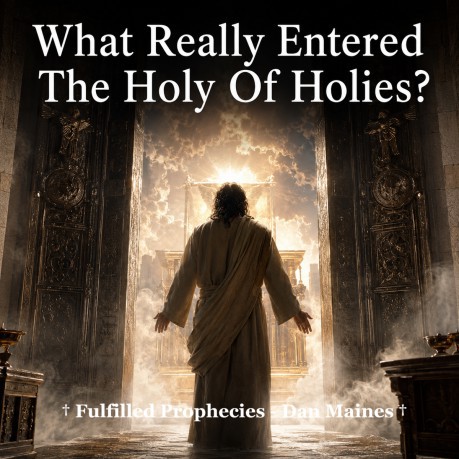
What
Really Entered The Holy Of Holies? Introduction Hebrews
8:1-2 † Jesus wasn't
serving in the earthly temple in Jerusalem. He was ministering in the
true sanctuary in heaven. (Hebrews 8:1-2) Hebrews
8:5 † The earthly
tabernacle was only a shadow. Shadows aren't the reality, they point
to the reality. (Hebrews 8:5)
Hebrews 9:6-8 † As long as
the earthly tabernacle remained standing, access into the true holy
place wasn't yet fully revealed. (Hebrews 9:6-8) Hebrews
9:11-12 † Christ
entered the greater and more perfect tabernacle, not made with human
hands. (Hebrews 9:11-12) Hebrews
9:24 † The earthly
holy place was only a pattern. Heaven itself was the true reality.
(Hebrews 9:24) Hebrews
9:26 † The writer
said Christ appeared at the end of the ages, not thousands of years
before the end. (Hebrews 9:26)
Hebrews 10:19-22 † Believers
now had direct access to God through Christ. (Hebrews 10:19-22) Matthew
23:38 † Jesus called
it your house, not My house. (Matthew 23:38) Matthew
27:50-51 † God tore the
veil from top to bottom, showing that the old system was finished by
divine action. (Matthew 27:50-51)
John 4:21-24 † Jesus
declared that worship would no longer be centered in Jerusalem. (John
4:21)
Hebrews 12:22-28
See to it that you do not refuse Him who is speaking. For if those
did not escape when they refused him who warned them on earth, much
less will we escape who turn away from Him who warns us from heaven.
And His voice shook the earth then, but now He has promised, saying,
"Yet once more I will
shake not only the earth, but
also the heaven." This expression, "Yet once more,"
denotes the removing of those things which can be shaken, as of
created things, so that those things which cannot be shaken may
remain. Therefore, since we receive a kingdom which cannot be shaken,
let's show gratitude, by which we may offer to God an acceptable
service with reverence and awe;
† The writer
said ye are come unto heavenly Jerusalem, showing this was already a
present covenant reality. (Hebrews 12:22) Hebrews
8:13 † The Old
Covenant was already growing old and ready to disappear when Hebrews
was written. (Hebrews 8:13) Historical References How It Applies To Us
Today Q & A Appendix Q:
Why was the temple destroyed in AD 70? Q:
Does God plan to restore animal sacrifices again? Q:
What is the true temple now? Q:
What was being shaken and removed in Hebrews 12? Q:
If the earthly temple was only a shadow, why do some Christians still
expect another temple to be built? A:
Because many people read prophecy through a future earthly system
instead of through Christ's fulfilled work. Hebrews says the earthly
temple was only a copy and shadow of the heavenly reality fulfilled
by Christ. Hebrews 8:5. Q:
Did the tearing of the veil really mean the end of the Old Covenant
system? A:
Yes. The veil represented separation from God's presence under the
Old Covenant priesthood. When God tore the veil from top to bottom at
Christ's death, it showed that access to God was now open through
Jesus Christ. Matthew 27:50-51; Hebrews 10:19-20. Q:
Why does Hebrews say the first covenant was ready to vanish away? A:
Because the Old Covenant system was approaching its final judgment in
the destruction of Jerusalem and the temple in AD 70. Hebrews was
written while the temple was still standing but near its end. Hebrews
8:13. Q:
Is heavenly Jerusalem a future city still coming someday? A:
No. Hebrews told first century believers ye are come unto mount Zion,
and unto the city of the living God, the heavenly Jerusalem. It was
already a present covenant reality in Christ. Hebrews 12:22. † This is the fulfilled
perspective we proclaim at Fulfilled Prophecies † Source Index
By Dan Maines
†
Most people were taught that Jesus went into a future heavenly
building somewhere beyond the sky, but Hebrews teaches something far
greater. Christ entered the true Holy Of Holies, not made with human
hands, and by doing so He brought the entire Old Covenant temple
system to its complete end. (Hebrews 8:1-2)
†
The earthly tabernacle was never the final reality. It was only a
shadow, a copy, and a temporary system pointing forward to Christ and
the heavenly sanctuary He would open through His sacrifice. Once
Christ entered the true sanctuary, the earthly one was left obsolete
and ready to vanish away in judgment. (Hebrews 8:5; Hebrews 8:13)
†
This sermon will show that Jesus fulfilled everything the temple
represented, and that the destruction of Jerusalem and the temple in
AD 70 publicly proved that the old system was finished forever.
(Matthew 24:1-2; Hebrews 9:24)
Now the
main point in what has been said is this: we have such a high priest,
who has taken His seat at the right hand of the throne of the Majesty
in the heavens, a minister in the sanctuary and in the true
tabernacle, which the Lord set up, not man.
†
The writer contrasts the earthly tabernacle with the true tabernacle.
One was built by men, the other was established by God Himself.
(Hebrews 8:1-2)
†
This completely destroys the idea that God intended to return to an
earthly temple system later on. (Hebrews 8:1-2)
†
Christ sat down because His priestly work was completed. Earthly
priests never sat down because their sacrifices could never fully
remove sin. (Hebrews 10:11-12)
who serve a
copy and shadow of the heavenly things, just as Moses was warned by
God when he was about to erect the tabernacle; for, "See,"
He says, "that
you make all things by
the pattern which was shown to you on the mountain."
†
Moses was shown a heavenly pattern because the earthly structure
represented something greater that would later be fulfilled in
Christ. (Hebrews 8:5)
†
Futurism reverses the entire point of Hebrews by taking people back
to shadows after Christ already brought the substance. (Hebrews
8:5)
†
Paul taught the same thing when he said the Old Covenant ordinances
were a shadow of things to come, but the body belongs to Christ.
(Colossians 2:16-17)
Now
when these things have been so prepared, the priests are continually
entering the outer tabernacle, performing the divine worship, but
into the second, only the high priest enters once a year, not without
taking blood which he offers for himself and for the sins of the
people committed in ignorance. The Holy Spirit is signifying this,
that the way into the holy place has not yet been disclosed while the
outer tabernacle is still standing,
†
The veil symbolized separation from God's presence under the Old
Covenant system. (Hebrews 9:6-8)
†
Christ would remove that separation completely through His death and
ascension. (Hebrews 10:19-20)
†
This is why the veil in the temple was torn from top to bottom at the
crucifixion. God Himself was ending the old priestly system. (Matthew
27:50-51)
But
when Christ appeared as a high priest of the good things having come,
He entered through the greater and more perfect tabernacle, not made
by hands, that is, not of this creation; and not through the blood of
goats and calves, but through His own blood, He entered the holy
place once for all time, having obtained eternal redemption.
†
The phrase not of this creation proves this wasn't an earthly
structure. (Hebrews 9:11-12)
†
Animal sacrifices could never bring eternal redemption, but Christ's
sacrifice accomplished it fully and permanently. (Hebrews 9:11-12)
†
He entered once for all. That means the work was complete and never
needed repetition. (Hebrews 9:12)
†
The earthly Day of Atonement happened every year because the old
system was temporary and incomplete. (Hebrews 10:1-4)
For Christ
did not enter a holy place made by hands, a mere copy of the true
one, but into heaven itself, now to appear in the presence of God for
us;
†
Jesus fulfilled what the earthly Holy Of Holies only symbolized.
(Hebrews 9:24)
†
This wasn't about traveling through outer space into a literal
building in the sky. This was covenant access into the true presence
of God. (Hebrews 9:24)
†
The Old Covenant priest entered a temporary earthly chamber. Christ
entered the true heavenly presence once and forever. (Hebrews 9:24)
Otherwise,
He would have needed to suffer often since the foundation of the
world; but now once at the consummation of the ages He has been
revealed to put away sin by the sacrifice of Himself.
†
This was the end of the Old Covenant age that was centered in the
temple system. (Hebrews 9:26)
†
Jesus appeared at the climax of the covenant ages to completely put
away sin through His sacrifice. (Hebrews 9:26)
†
This destroys the idea that the true end of the age was still far
future from the first century perspective. (Matthew 24:34; Hebrews
9:26)
Therefore,
brothers and sisters, since we have confidence to enter the holy
place by the blood of Jesus, by a new and living way which He
inaugurated for us through the veil, that is, through His flesh, and
since we have a great priest over the house of God, let's approach
God with a sincere heart in full assurance of faith, having our
hearts sprinkled clean from an evil conscience and our bodies washed
with pure water.
†
The veil was identified with Christ's flesh. His death opened the way
into God's presence. (Hebrews 10:20)
†
The old temple system kept people separated. Christ removed the
barrier. (Ephesians 2:13-18)
†
This was already a present reality for first century believers. The
writer said let us draw near, not someday thousands of years later.
(Hebrews 10:22)
†
The true house of God was no longer the Jerusalem temple, but the
people of God in Christ. (Ephesians 2:19-22)
Behold,
your house is being left to you desolate!
†
God had already departed from the corrupt temple system because
Israel rejected their Messiah. (Matthew 23:37-38)
†
The temple still stood physically for a short time, but covenantally
it was already abandoned. (Matthew 23:38)
†
AD 70 became the visible judgment confirming what Jesus had already
declared. (Matthew 24:1-2)
And
Jesus cried out again with a loud voice, and gave up His spirit. And
behold, the veil of the temple was torn in two from top to bottom;
and the earth shook and the rocks were split.
†
Access to God was no longer limited to earthly priests and temple
rituals. (Hebrews 10:19-20)
†
The temple still stood physically for a short time, but spiritually
its purpose had already ended. (Hebrews 8:13)
†
AD 70 became the public judgment and removal of the obsolete covenant
order Jesus had already fulfilled. (Matthew 24:1-2)
Jesus
said to her, "Believe Me, woman, that a time is coming when you
will worship the Father neither on this mountain nor in Jerusalem.
You Samaritans worship what you do not know; we worship what we do
know, because salvation is from the Jews. But a time is coming, and
even now has arrived, when the true worshipers will worship the
Father in spirit and truth; for such people the Father seeks to be
His worshipers. God is spirit, and those who worship Him must worship
in spirit and truth."
†
The coming New Covenant would remove dependence on earthly sacred
locations. (John 4:21-24)
†
True worship would be spiritual, not tied to temple rituals and
sacrifices. (John 4:23-24)
†
This perfectly agrees with Hebrews and the ending of the earthly
sanctuary system. (Hebrews 9:24)
But
you have come to Mount Zion and to the city of the living God, the
heavenly Jerusalem, and to myriads of angels, to the general assembly
and church of the firstborn who are enrolled in heaven, and to God,
the Judge of all, and to the spirits of the righteous made perfect,
and to Jesus, the mediator of a new covenant, and to the sprinkled
blood, which speaks better than the blood of Abel.
†
The Old Covenant system was the thing being shaken and removed.
(Hebrews 12:26-27)
†
The earthly temple and priesthood belonged to the temporary order
that was passing away. (Hebrews 8:13)
†
The kingdom of Christ cannot be shaken because it isn't built on
earthly temples made with hands. (Hebrews 12:28)
When He
said, "A new covenant," He has made the first obsolete. But
whatever is becoming obsolete and growing old is about to disappear.
†
This proves the temple was still standing at that time, but its
destruction was near. (Hebrews 8:13)
†
The phrase vanishing away perfectly fits the coming destruction of
Jerusalem and the temple in AD 70. (Matthew 24:1-2)
†
Once the true Holy Of Holies was opened by Christ, the earthly one
had no remaining covenant purpose. (Hebrews 9:24)
†
Josephus recorded that the temple was completely destroyed in AD 70,
exactly as Jesus prophesied in Matthew 24:1-2. (Josephus, Wars of the
Jews, Book 6)
†
Eusebius wrote that the believers fled Jerusalem before its
destruction, recognizing Christ's warnings had been fulfilled.
(Eusebius, Ecclesiastical History, Book 3)
†
Clement of Alexandria taught that the sacrifices and temple
ordinances had reached their completion in Christ. (Clement of
Alexandria, Stromata)
†
The Epistle of Barnabas explained that the physical temple system was
temporary and fulfilled spiritually in the people of God. (Epistle of
Barnabas, Chapters 16-17)
†
After AD 70 the Jewish genealogical records connected to the
priesthood were destroyed, making any future verified Levitical
priesthood impossible historically. (Josephus, Against Apion, Book 1)
†
We don't need an earthly temple because Christ fulfilled everything
the temple represented. (Hebrews 9:24)
†
We don't need earthly priests because Jesus is our eternal High
Priest. (Hebrews 8:1-2)
†
We don't need repeated sacrifices because Christ obtained eternal
redemption once for all. (Hebrews 9:12)
†
We already have access to God through Christ right now. (Hebrews
10:19-22)
†
The fulfilled kingdom isn't centered in earthly Jerusalem, but in
Christ and His people. (Hebrews 12:22-28)
†
We can live with confidence knowing the old covenant separation has
been removed forever. (Ephesians 2:13-18)
†
Our worship isn't tied to sacred buildings or earthly systems because
true worship is now in spirit and truth. (John 4:23-24)
Q:
Did Jesus enter a literal room somewhere in heaven?
A:
Hebrews explains that the earthly Holy Of Holies was a pattern of the
true heavenly reality. Christ entered into the true presence of God
on our behalf. Hebrews 9:24 says He entered heaven itself, not a man
made sanctuary.
A:
Because the Old Covenant system had already been fulfilled and made
obsolete by Christ. Hebrews 8:13 says it was ready to vanish away.
Jesus also predicted its destruction in Matthew 24:1-2.
A:
No. Hebrews teaches that Christ's sacrifice was once for all and
brought eternal redemption. Returning to animal sacrifices would deny
the sufficiency of Christ's finished work. Hebrews 10:12-18.
A:
The people of God in Christ are now the dwelling place of God.
Ephesians 2:19-22 and 1 Corinthians 3:16 teach that believers are
God's temple.
A:
The Old Covenant world centered in the temple system was being shaken
and removed so the unshakable kingdom of Christ could remain. Hebrews
12:27-28.
©
Fulfilled Prophecies - Dan Maines.
†
Hebrews 8:1-2; Hebrews 8:5; Hebrews 9:6-8; Hebrews 9:11-12; Hebrews
9:24; Hebrews 9:26; Hebrews 10:19-22; Matthew 23:38; Matthew
27:50-51; John 4:21-24; Hebrews 12:22-28; Hebrews 8:13
†
Josephus, Wars of the Jews, Book 6; Josephus, Against Apion, Book 1;
Eusebius, Ecclesiastical History, Book 3; Clement of Alexandria,
Stromata; Epistle of Barnabas, Chapters 16-17
Links