The
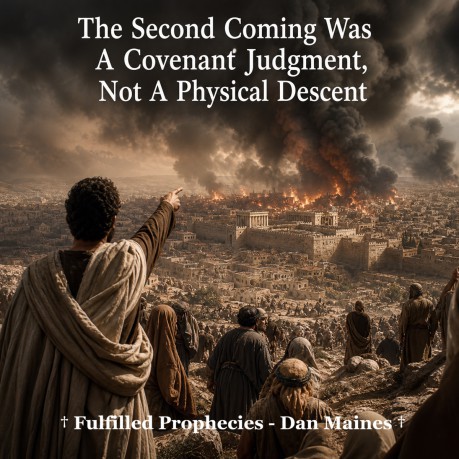
Second Coming Was A Covenant Judgment, Not A Physical Descent Introduction † Jesus did
not invent new language when He spoke about His coming, He used
language already established in the Old Testament (Isaiah 19:1; Psalm
104:3). † When we read
His words through that covenantal framework, it becomes clear that
His coming was about judgment, not a physical descent (Matthew 24:30;
Daniel 7:13). † The audience
time statements lock this into their generation, not thousands of
years later (Matthew 16:27-28; Matthew 24:34). Matthew
16:27-28 28 "Truly
I say to you, there are some of those who are standing here who will
not taste death until they see the Son of Man coming in His kingdom." † Jesus
clearly says some standing there would not die before seeing this
coming, that places the event in their lifetime, not ours (Matthew
16:28; Matthew 24:34). † This is a
direct time statement tied to His audience, and it cannot be
stretched without ignoring His own words (Luke 21:32; Mark 9:1). † The coming
is tied to judgment and reward, which is covenantal language tied to
Israel's accountability under the Law (Deuteronomy 32:35-36; Isaiah
40:10). Isaiah 19:1 Behold, the Lord
is riding on a swift cloud and is about to come to Egypt; † God is
described as riding on a cloud coming to Egypt, yet this was not a
visible physical descent, it was judgment language (Isaiah 13:1;
Isaiah 13:10). † This shows
that coming on the clouds was already understood as divine
intervention in judgment, not physical travel (Psalm 104:3; Nahum
1:3). † Jesus used
this same language, meaning His audience would have understood it the
same way, as covenant judgment (Matthew 26:64; Daniel 7:13). Daniel
7:13-14 † The Son of
Man is not coming down to earth here, He is coming to the Ancient of
Days, this is about receiving authority, not physical descent (Daniel
7:13; Acts 2:33). † This proves
that coming on the clouds is throne language, showing exaltation and
kingship, not movement through the sky (Psalm 110:1; Daniel 7:14). † Jesus
applied this directly to Himself, meaning His coming was about being
revealed in authority, not physically appearing (Matthew 24:30;
Revelation 1:7). Matthew
24:30 † The phrase
coming on the clouds is throne language drawn directly from the Old
Testament, not describing movement through the sky (Daniel 7:13;
Psalm 18:9-12). † The mourning
of the tribes matches covenant judgment against Israel, not the
entire globe, aligning with Zechariah's prophecy (Zechariah 12:10-12;
Revelation 1:7). † This remains
within the same generation context Jesus already established, keeping
everything in that first century timeframe (Matthew 24:34; Luke
21:22). † The sign is
not Jesus physically appearing, it is the visible evidence of His
authority and judgment through the destruction of Jerusalem (Luke
21:20-22; Matthew 22:7). Matthew
26:64 † Jesus tells
the high priest they would see this, again locking it into that first
century audience (Matthew 26:64; Matthew 23:36). † This ties
the cloud coming directly to His authority at God's right hand, not a
future physical descent (Psalm 110:1; Acts 2:34-35). † The judgment
would fall on that leadership, exactly as Jesus warned throughout His
ministry (Matthew 23:38; Luke 21:22). Revelation
1:7 † It
specifically says those who pierced Him would see Him, placing this
in the first century, not thousands of years later (Revelation 1:7;
Matthew 27:25). † This matches
the mourning of the tribes in Matthew 24:30, showing it's the same
covenant judgment event (Zechariah 12:10-12; Matthew 24:30). † The cloud
language remains consistent with Old Testament judgment imagery, not
physical appearance (Isaiah 19:1; Daniel 7:13).
Psalm 18:7-15 † This uses
the same coming down and cloud imagery, yet no one takes this as a
literal physical descent, it is clearly judgment language (Psalm
18:9; 2 Samuel 22:10). † This
reinforces that cloud coming language throughout Scripture represents
divine intervention, not physical movement (Isaiah 13:10; Nahum 1:3). † Jesus used
this established language consistently, meaning His audience would
have understood it as judgment (Matthew 24:30; Matthew 26:64). Historical References † Eusebius
recorded that the destruction of Jerusalem fulfilled the Lord's
warnings about judgment and His coming against that generation
(Eusebius, Ecclesiastical History, Book 3.5; Luke 21:20). † Josephus
described signs in the sky and overwhelming destruction before
Jerusalem fell, matching the language of signs and coming in judgment
(Josephus, Wars of the Jews, Book 6.5.3; Matthew 24:30). † Tacitus
confirmed the catastrophic events surrounding that time, showing the
historical reality of that judgment (Tacitus, Histories 5.13; Matthew
24:21). How It Applies To Us
Today † We are not
waiting for a future coming, Christ already came in judgment and
established His kingdom (Matthew 16:28; Mark 9:1). † We now live
under a kingdom that cannot be shaken, because the old covenant
system has already been removed (Hebrews 12:27-28; Hebrews 8:13). † This gives
us confidence, because judgment has already passed and we stand in a
completed covenant (Romans 8:1; John 5:24). Q & A Appendix Q
If Jesus already came, why didn't people see Him physically? Q
What does coming on the clouds actually mean? Q
How do we know this happened in their generation? Q
Why do many still think it's future? Q
Why does Daniel 7 say He comes on the clouds if that's not
physical? Q
If this was fulfilled in AD 70, why does it say every eye will see
Him? Q
Doesn't Acts 1:11 say He will come the same way He left? Q
What is the sign of the Son of Man in heaven? Q
Why did the tribes mourn if this was only about Israel? Q
How do we know this is judgment language and not literal? Q
What does sitting at the right hand mean in relation to His coming? Q
If Jesus already came, what are we waiting for now? Q
Why is this so hard for people to see? Q
Does this deny the power or glory of Christ's coming? † This is the fulfilled
perspective we proclaim at Fulfilled Prophecies † Source Index † Matthew
16:27-28; Isaiah 19:1; Daniel 7:13-14; Matthew 24:30; Matthew 26:64;
Revelation 1:7; Psalm 18:7-15; Matthew 24:34; Luke 21:32; Mark 9:1;
Deuteronomy 32:35-36; Isaiah 40:10; Isaiah 13:1; Isaiah 13:10; Psalm
104:3; Nahum 1:3; Acts 2:33; Psalm 110:1; Zechariah 12:10-12; Luke
21:22; Luke 21:20-22; Matthew 22:7; Hebrews 12:27-28; Hebrews 8:13;
Romans 8:1; John 5:24 † Eusebius,
Ecclesiastical History, Book 3.5; Josephus, Wars of the Jews, Book
6.5.3; Tacitus, Histories 5.13
By Dan Maines
27 For
the Son of Man is going to come in the glory of His Father with His
angels, and will
then repay every person according to his
deeds.
1The
pronouncement concerning Egypt:
The
idols of Egypt will tremble at His presence,
And the heart of
the Egyptians will melt within them.
13 "I
kept looking in the night visions,
And behold, with the clouds
of heaven
One like a son of man was coming,
And He came up
to the Ancient of Days
And was presented before Him.
14 And
to Him was given dominion,
Honor, and a kingdom,
So that
all the peoples, nations, and populations of all languages
Might
serve Him.
His dominion is an everlasting dominion
Which
will not pass away;
And His kingdom is one
Which will not
be destroyed.
30 And
then the sign of the Son of Man will appear in the sky, and then all
the tribes of the earth will mourn, and they will see the Son
of Man coming on the clouds of the sky
with power and great glory.
64 Jesus
said to him, "You have said it yourself. But I tell you, from
now on you will see the Son of Man sitting at the right hand of
power, and coming on the clouds of heaven."
7 Behold,
He
is coming with the clouds,
and every eye will see Him, even those who pierced Him; and all the
tribes of the earth will mourn over Him. So it is to be. Amen.
7 Then
the earth shook and quaked;
And the foundations of the mountains
were trembling
And were shaken, because He was angry.
8 Smoke
went up out of His nostrils,
And fire from His mouth was
devouring;
Coals burned from it.
9 He also bowed the
heavens down low, and came down
With thick darkness under His
feet.
10 He rode on a cherub and flew;
And He sped on
the wings of the wind.
11 He made darkness His hiding
place, His canopy around Him,
Darkness of waters, thick
clouds.
12 From the brightness before Him passed His thick
clouds,
Hailstones and coals of fire.
13 The Lord
also thundered in the heavens,
And the Most High uttered His
voice,
Hailstones and coals of fire.
14 He sent out
His arrows, and scattered them,
And lightning flashes in
abundance, and routed them.
15 Then the channels of water
appeared,
And the foundations of the world were exposed
By
Your rebuke, Lord,
At
the blast of the breath of Your nostrils.
A
Because the coming was never about physical sight, it was about
covenant judgment using established prophetic language (Isaiah 19:1;
Matthew 24:30).
A
It refers to divine authority and judgment, not physical movement, as
shown throughout the Old Testament (Daniel 7:13; Psalm 104:3).
A
Jesus said some standing there would not die before seeing it, and He
confirmed all these things would happen in that generation (Matthew
16:28; Matthew 24:34).
A
Because they read the language literally instead of covenantally,
ignoring how the Old Testament already defined it (Isaiah 13:10;
Isaiah 19:1).
A
Because Daniel shows Him coming to the Father to receive the kingdom,
not coming down to earth, which proves the language is about
authority, not movement (Daniel 7:13-14; Acts 2:33).
A
Because "seeing" in prophetic language refers to perceiving
judgment and authority, not physical eyesight, just like Old
Testament judgment texts (Isaiah 26:11; Jeremiah 1:14-16).
A
Yes, He went into the clouds and was received into authority, and He
came in the clouds in judgment, consistent with cloud language
throughout Scripture (Acts 1:9-11; Daniel 7:13).
A
The sign is not Jesus appearing physically, it is the evidence that
He is enthroned and reigning, shown through the destruction of
Jerusalem (Matthew 24:30; Luke 21:20-22).
A
Because the tribes refers to the tribes of the land, Israel itself,
fulfilling covenant judgment warnings given through the prophets
(Zechariah 12:10-12; Amos 8:8-10).
A
Because the exact same language is used repeatedly in the Old
Testament for historical judgments with no physical descent (Isaiah
19:1; Nahum 1:3).
A
It means He was given authority and reign, and His coming reveals
that authority through judgment (Psalm 110:1; Acts 2:33-36).
A
We are not waiting for another coming in judgment, we are living in
His established kingdom under the completed new covenant (Hebrews
12:28; Ephesians 2:19-22).
A
Because they read the language through a modern literal lens instead
of letting Scripture interpret Scripture from the Old Testament
foundation (Isaiah 13:10; Daniel 7:13).
A
No, it actually affirms it, because His coming accomplished exactly
what He said it would in that generation (Matthew 24:34; John 17:4).
©
Fulfilled Prophecies - Dan Maines.
Links