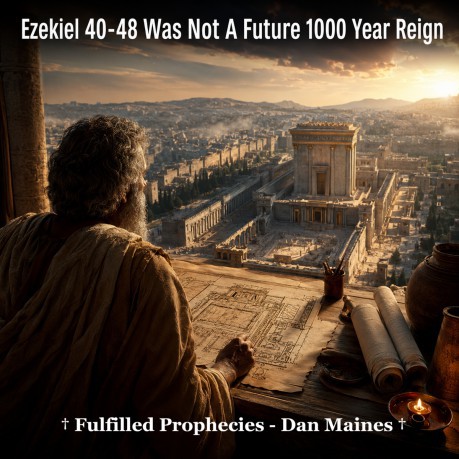
Ezekiel 40-48 Was Not A
Future 1000 Year Reign Introduction † One of the biggest questions people ask about
Ezekiel 40-48 is when this temple vision fits in the timeline. Many
futurists place it into a future earthly 1000 year reign after Christ
returns. They teach that animal sacrifices, including sin offerings,
will begin again during that kingdom age. But that creates major
problems with the finished work of Christ. † The New Testament clearly teaches that Christ
offered one sacrifice for sins forever, and that there is no longer
any offering for sin. If Ezekiel 40-48 teaches a future return to
animal sacrifices for sin after the cross, then it would directly
contradict Hebrews. † The fulfilled perspective understands
Ezekiel's vision as symbolic covenant language pointing to the
restoration and completion of God's covenant people through Christ
and the New Covenant age, not a rebuilt earthly temple during a
future millennium. † Many people notice that Ezekiel's vision
still contains sinners, death, offerings, priests, and distinctions
between holy and unclean. That's exactly why this cannot describe the
eternal perfected state after the final victory of Christ. † The question isn't whether Ezekiel saw a
kingdom. He did. The question is what kind of kingdom he was seeing,
and when it was fulfilled. Ezekiel 40:1-2 In the five and twentieth year of our captivity, in the beginning
of the year, in the tenth day of the month, in the fourteenth year
after that the city was smitten, in the selfsame day, the hand of
Jehovah was upon me, and he brought me thither. In the visions of God
brought he me into the land of Israel, and set me down upon a very
high mountain, whereon was as it were the frame of a city on the
south. † Ezekiel was given a prophetic vision while
Israel was still in captivity. This was a covenant restoration vision
after judgment had fallen upon Jerusalem. (Ezekiel 37:21-28) † The vision begins after the destruction of
the city, showing that God was revealing future covenant restoration
for His people. (Isaiah 2:2-3) † The "very high mountain" language
connects with prophetic kingdom imagery and heavenly covenant
language, not merely earthly architecture. (Revelation 21:10) Ezekiel 43:10-11 Thou, son of man, show the house to the house of Israel, that they
may be ashamed of their iniquities; and let them measure the pattern.
And if they be ashamed of all that they have done, make known unto
them the form of the house, and the fashion thereof, and the egresses
thereof, and the entrances thereof, and all the forms thereof, and
all the ordinances thereof, and all the laws thereof; and write it in
their sight, that they may keep the whole form thereof, and all the
ordinances thereof, and do them. † This temple vision was connected to Israel's
repentance and covenant restoration after judgment. (Jeremiah
31:31-34) † The temple was never built according to
Ezekiel's measurements after the Babylonian captivity. The second
temple under Zerubbabel did not match this vision. That's important.
(Ezra 3:12) † This shows Ezekiel was seeing something
greater than a physical building. The vision pointed forward to the
greater covenant dwelling of God among His people. (John 2:19-21) Ezekiel 45:17 And it shall be the prince's part to give the burnt-offerings, and
the meal-offerings, and the drink-offerings, in the feasts, and in
the new moons, and in the sabbaths, in all the appointed feasts of
the house of Israel: he shall prepare the sin-offering, and the
meal-offering, and the burnt-offering, and the peace-offerings, to
make atonement for the house of Israel. † Futurists often point to this verse and claim
it proves future sacrifices during a millennial reign. † But if this were literally future, then
Christ's once-for-all atonement would not actually be final. That
directly conflicts with the New Testament. (Hebrews 7:27) † Ezekiel was using Old Covenant temple
language because that was the covenant framework Israel understood at
the time. † The prophets often described New Covenant
realities through Old Covenant imagery. (Isaiah 19:19-25; Amos
9:11-12) † Even the New Jerusalem in Revelation uses
symbolic temple and city imagery to describe God's covenant people.
(Revelation 21:9-27) Ezekiel 45:22 And upon that day shall the prince prepare for himself and for all
the people of the land a bullock for a sin-offering. † This creates a major problem for the futurist
interpretation that says the prince is Christ reigning during a
future millennium. † The prince offers a sacrifice for himself,
showing he is not sinless. Jesus never needed a sacrifice for Himself
because He had no sin. (Hebrews 4:15) † Christ offered Himself once for all and never
again needed sacrifices repeated. (Hebrews 7:26-27) † This alone proves Ezekiel's vision cannot
describe Jesus restoring literal animal sacrifices during a future
earthly kingdom. Ezekiel 47:1-9 And he brought me back unto the door of the house; and behold,
waters issued out from under the threshold of the house eastward...
And it came to pass, that every living creature which swarmeth, in
every place whither the rivers come, shall live. † The river flowing from the temple points
directly to the life flowing from Christ and His kingdom. (John
7:37-39) † This is covenant life imagery, not merely
earthly geography. (Revelation 22:1-2) † The healing waters symbolize the spread of
life to the nations through the New Covenant kingdom. (Isaiah 35:1-7) † Revelation borrows heavily from Ezekiel's
imagery and applies it to the New Covenant city and people of God.
(Revelation 22:1-5) Ezekiel 48:1-29 Now these are the names of the tribes: from the north end to the
side of the way of Hethlon to the entrance of Hamath, Hazar-enan at
the border of Damascus, northward beside Hamath, and they shall have
their sides east and west, Dan, one portion. † The tribal allotments in Ezekiel 48 do not
fit the actual geography of the land of Israel. † The land divisions are arranged in perfectly
parallel strips from east to west, something never seen historically
in Israel's inheritance. (Joshua 13-19) † The dimensions and layout point to symbolic
covenant imagery rather than literal future real estate boundaries. † Ezekiel was portraying covenant order,
restoration, and inheritance among God's people through prophetic
imagery. Hebrews 10:10-14 By which will we have been sanctified through the offering of the
body of Jesus Christ once for all. And every priest indeed standeth
day by day ministering and offering oftentimes the same sacrifices,
the which can never take away sins: but he, when he had offered one
sacrifice for sins for ever, sat down on the right hand of God;
henceforth expecting till his enemies be made the footstool of his
feet. For by one offering he hath perfected for ever them that are
sanctified. † Hebrews destroys the idea that God would
restore animal sin sacrifices after the cross. Christ fulfilled what
those sacrifices pointed toward. (Hebrews 9:11-12) † The Old Covenant sacrifices could never
permanently remove sin. Christ accomplished what they never could.
(Hebrews 10:1-4) † If Ezekiel 40-48 teaches literal future sin
offerings after Christ's completed sacrifice, then Hebrews would make
no sense at all. (Hebrews 8:13) † That's why Ezekiel's temple must be
understood covenantally and symbolically, not as a future return to
Mosaic worship. Hebrews 8:13 In that he saith, A new covenant, he hath made the first old. But
that which is becoming old and waxeth aged is nigh unto vanishing
away. † The New Testament never tells believers to
expect a future return to Levitical priesthood, temple sacrifices, or
Mosaic ceremonies after Christ. † Instead, scripture repeatedly says the old
system became obsolete and vanished away through Christ's finished
work. (Colossians 2:14-17) † Returning to animal sacrifices after the
cross would move backward into shadows after the reality has already
come. (Hebrews 10:1) † Christ fulfilled the priesthood, the
sacrifices, the temple, and the covenant system completely. (Matthew
5:17) Jeremiah 3:16-17 And it shall come to pass, when ye are multiplied and increased in
the land, in those days, saith Jehovah, they shall say no more, The
ark of the covenant of Jehovah; neither shall it come to mind;
neither shall they remember it; neither shall they miss it; neither
shall it be made any more. At that time they shall call Jerusalem the
throne of Jehovah; and all the nations shall be gathered unto it, to
the name of Jehovah, to Jerusalem: neither shall they walk any more
after the stubbornness of their evil heart. † Ezekiel's temple vision never mentions the
ark of the covenant. † There is also no mention of a high priest or
the Day of Atonement in the vision. † This proves Ezekiel was not describing a
restoration of the exact Mosaic system that existed before the exile. † The vision pointed forward to a greater
covenant reality where God Himself would dwell among His people
through the Messiah. (Revelation 21:22) Revelation 21:1-3 And I saw a new heaven and a new earth: for the first heaven and
the first earth are passed away, and the sea is no more. And I saw
the holy city, new Jerusalem, coming down out of heaven from God,
made ready as a bride adorned for her husband. And I heard a great
voice out of the throne saying, Behold, the tabernacle of God is with
men, and he shall dwell with them, and they shall be his peoples, and
God himself shall be with them, and be their God. † John directly uses Ezekiel's temple, river,
gates, trees, and city imagery and applies it to the New Covenant
order. (Ezekiel 47:1-12) † Revelation interprets Ezekiel for us. The
imagery points to God's covenant people dwelling with Him through
Christ. † The passing away of the old heaven and earth
refers to the passing of the Old Covenant world centered around
Jerusalem and the temple system. (Hebrews 8:13) † The New Jerusalem is not a future earthly
Jewish millennium, but the fulfilled covenant dwelling of God with
His people. (Galatians 4:26) Revelation 21:22 And I saw no temple therein: for the Lord God the Almighty, and
the Lamb, are the temple thereof. † This is one of the clearest reasons Ezekiel's
temple cannot be a future literal eternal temple. † In the completed New Covenant order, God
Himself is the temple. Christ fulfilled everything the old temple
represented. (John 1:14) † The church became the dwelling place of God
through the Spirit. (Ephesians 2:19-22) † The temple system passed away with the
destruction of Jerusalem in AD 70, exactly as Jesus predicted.
(Matthew 24:1-2) † Ezekiel's vision pointed toward covenant
restoration fulfilled in Christ and His kingdom, not toward a future
rebuilt Mosaic system. Revelation 22:14-15 Blessed are they that wash their robes, that they may have the
right to come to the tree of life, and may enter in by the gates into
the city. Without are the dogs, and the sorcerers, and the
fornicators, and the murderers, and the idolaters, and every one that
loveth and maketh a lie. † Some ask why sinners are still described as
outside the gates if the kingdom had already arrived. † The answer is because the kingdom was
established in history while unbelievers still existed outside of
covenant life. † This doesn't describe a future earthly
millennium. It describes covenant separation between those in Christ
and those outside the covenant city. (Galatians 4:24-31) † Even after AD 70, unbelievers still existed
in the world, but they were outside the covenant blessings found in
Christ. † The gates imagery comes directly from
covenant city symbolism throughout scripture. (Isaiah 60:11-18) Historical References † Justin Martyr connected Old Testament temple
imagery to Christ and the church rather than a future rebuilt Jewish
temple. (Dialogue With Trypho, Chapter 113) † Irenaeus frequently interpreted prophetic
temple language typologically and covenantally in relation to Christ
and His people. (Against Heresies, Book 4) † Eusebius taught that the destruction of
Jerusalem fulfilled Christ's warnings concerning the temple system.
(Ecclesiastical History, Book 3) † Augustine later described the church itself
as the fulfilled city and dwelling place of God. (City of God, Book
20) How It Applies To Us Today † We don't look for a future return to animal
sacrifices because Christ already fulfilled the sacrificial system
completely. (Hebrews 10:18) † We are already part of God's holy temple
through Christ. (1 Corinthians 3:16) † The kingdom isn't waiting for a future
earthly temple to begin. Christ reigns now. (Acts 2:29-36) † Ezekiel's vision reminds us that God's plan
was always pointing toward restoration through the Messiah and the
gathering of His covenant people. † The New Covenant brought direct access to God
through Christ, without earthly priests, sacrifices, or temple
rituals. (Ephesians 2:18) Q & A Appendix Q If Ezekiel's sacrifices weren't literal future
sacrifices, why are they mentioned at all? A Because Ezekiel was speaking to Old Covenant
Israel using the covenant language they understood. The sacrifices
symbolized cleansing, worship, covenant fellowship, and restoration
pointing forward to Christ. Hebrews explains that Christ fulfilled
all those shadows. (Hebrews 8:4-6; Hebrews 10:1) Q Does Ezekiel 40-48 describe the church? A Yes, in prophetic symbolic form. The New
Testament repeatedly applies temple imagery to Christ and His people.
(Ephesians 2:19-22; 1 Peter 2:5) Q Was Ezekiel's temple ever physically built? A No. The post-exile temple did not match
Ezekiel's vision. This shows the prophecy pointed beyond a physical
structure toward a greater covenant fulfillment in Christ. Q Why are sinners still outside the gates in
Revelation 22? A Because the kingdom existed in history while
unbelievers still remained outside covenant life. The imagery shows
covenant separation, not a future temporary kingdom before eternity.
(Revelation 22:14-15) Q Was Ezekiel describing a future 1000 year
reign? A No. The vision contains Old Covenant
sacrifices, priests, and ceremonial laws which were fulfilled and
removed through Christ. The New Testament never teaches a future
return to Mosaic worship. (Hebrews 8:13) Q Why do many believe Ezekiel 40-48 is future? A Many believe Ezekiel 40-48 is future because
they read the prophecy literally and separate it from the New
Testament explanation of Christ fulfilling the temple, priesthood,
and sacrifices. Dispensational teaching also places these chapters
into a future earthly millennium because they see Israel and the
church as permanently separate. But the New Testament repeatedly
teaches that the sacrificial system was fulfilled and removed through
Christ. (Hebrews 8:13; Hebrews 10:1-18) Q If Ezekiel's temple was symbolic, why are the
measurements so detailed? A Detailed measurements were common in prophetic
visions to show divine perfection, order, holiness, and separation.
Revelation also gives symbolic measurements for the New Jerusalem,
yet the city is clearly symbolic of God's covenant people.
(Revelation 21:9-17) Q Why does Ezekiel describe priests and offerings
if Christ had already fulfilled them? A Ezekiel was prophesying centuries before
Christ, so he used the covenant system and worship language Israel
already understood. The sacrifices and priesthood pointed forward to
Christ and the New Covenant realities that would fulfill them.
(Hebrews 9:8-12) Q Could Ezekiel's temple simply be a memorial
system pointing back to Christ's sacrifice? A No, because Ezekiel specifically describes sin
offerings and atonement sacrifices. The New Testament never teaches
that animal sacrifices would return even as memorials after Christ
fulfilled them. Instead, believers remember Christ through the Lord's
Supper, not through renewed temple sacrifices. (1 Corinthians
11:23-26; Hebrews 10:18) † This is the fulfilled perspective we proclaim at
Fulfilled Prophecies † © Fulfilled Prophecies - Dan Maines. Source Index † Ezekiel 37:21-28; Isaiah 2:2-3; Ezra 3:12;
John 2:19-21; Isaiah 19:19-25; Amos 9:11-12; Isaiah 35:1-7; Joshua
13-19; Colossians 2:14-17; Matthew 5:17; Galatians 4:26; John 1:14;
Ephesians 2:19-22; Galatians 4:24-31; Isaiah 60:11-18; 1 Corinthians
3:16; Acts 2:29-36; Ephesians 2:18; 1 Peter 2:5 † Justin Martyr, Dialogue With Trypho, Chapter
113; Irenaeus, Against Heresies, Book 4; Eusebius, Ecclesiastical
History, Book 3; Augustine, City of God, Book 20
By Dan Maines
Go
here for Ezekiel
40-48 and the Fulfillment in Christ
-
https://www.facebook.com/groups/1349070089314462/posts/1823460885208711/
Links