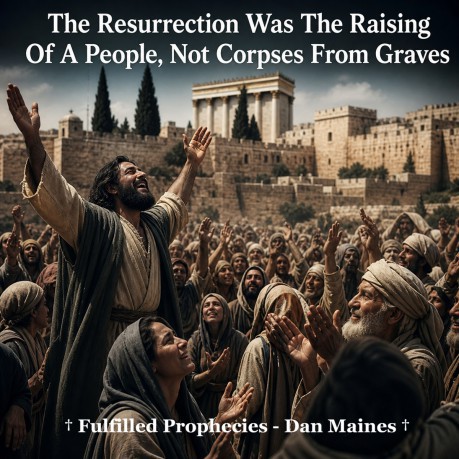
The
Resurrection Was The Raising Of A People, Not Corpses From Graves Introduction † Most people
have been taught that resurrection means dead bodies coming out of
literal graves, but the Bible itself defines resurrection language
long before the New Testament ever explains it (Ezekiel 37:11; Hosea
6:1-2). † If we let
scripture interpret scripture, we'll see resurrection wasn't about
dirt and bones, it was about God raising a covenant people from death
into life (Isaiah 26:19; Daniel 12:2). † This isn't
speculation, it's already established in the Old Testament, then
fulfilled in the first century exactly as Jesus and the apostles said
it would be (Matthew 24:34; John 5:24-25). Ezekiel 37:1-5
37 The hand of the Lord
was upon me, and He brought me out by the Spirit of the Lord
and set me down in the middle of the valley; and it was full of
bones. 2 He had me pass among them all around, and behold, there
were very many on the surface of the valley; and behold, they were
very dry. 3 Then He said to me, "Son of man, can these
bones live?" And I answered, "Lord God,
You Yourself know." 4 Again He said to me, "Prophesy
over these bones and say to them, 'You dry bones, hear the word of
the Lord.' 5 This
is what the Lord God
says to these bones: 'Behold, I am going to make breath enter you so
that you may come to life.
† The bones
represent the whole house of Israel, not individuals in coffins, this
is covenant language, not biological resurrection (Ezekiel 37:11). † The breath
entering them is the Spirit of God restoring the nation, bringing
them back into covenant life, not resurrecting physical corpses
(Ezekiel 37:14). Ezekiel 37:11-13
11 Then He said to me, "Son of man, these bones are the
entire house of Israel; behold, they say, 'Our bones are dried up and
our hope has perished. We are completely cut off.' 12 Therefore
prophesy and say to them, 'This is what the Lord God
says: "Behold, I am going to open your graves and cause you to
come up out of your graves, My people; and I will bring you into the
land of Israel. 13 Then you will know that I am the Lord,
when I have opened your graves and caused you to come up out of your
graves, My people. † God
interprets the vision for us, the graves are symbolic of Israel's
condition, not literal burial sites (Ezekiel 37:11). † Coming out
of graves is covenant restoration language, Israel being brought out
of death under judgment back into life with God (Isaiah 26:19). † This proves
resurrection language was already established as corporate, national,
and covenantal long before the New Testament (Hosea 6:1-2). Isaiah 26:19
19 Your dead will live; † Isaiah uses
the same resurrection language, but it's in the middle of judgment
and deliverance of Israel, not a global cemetery event (Isaiah
26:20-21). † Dwelling in
the dust is covenant death language, the same pattern seen in Ezekiel
and Daniel (Daniel 12:2). † This
confirms resurrection language was prophetic and corporate long
before the New Testament explains it (Hosea 6:1-2). Daniel 12:2
2 And many of those who sleep in the dust of the ground will
awake, these to everlasting life, but the others to disgrace and
everlasting contempt. † Daniel uses
the same language, sleeping in the dust isn't describing literal
corpses waiting in the ground, it's describing a people in covenant
death (Daniel 12:1). † The
awakening is tied to the time of tribulation for Israel, the same
time Jesus said would happen in that generation (Matthew 24:21, 34). † This is the
same resurrection pattern, a corporate rising, not a global cemetery
event (Isaiah 26:19). Matthew 27:52-53
52 Also the tombs were opened, and many bodies of the saints who
had fallen asleep were raised; 53 and coming out of the tombs
after His resurrection, they entered the holy city and appeared to
many. † This event
is often forced into a physical framework, but it's using the exact
same prophetic language already defined in Ezekiel and Daniel
(Ezekiel 37:12; Daniel 12:2). † The holy
city is Jerusalem, the center of the Old Covenant, showing a covenant
transition taking place (Hebrews 12:22-23). † This is a
sign of the resurrection age beginning, not a preview of a future
global resurrection, it fits the prophetic pattern already
established (Daniel 12:2). John 5:25-29
25 Truly, truly, I say to you, a time is coming and even now has
arrived, when the dead will hear the voice of the Son of God, and
those who hear will live. 26 For just as the Father has life in
Himself, so He gave to the Son also to have life in Himself; 27 and
He gave Him authority to execute judgment, because He is the Son of
Man. 28 Do not be amazed at this; for a time is coming when all
who are in the tombs will hear His voice, 29 and will come out:
those who did the good deeds to a resurrection of life, those who
committed the bad deeds to a resurrection of judgment. † Jesus said
the hour now is, meaning the resurrection had already begun in His
ministry, not something thousands of years later (John 5:25). † Hearing His
voice and living is present covenant life, the same pattern of being
raised from death into life (John 5:24). † This matches
the prophetic language, showing fulfillment beginning in that
generation (Matthew 24:34). 1 Corinthians 15:44-46
44 it is sown a natural body, it is raised a spiritual body. If
there is a natural body, there is also a spiritual body. 45 So
also it is written: "The first man,
Adam, became a living
person." The last
Adam was a life-giving spirit. 46 However, the spiritual is not
first, but the natural; then the spiritual. † Paul isn't
contrasting physical versus non-physical, he's contrasting two
covenant bodies, Adamic Israel under Law and the new creation in
Christ (1 Corinthians 15:22). † The natural
body is the old covenant order, earthly, perishing, and under death
(Romans 7:5). † The
spiritual body is the new covenant people, raised into life through
Christ, not individuals climbing out of graves (2 Corinthians 5:17). † This matches
Ezekiel perfectly, a people raised by the Spirit into a new covenant
existence (Ezekiel 37:14). 1 Corinthians 15:51-52
51 Behold, I am telling you a mystery; we will not all sleep,
but we will all be changed, 52 in a moment, in the twinkling of
an eye, at the last trumpet; for the trumpet will sound, and the dead
will be raised imperishable, and we will be changed. † Paul said
we, not they, placing the resurrection in his own generation (1
Corinthians 15:8). † Not all
would sleep, meaning some would still be alive when this
transformation happened, proving it wasn't about graves opening
worldwide (1 Thessalonians 4:15). † The change
is covenantal, from the old to the new, from death in Adam to life in
Christ (Romans 5:18). 1 Corinthians 15:54-55
54 But when this perishable puts on the imperishable, and this
mortal puts on immortality, then will come about the saying that is
written: "Death has been
swallowed up in victory. 55 Where,
O Death, is
your victory? Where,
O Death, is
your sting?" † Paul is
quoting Hosea, showing this resurrection language was already
established in Israel's prophets (Hosea 13:14). † Death being
swallowed up isn't about biology, it's about the end of covenant
death under the Law (1 Corinthians 15:56). † This proves
Paul is interpreting resurrection through the Old Testament
framework, not creating something new (Isaiah 25:8). Ephesians 2:1-6
2 And you were dead in your offenses and sins, 2 in which
you previously walked according to the course of this world,
according to the prince of the power of the air, of the spirit that
is now working in the sons of disobedience. 3 Among them we too
all previously lived in the lusts of our flesh, indulging the desires
of the flesh and of the mind, and were by nature children of wrath,
just as the rest. 4 But God, being rich in mercy, because of His
great love with which He loved us, 5 even when we were dead in
our wrongdoings, made us alive together with Christ (by grace you
have been saved), 6 and raised us up with Him, and seated us
with Him in the heavenly places in Christ Jesus, † Paul clearly
says we were dead and are now made alive, this is resurrection
language in the present, not future (Ephesians 2:5). † Raised us up
is past tense, showing resurrection was already taking place in the
first century (Colossians 3:1). † This
perfectly matches the corporate resurrection pattern seen in the
prophets and fulfilled in Christ (John 5:24). Historical References † Josephus
describes Israel as completely cut off, the temple destroyed, the
people slaughtered and scattered, language that mirrors covenant
death and the imagery of dry bones (Josephus, Wars of the Jews, Book
6). † Eusebius
records the destruction of Jerusalem as the fulfillment of Christ's
prophecy, marking the end of the old covenant world and confirming
the transition into the new (Eusebius, Ecclesiastical History, Book
3). † Irenaeus
acknowledged prophetic resurrection language tied to Israel's
restoration, showing early recognition of corporate fulfillment
themes (Irenaeus, Against Heresies, Book 5). How It Applies To Us
Today † We're not
waiting for resurrection, we're living in it, raised with Christ as
His people (Ephesians 2:5-6). † Our identity
isn't tied to a future event, it's rooted in a completed work, we've
already been brought from death into life (Colossians 1:13). † This removes
fear and replaces it with confidence, because resurrection isn't
ahead of us, it's who we are now in Christ (John 5:24). Q & A Appendix Q
If resurrection isn't about bodies coming out of graves, what about
physical death? A
The Bible defines resurrection as covenant life from death, not
reversing biological death, Jesus said whoever lives and believes in
Me shall never die, John 11:26. Q
Why does Paul talk about the dead being raised? A
Because the dead were those under the old covenant who had not yet
entered into the new covenant life, fulfilled at the end of the age,
Hebrews 11:39-40. Q
Does this mean we're already in the resurrection age? A
Yes, scripture says we've already been raised with Christ, Colossians
3:1. Q
Then what changed in AD 70? A
The old covenant world fully passed away, and the resurrection of
God's people into the new covenant was completed, Matthew 24:34. Q
If Ezekiel 37 is about Israel, why does it use graves and bones
language? A
Because that's how God described covenant death and restoration, He
defined the vision Himself by saying these bones are the whole house
of Israel, Ezekiel 37:11. Q
Doesn't Daniel 12 clearly say people come out of the dust of the
earth? A
Yes, but that same dust language was already used in Isaiah and
Ezekiel to describe covenant death, not literal dirt, Isaiah 26:19;
Ezekiel 37:12. Q
What about the phrase tombs were opened in Matthew 27? A
That language matches the prophetic pattern already established,
showing a covenant shift taking place in Jerusalem, not a worldwide
physical resurrection, Ezekiel 37:12; Daniel 12:2. Q
If resurrection already happened, why do people still physically die? A
Because the resurrection the Bible focuses on is deliverance from
covenant death, not the end of biological death, John 11:25-26. Q
What does it mean that death was swallowed up in victory? A
It means the power of death under the Law was removed through Christ,
not that physical death ceased, 1 Corinthians 15:56; Romans 7:9-11. Q
Why does Paul say flesh and blood cannot inherit the kingdom? A
Because he's talking about the old covenant condition, not physical
flesh, the kingdom required transformation into the new covenant
life, 1 Corinthians 15:50; Galatians 4:29-31. Q
Is the resurrection connected to the end of the age? A
Yes, the resurrection is tied to the end of the old covenant age,
which Jesus said would happen in that generation, Matthew 24:3, 34. Q
How do we know this wasn't pushed into our future? A
Because every time reference places it in the first century,
including Paul saying we shall not all sleep, 1 Corinthians 15:51. Q
What does it mean that we are already seated with Christ? A
It means we've already been raised into covenant life and position
with Him, this is present reality, not future hope, Ephesians 2:6. Q
Why is this teaching so hard for people to accept? A
Because tradition has trained people to think physically instead of
letting the Bible define its own language, Mark 7:13. † This is the fulfilled
perspective we proclaim at Fulfilled Prophecies † Source Index † Ezekiel
37:1-5, 11-13; Isaiah 26:19; Daniel 12:2; Matthew 27:52-53; John
5:25-29; 1 Corinthians 15:44-46, 51-52, 54-55; Ephesians 2:1-6 † Josephus,
Wars of the Jews, Book 6; Eusebius, Ecclesiastical History, Book 3;
Irenaeus, Against Heresies, Book 5
By Dan Maines
†
God wasn't showing Ezekiel a graveyard, He was showing him the
condition of Israel, completely cut off, scattered, and spiritually
dead (Ezekiel 37:11).
Their corpses will rise.
You who
lie in the dust, awake and shout for joy,
For your dew is as the
dew of the dawn,
And the earth will give birth to the departed
spirits.
©
Fulfilled Prophecies - Dan Maines.
Links