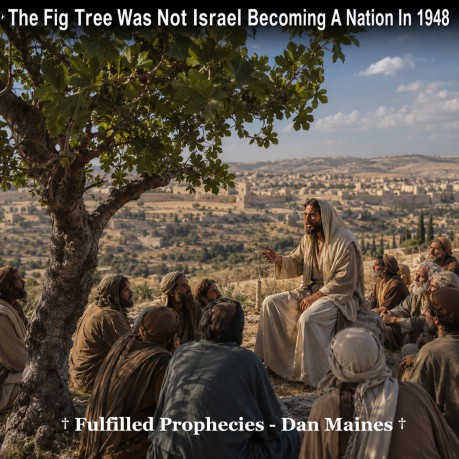
The
Fig Tree Was Not Israel Becoming A Nation In 1948 Introduction † One of the
most repeated modern prophecy claims is that the fig tree in Matthew
24 represents national Israel becoming a nation again in 1948. But
when we actually read the context, Jesus never said the fig tree was
Israel reborn as a modern political nation. He used the fig tree as a
simple illustration about recognizing nearness, just like seeing
leaves tells you summer is near. (Matthew 24:32-33) † The entire
context of Matthew 24 was directed to the disciples concerning the
destruction of the temple that stood before them. Jesus placed the
fulfillment within their generation, not thousands of years later.
The fig tree parable doesn't override the timing statements already
given in the chapter. (Matthew 24:1-3, 34) † Scripture
never says the establishment of a modern secular state in 1948
fulfilled Matthew 24. That idea came from modern dispensational
teaching, not from the text itself. (Matthew 24:32-34) Matthew 24:1-3 1 Jesus
left the temple area and was going on His way when His disciples came
up to point out the temple buildings to Him. 2 But He responded
and said to them, "Do you not see all these things? Truly I say
to you, not one stone here will be left upon another, which will not
be torn down." 3 And
as He was sitting on the Mount of Olives, the disciples came to Him
privately, saying, "Tell us, when will these things happen, and
what will be the sign of Your coming, and of the end of the age?" † Jesus
directly connected the discussion to the temple standing before them.
The disciples asked when THESE THINGS would happen, not events 2000
years later. The context never changes. (Matthew 24:1-3) † The phrase
end of the age refers to the end of the Old Covenant age centered
around the temple system, sacrifices, priesthood, and Jerusalem. It
wasn't speaking about the end of planet earth. (Hebrews 8:13; Hebrews
9:26) † The
destruction Jesus described happened exactly in AD 70 under the Roman
armies led by Titus. The temple was destroyed just as Christ
foretold. (Luke 21:20-22) Matthew 24:32-34
32 "Now learn the parable from the fig tree: as soon as its
branch has become tender and sprouts its leaves, you know that summer
is near; 33 so you too, when you see all these things, recognize
that He is near, right at the door. 34 Truly I say to you, this
generation will not pass away until all these things take place. † Jesus said
the fig tree was a PARABLE. He wasn't giving a secret code about a
future nation state in 1948. He used a normal agricultural example
everyone understood. When trees bud, summer is near. (Matthew 24:32) † Luke removes
the possibility of making the fig tree equal national Israel because
Luke says AND ALL THE TREES. That destroys the entire 1948 argument.
(Luke 21:29-31) † Jesus said
WHEN YOU SEE THESE THINGS. The signs were for the people living then,
not for people 2000 years later watching modern news headlines.
(Matthew 24:33) † The timing
statement settles the matter. THIS GENERATION shall not pass away
till ALL these things are accomplished. Jesus placed fulfillment
within the lifetime of His audience. (Matthew 24:34; Matthew
16:27-28) Luke 21:29-31
29 And He told them a parable: "Look at the fig tree and
all the trees: 30 as soon as they put forth leaves, you see for
yourselves and know that summer is now near. 31 So you too, when
you see these things happening, recognize that the kingdom of God is
near. † If the fig
tree must symbolize Israel in Matthew 24, then what do all the other
trees symbolize in Luke 21? The answer is simple. They are not
symbols of nations at all. Jesus was simply using seasonal signs
everyone recognized. (Luke 21:29-31) † Christ
compared the budding trees to visible signs leading up to Jerusalem's
destruction. Just as leaves show summer is near, the signs He listed
showed judgment was near. (Matthew 24:15-21, 33) † Nothing in
the text mentions a rebirth of national Israel, a twentieth century
nation, or events thousands of years later. Those ideas are imported
into the passage from outside systems. (Matthew 24:32-34) Matthew 21:18-19
18 Now in the early morning, when He was returning to the city,
He became hungry. 19 And seeing a lone fig tree by the road, He
came to it and found nothing on it except leaves alone; and He said
to it, "No longer shall there ever be any fruit from you."
And at once the fig tree withered. † Here the fig
tree represented fruitless first century Israel under judgment, not a
future restoration in 1948. (Matthew 21:18-19) † Jesus cursed
the fig tree forever because it symbolized the coming judgment upon
Jerusalem and the temple system. (Matthew 23:37-38) † If futurists
claim the fig tree in Matthew 24 means Israel's rebirth, then Christ
cursing the fig tree forever creates a major contradiction for their
interpretation. (Matthew 21:19) Matthew 16:27-28 27 For
the Son of Man is going to come in the glory of His Father with His
angels, and will then repay
every person according to his deeds. 28 "Truly
I say to you, there are some of those who are standing here who will
not taste death until they see the Son of Man coming in His kingdom." † Jesus
repeatedly placed His coming within the lifetime of His first century
audience. Some standing there would still be alive when it happened.
That cannot refer to 1948 or events thousands of years later.
(Matthew 16:27-28) † The Bible
interprets itself. Christ gave clear time statements over and over
again. Modern systems try to override those statements by inserting a
giant gap into the text that Jesus never mentioned. (Matthew 10:23;
Matthew 24:34; Revelation 1:1-3) † The burden
of proof belongs on anyone claiming Jesus secretly skipped nearly
2000 years in the middle of His warning to the disciples. (Matthew
24:3, 34) Luke 21:20-22
20 "But when you see Jerusalem surrounded by armies, then
recognize that her desolation is near. 21 Then those who are in
Judea must flee to the mountains, and those who are inside the city
must leave, and those who are in the country must not enter the city;
22 because these are days of punishment, so that all things
which have been written will be fulfilled. † Jesus
identified the fulfillment event clearly, Jerusalem surrounded by
armies. That happened in AD 70 exactly as recorded in history. (Luke
21:20-22) † Jesus said
ALL THINGS WHICH ARE WRITTEN would be fulfilled in those days of
vengeance. He didn't point to a future 1948 restoration. He pointed
to judgment upon first century Jerusalem. (Luke 21:22; Matthew
23:35-36) † The
disciples could physically flee Judea because the warning applied to
THEIR lifetime. That's why early Christians escaped Jerusalem before
its destruction. (Luke 21:21; Matthew 24:15-18) Romans 11:25-26
25 For I do not want you, brothers and sisters, to be uninformed
of this mystery-so that you will not be wise in your own
estimation-that a partial hardening has happened to Israel until the
fullness of the Gentiles has come in; 26 and so all Israel will
be saved; just as it is written: "The
Deliverer will come from Zion, † Paul never
said Israel would become a political nation again in the last days.
He spoke about salvation through Christ, not a twentieth century
government. (Romans 11:25-27) † All Israel
is fulfilled in the remnant joined together with believing Gentiles
into one body in Christ. (Ephesians 2:11-16; Galatians 3:28-29) † Scripture
defines God's people through covenant relationship in Christ, not
through modern nationality or political borders. (Romans 2:28-29;
Philippians 3:3) Romans 2:28-29
28 For he is not a Jew who is one outwardly, nor is circumcision
that which is outward in the flesh. 29 But he is a Jew who is
one inwardly; and circumcision is of the heart, by the Spirit, not by
the letter; and his praise is not from people, but from God. † Paul
destroyed the idea that covenant standing is based on outward
national identity. True covenant identity is found in the heart
through Christ. (Romans 2:28-29) † The modern
state formed in 1948 is a political nation, not a covenant nation
under the Law of Moses, with Levitical priesthood, temple sacrifices,
and covenant standing. (Hebrews 8:13) † The New
Covenant united Jew and Gentile into one new man. Scripture never
teaches two separate covenant peoples with separate prophetic
destinies. (Ephesians 2:14-16) Historical References † Eusebius
wrote that the believers in Jerusalem fled to Pella before the
destruction of the city because they remembered the Lord's warning
concerning Jerusalem being surrounded by armies. (Luke 21:20-21) † Josephus
recorded the horrific destruction of Jerusalem in AD 70, including
famine, fire, and the complete overthrow of the temple, exactly
matching Christ's prophecy. (Matthew 24:1-2; Luke 21:20-24) † Clement of
Alexandria and other early writers consistently viewed the
destruction of Jerusalem as a major fulfillment of Christ's warnings.
(Matthew 24:34) † No early
Christian writer taught that the fig tree referred to a twentieth
century political state called Israel. That interpretation appeared
many centuries later. (Matthew 24:32-34) How It Applies To Us
Today † We should
let Scripture define prophecy, not modern newspapers or political
movements. (2 Peter 1:19-20) † Jesus proved
Himself to be a true prophet because everything He said concerning
Jerusalem came to pass exactly within the generation He specified.
(Matthew 24:34; Luke 21:20-22) † The kingdom
of God isn't tied to a modern earthly nation. Christ reigns now over
His spiritual kingdom. (Colossians 1:13; John 18:36) † Modern
prophecy systems often create fear and confusion because they ignore
audience relevance and timing statements. (Revelation 1:1-3) † Our faith
should rest in what Christ already fulfilled, not in endless
speculation about current events. (John 19:30; Luke 21:22) † If Matthew
24 depended on 1948, then Jesus' statement THIS GENERATION SHALL NOT
PASS AWAY failed for nearly 1900 years. (Matthew 24:34) Q & A Appendix Q
Does the Bible ever say the fig tree is Israel in Matthew 24? A
No. Jesus simply called it a parable about recognizing nearness. Luke
21:29 adds and all the trees, proving it wasn't a secret code for
modern Israel. (Luke 21:29-31) Q
Didn't Israel become a nation in 1948? A
Yes, a modern political state was formed in 1948, but Scripture never
connects that event to Matthew 24 or the fig tree parable. (Matthew
24:32-34) Q
What was Jesus actually predicting in Matthew 24? A
Jesus was predicting the destruction of Jerusalem and the temple in
that generation. (Matthew 24:1-3, 34; Luke 21:20-22) Q
Why do many people connect the fig tree to 1948? A
That interpretation mainly came through modern dispensational
theology, not from the text itself or early Christian teaching.
(Matthew 24:32-34) Q
What destroys the 1948 fig tree theory completely? A
Luke 21:29 says the fig tree AND ALL THE TREES. If the fig tree
represents modern Israel, then the other trees would also need to
represent modern nations, which makes no sense in the context. (Luke
21:29-31) Q
Does Romans 11 teach modern Israel's prophetic restoration? A
No. Romans 11 speaks about salvation through Christ and the inclusion
of the remnant together with believing Gentiles into one body.
(Romans 11:25-27; Ephesians 2:11-16) Q
Why is Matthew 24:34 so important? A
Because Jesus said ALL these things would happen before that
generation passed away. Any interpretation pushing fulfillment
thousands of years later makes Christ's timing statement meaningless.
(Matthew 24:34) Q
If the fig tree represents Israel, why does Luke say and all the
trees? A
Because the fig tree was never meant to symbolize modern Israel in
the first place. Jesus used ordinary trees as a simple seasonal
illustration showing that signs reveal nearness. (Luke 21:29-31) Q
Did any first century Christian teach that the fig tree referred to a
future nation in 1948? A
No. Early Christians understood Matthew 24 as referring to the
destruction of Jerusalem in their generation. The 1948 interpretation
is a modern invention. (Matthew 24:34; Luke 21:20-22) Q
Why did Jesus curse the fig tree if it represented a future restored
Israel? A
He didn't. The cursed fig tree symbolized fruitless first century
Israel under judgment. That actually works against the futurist
interpretation. (Matthew 21:18-19; Matthew 23:37-38) Q
Does the modern nation of Israel today operate under the Old
Covenant? A
No. There is no functioning Levitical priesthood, no temple
sacrifices, and no covenant standing apart from Christ. The Old
Covenant vanished away. (Hebrews 8:13) Q
What did Jesus mean by summer is near? A
Just as leaves show summer is approaching, the signs Jesus gave
showed Jerusalem's judgment was approaching in their lifetime.
(Matthew 24:32-34) Q
Why is audience relevance important in prophecy? A
Because Jesus was speaking directly to His disciples about events
THEY would see and experience. Ignoring audience relevance forces the
passage thousands of years away from the people Christ addressed.
(Matthew 24:15-16, 34) Q
Did Jesus ever tell His disciples to watch for a future twentieth
century nation? A
No. He told them to watch for Jerusalem surrounded by armies, false
christs, tribulation, and the temple's destruction within their
generation. (Luke 21:20-22; Matthew 24:34) Q
What happens if Matthew 24 is pushed into the modern future? A
Christ's repeated timing statements become meaningless, including
this generation shall not pass away till all these things be
accomplished. (Matthew 24:34) Q
Why do so many insist that Israel becoming a nation in 1948 is the
fig tree prophecy, and what are they trying to prove? A
Because many modern prophecy systems depend on 1948 as the starting
point for end times speculation. If the fig tree doesn't represent
modern Israel, then entire futurist timelines begin collapsing. The
doctrine is often used to keep Matthew 24, the tribulation,
antichrist expectations, and Christ's coming pushed into our future
instead of recognizing that Jesus said these things would happen in
THAT generation. (Matthew 24:32-34; Luke 21:20-22) † This is the fulfilled
perspective we proclaim at Fulfilled Prophecies † © Fulfilled Prophecies - Dan Maines. Source Index † Matthew
10:23; Matthew 16:27-28; Matthew 21:18-19; Matthew 23:35-38; Matthew
24:1-3, 15-21, 32-34; Luke 21:20-24, 29-31; John 18:36; John 19:30;
Romans 2:28-29; Romans 11:25-27; Colossians 1:13; Galatians 3:28-29;
Ephesians 2:11-16; Philippians 3:3; Hebrews 8:13; Hebrews 9:26; 2
Peter 1:19-20; Revelation 1:1-3 † Josephus,
Wars of the Jews, Book 6; Eusebius, Ecclesiastical History, Book 3,
Chapter 5; Clement of Alexandria, Stromata
By Dan Maines
He
will remove ungodliness from Jacob."
Links