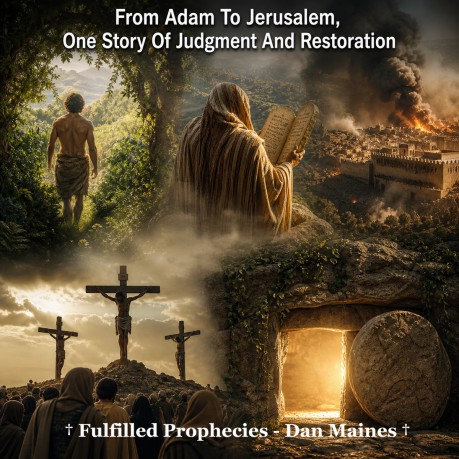
From
Adam To Jerusalem, One Story Of Judgment And Restoration Introduction † The Bible
doesn't tell disconnected stories, it's one continuous account moving
toward a climax, from the garden in Genesis to the destruction of
Jerusalem. (Luke 24:44) Genesis 3:22-24
Then the Lord God said,
"Behold, the man has become like one of Us, knowing good and
evil; and now, he might reach out with his hand, and take fruit also
from the tree of life, and eat, and live forever"- therefore the
Lord God sent him out
of the Garden of Eden, to cultivate the ground from which he was
taken. So He drove the man out; and at the east of the Garden of Eden
He stationed the cherubim and the flaming sword which turned every
direction to guard the way to the tree of life.
† Adam wasn't
just removed from a location, he was cut off from access to life and
God's presence. (Genesis 2:17; Isaiah 59:2) Deuteronomy 28:63-64
And it will come about that, just as the Lord
rejoiced over you to be good to you, and make you numerous, so will
the Lord rejoice over
you to wipe you out and destroy you; and you will be torn away from
the land which you are entering to possess. Furthermore, the Lord
will scatter you among all the peoples, from one end of the earth to
the other; and there you will serve other gods, made of wood and
stone, which you and your fathers have not known. † Israel
stands in Adam's place, given land, blessing, and access to God, but
under covenant responsibility. (Exodus 19:5-6; Psalm 80:8-11) Matthew 23:35-36
so that upon you will fall the guilt of all the righteous blood shed
on earth, from the blood of righteous Abel to the blood of Zechariah,
the son of Berechiah, whom you murdered between the temple and the
altar. Truly I say to you, all these things will come upon this
generation. † Jesus
directly connects that generation to the entire history of bloodshed,
starting with Abel. (Genesis 4:8; Luke 11:50-51) † Adam was
driven out of the garden, Israel was driven out of the land, and that
generation was driven out through destruction. (Genesis 3:24;
Deuteronomy 28:64; Matthew 22:7) Historical References † Josephus
records the complete devastation of Jerusalem, showing the
fulfillment of covenant curses exactly as written. (Josephus, Wars of
the Jews, Book 6.9.1) How It Applies To Us
Today † We're not
under a system of restricted access anymore, the way to life isn't
guarded, it's open in Christ. (Hebrews 10:19-22) Q & A Appendix Q
How do we know Matthew 23 is talking about AD 70 and not the
future? Q
How is Adam connected to Israel and Jerusalem? Q
What was actually restored after AD 70? Q
Why is AD 70 the climax of the story? Q
Why does Jesus go all the way back to Abel? Q
Does this mean there's no future judgment? Q
If the temple represented Eden, why did God allow it to stand so
long? Q
How do we know the temple veil connects back to Genesis 3? Q
Why does Hebrews say the way wasn't open yet? Q
Did Jesus predict the complete end of that system? Q
How does the vineyard connect to Adam's garden? Q
What proves AD 70 was covenant judgment and not just a Roman war? Q
How do we know the Law itself was part of the barrier? Q
What replaced the temple after AD 70? Q
Why is Abel specifically mentioned by Jesus? Q
Does Revelation connect to this same story? Q
How do we know the story ends in restoration, not just judgment? Q
What does it mean for us right now? † This is the fulfilled
perspective we proclaim at Fulfilled Prophecies † Source Index † Genesis
3:22-24; Deuteronomy 28:63-64; Matthew 23:35-36; Luke 21:20-22;
Hebrews 10:19-22; Exodus 26:31-33; Matthew 27:51; Isaiah 5:1-7;
Matthew 21:33-41; Genesis 4:8; Luke 11:50-51
By Dan Maines
†
Adam's fall brought exile from God's presence, Israel repeated that
same failure under the Law, and both find their resolution in Christ
and the judgment of that generation. (Romans 5:12; Hebrews 8:13)
†
What happened in AD 70 wasn't random, it was the full completion of
everything God said from the beginning. (Genesis 3:22-24; Deuteronomy
28:63-64; Matthew 23:35-36)
†
The cherubim and flaming sword show restricted access, the way to
life was now guarded under judgment. (Exodus 26:31-33; Hebrews
9:6-8)
†
This is the first exile, separation because of disobedience, and it
sets the pattern for everything that follows. (Romans 5:12; Hosea
6:7)
†
Their disobedience brings the same result as Adam, removal from the
land, scattering, and loss of covenant blessing. (Leviticus 26:31-33;
2 Kings 17:6-7)
†
The curse isn't random, it's the continuation of the same judgment
pattern first seen in Eden. (Jeremiah 25:11; Daniel 9:11-13)
†
He's not starting a new story, He's finishing the one that began in
Genesis. (Matthew 21:33-41; Acts 7:51-52)
†
The judgment of AD 70 is the full covenant consequence, the final
exile, and the end of that system. (Luke 21:20-22; Hebrews 8:13)
†
The temple itself mirrored Eden, the veil had cherubim just like the
garden, showing restricted access remained under the Law. (Exodus
26:31-33; 1 Kings 6:29)
†
Hebrews explains that as long as that system stood, the way into
God's presence wasn't yet open. (Hebrews 9:8)
†
When Christ died, the veil was torn, showing access was being opened.
(Matthew 27:51)
†
AD 70 completed that process by removing the entire temple system
that kept that separation in place. (Hebrews 10:19-20; Luke
21:20-22)
†
Israel is called God's vineyard, a cultivated garden that failed just
like Adam. (Isaiah 5:1-7; Matthew 21:33-41)
†
Cain killing Abel is the first bloodshed, and Jesus says all that
blood would come on that generation, showing the entire story from
Genesis forward is in view. (Genesis 4:8; Matthew 23:35; Luke
11:50-51)
†
What began with a guarded tree ends with open access through Christ.
(Revelation 22:14; John 14:6)
†
Eusebius confirms that the destruction of Jerusalem was seen by early
believers as divine judgment on that generation. (Eusebius,
Ecclesiastical History 3.5)
†
Tacitus describes the Roman destruction, aligning with the warnings
Jesus gave about that city. (Tacitus, Histories 5.13)
†
Irenaeus speaks of the judgment that came upon Jerusalem, recognizing
the fulfillment of the Lord's warnings against that city. (Irenaeus,
Against Heresies 4.26.1)
†
The pattern of judgment shows God keeps His word, both in warning and
in promise. (Matthew 5:18; Joshua 21:45)
†
We're living in the restored reality where separation has been
removed, not waiting for it. (Ephesians 2:13-16)
A
Jesus said all these things would come upon that generation, and tied
it to the destruction of Jerusalem in Luke 21:20-22 where He says
those are the days of vengeance so that all things which are written
may be fulfilled.
A
Adam was placed in a garden and lost access through sin, Israel was
placed in the land and lost it through sin, and Jesus shows that same
pattern ending in His generation, tying Abel to that judgment in
Matthew 23:35-36.
A
Access to God without the temple system, Hebrews 10:19-20 says we now
have confidence to enter the holy place through Christ, showing the
barrier seen in Genesis 3 was removed.
A
Luke 21:22 says those were the days of vengeance so that all things
which are written may be fulfilled, meaning everything from Genesis
forward reached completion there.
A
Because He's closing the entire biblical storyline, not just
addressing one moment, Matthew 23:35 and Luke 11:50-51 show that all
the righteous blood from the beginning was coming to its completion
in that generation.
A
The covenant judgment Jesus spoke about was fulfilled in that
generation, as He said in Matthew 24:34, but God still judges
individuals in righteousness, Hebrews 9:27.
A
Because it was a temporary system pointing forward to Christ, Hebrews
9:9-10 says it was symbolic for that present time and imposed until a
time of reformation, showing it wasn't meant to last forever.
A
Exodus 26:31 says the veil had cherubim woven into it, the same
guardians placed at Eden in Genesis 3:24, showing the temple was a
continuation of restricted access to God.
A
Hebrews 9:8 explains that as long as the first tabernacle was still
standing, the way into the holy place wasn't yet revealed, meaning
the old system itself was the barrier.
A
Yes, Matthew 24:2 says not one stone would be left upon another, and
Luke 21:6 repeats the same, showing total destruction was coming.
A
Isaiah 5:7 calls Israel the vineyard of the Lord, and Matthew
21:33-41 shows that vineyard judged for unfaithfulness, proving
Israel was a cultivated "garden" that failed just like
Adam.
A
Luke 21:22 says those were the days of vengeance so that all things
written would be fulfilled, meaning it was God's judgment fulfilling
Scripture, not random history.
A
Ephesians 2:14-15 says Christ broke down the dividing wall and
abolished the enmity contained in ordinances, showing the Law system
was part of what separated.
A
Ephesians 2:19-22 says believers are now the dwelling of God, built
together as a holy temple, showing the physical structure was
replaced with a spiritual reality.
A
Because Genesis 4:10 says Abel's blood cried out from the ground, and
Jesus shows that cry wasn't forgotten, it reached its judgment
fulfillment in that generation in Matthew 23:35.
A
Yes, Revelation 18:24 says in Babylon was found the blood of prophets
and saints and all who were slain on the earth, matching exactly what
Jesus said in Matthew 23:35.
A
Revelation 22:14 shows access to the tree of life restored, proving
the guarded access from Genesis 3 was finally opened.
A
It means we're not waiting for access to God, John 5:24 says we have
already passed out of death into life, showing the restoration is
present, not future.
©
Fulfilled Prophecies - Dan Maines.
†
Josephus, Wars of the Jews, Book 6.9.1; Eusebius, Ecclesiastical
History 3.5; Tacitus, Histories 5.13; Irenaeus, Against Heresies
4.26.1
Links