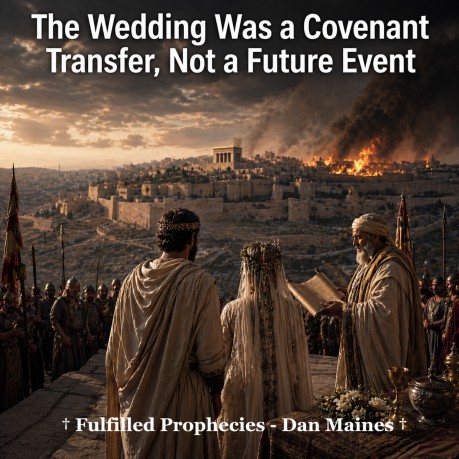
The
Wedding Was a Covenant Transfer, Not a Future Event Introduction † Most people
push the marriage of the Lamb into the future, but Jesus already told
us when it would happen, and it was tied directly to judgment on
Jerusalem (Matthew 22:7). † The wedding
wasn't mystical language about heaven someday, it was covenant
language about a transfer from Old Covenant Israel to the New
Covenant bride (Revelation 19:7). † The key is
letting scripture define the timing, the audience, and the
consequence for rejecting the invitation (Revelation 1:1). Matthew
21:43 † This is the
legal transfer statement, the kingdom is taken from Old Covenant
Israel and given to another people (Matthew 21:43). † This sets up
the wedding in Matthew 22 as the transition event, not a random
future celebration (Matthew 22:2).
Matthew 22:1-7 † Jesus is
speaking directly to Israel, the ones who were first invited, and
they refused the invitation (Matthew 21:43). † The killing
of the servants matches the prophets and apostles sent to Israel, who
were rejected and killed (Matthew 23:34-36). † The burning
of their city isn't symbolic language, it's the judgment of Jerusalem
in AD 70, exactly as Jesus warned (Luke 19:41-44). † The wedding
is ready before the destruction, meaning the covenant transfer is
already in motion before the city is burned (Matthew 22:4-7).
Luke 14:16-24 † Same
invitation, same rejection, same replacement, confirming this is a
covenant shift, not a future event (Luke 14:24). † The
expansion to highways and hedges shows the inclusion of the Gentiles
after Israel's rejection (Acts 13:46). Revelation
19:7-9 Then he
*said to me, "Write: 'Blessed are those who are invited to the
wedding feast of the Lamb.'" And he *said to me, "These are
the true words of God."
† It says the
marriage of the Lamb is come, not that it's thousands of years away,
it was happening in that generation (Revelation 1:1). † The bride is
made ready, showing completion, not a future unfinished process
(Ephesians 5:25-27). † The
invitation language matches Matthew 22, showing the same event, the
same wedding, the same covenant transition (Matthew 22:3). † The
righteous acts of the saints show the New Covenant people fully
established as the bride (Hebrews 12:22-24). Revelation
21:2 Revelation
21:9-10 And he carried me away in the Spirit to
a great and high mountain, and showed me the holy city, Jerusalem,
coming down out of heaven from God,
† The bride is
clearly identified as New Jerusalem, not a future physical event but
a covenant people (Hebrews 12:22). † This
directly contrasts Old Jerusalem that was destroyed, showing
replacement, not coexistence (Galatians 4:25-26). Matthew
8:11-12 † The sons of
the kingdom are Old Covenant Israel, the original invited group who
rejected the Messiah (John 1:11). † Others from
east and west replace them, showing a covenant shift, not a future
event (Romans 9:30-31). † This is the
same wedding picture, inclusion of the nations and exclusion of
unbelieving Israel (Matthew 22:9-10).
Ephesians 5:25-27 † Christ was
actively preparing the bride in the first century, not waiting
thousands of years (Hebrews 9:26-28). † The
presentation language matches a wedding, showing completion at his
coming (2 Corinthians 11:2). † This lines
up with Revelation 19, the bride made ready at the time of judgment
(Revelation 19:7).
Hebrews 12:22-24 † It says ye
are come, present tense, meaning the bride reality was already
established in the first century (Hebrews 12:22). † This ties
the wedding, the city, and the New Covenant people together as one
fulfilled reality (Revelation 21:2). Historical References † Josephus
records the destruction of Jerusalem and the burning of the city in
AD 70, exactly matching Jesus' words in Matthew 22 (Josephus, Wars of
the Jews, Book 6). † Eusebius
confirms the fulfillment of Jesus' warnings about Jerusalem's
destruction within that generation (Eusebius, Ecclesiastical History,
Book 3). † Tacitus also
records the Roman destruction of Jerusalem, confirming the historical
reality of the event (Tacitus, Histories 5.13). How it applies to us
today † We're not
waiting for a future wedding, we're living in the completed New
Covenant reality where the bride has already been established
(Hebrews 8:13). † The
invitation has already gone out to the nations, and we're part of
that fulfilled kingdom now (Matthew 28:18-20). † The judgment
already came on the Old Covenant system, so there's no future
covenant transfer coming, it's finished (John 19:30). † This gives
us confidence, we're not waiting for completion, we're living in it
(Hebrews 12:28). Q & A Appendix Q:
When did the marriage of the Lamb take place? Q:
Who was originally invited to the wedding? Q:
What does the burning of the city represent? Q:
Who is the bride? Q:
Are we still waiting for the wedding? Q:
What proves the wedding happened before AD 70? Q:
Is the marriage of the Lamb a physical event? Q:
Why were the original invited guests rejected? Q:
What replaced Old Covenant Jerusalem? Q:
How do we know this isn't still future? † This is the fulfilled
perspective we proclaim at Fulfilled Prophecies † Source Index † Matthew
21:43; Matthew 22:1-7; Luke 14:16-24; Revelation 19:7-9; Revelation
21:2, 9-10; Matthew 8:11-12; Ephesians 5:25-27; Hebrews 12:22-24;
Luke 19:41-44; Matthew 23:34-36; Acts 13:46; John 1:11; Romans
9:30-31; Galatians 4:25-26; Hebrews 9:26-28; 2 Corinthians 11:2;
Matthew 28:18-20; John 19:30; Hebrews 8:13; Hebrews 12:28 † Josephus,
Wars of the Jews, Book 6; Eusebius, Ecclesiastical History, Book 3;
Tacitus, Histories 5.13
By Dan Maines
Therefore
I say to you, the kingdom of God will be taken away from you and
given to a people producing its fruit.
Jesus
spoke to them again in parables, saying, "The kingdom of heaven
is like a king who held a wedding feast for his son. And he sent his
slaves to call those who had been invited to the wedding feast, and
they were unwilling to come. Again he sent other slaves, saying,
'Tell those who have been invited, "Behold, I have prepared my
dinner; my oxen and my fattened cattle are all butchered and
everything is ready. Come to the wedding feast!"' But they paid
no attention and went their separate ways, one to his own farm,
another to his business, and the rest seized his slaves and treated
them abusively, and then killed them. Now the king was angry, and he
sent his armies and destroyed those murderers and set their city on
fire.
But
He said to him, "A man was giving a big dinner, and he invited
many; and at the dinner hour he sent his slave to tell those who had
been invited, 'Come, because everything is ready now.' And yet they
all alike began to make excuses. The first one said to him, 'I
purchased a field and I need to go out to look at it; please consider
me excused.' And another one said, 'I bought five yoke of oxen, and I
am going to try them out; please consider me excused.' And another
one said, 'I took a woman as my wife, and for that reason I cannot
come.' And the slave came back and reported this to his master. Then
the head of the household became angry and said to his slave, 'Go out
at once into the streets and lanes of the city and bring in here
those who are poor, those with disabilities, those who are blind, and
those who are limping.' And later the slave said, 'Master, what you
commanded has been done, and still there is room.' And the master
said to the slave, 'Go out into the roads and the hedges and press
upon them to come in, so that my house will be filled. For I tell
you, none of those men who were invited shall taste my dinner.'"
Let's
rejoice and be glad and give the glory to Him, because the marriage
of the Lamb has come, and His bride has prepared herself." It
was given to her to clothe herself in fine linen, bright and clean;
for the fine linen is the righteous acts of the saints.
And I saw
the holy city, new Jerusalem, coming down out of heaven from God,
prepared as a bride adorned for her husband.
Then
one of the seven angels who had the seven bowls, full of the seven
last plagues, came and spoke with me, saying, "Come here, I will
show you the bride, the wife of the Lamb."
And I
say to you that many will come from east and west, and recline at the
table with Abraham, Isaac, and Jacob in the kingdom of heaven; but
the sons of the kingdom will be thrown out into the outer darkness;
in that place there will be weeping and gnashing of teeth."
Husbands,
love your wives, just as Christ also loved the church and gave
Himself up for her, so that He might sanctify her, having cleansed
her by the washing of water with the word, that He might present to
Himself the church in all her glory, having no spot or wrinkle or any
such thing; but that she would be holy and blameless.
But
you have come to Mount Zion and to the city of the living God, the
heavenly Jerusalem, and to myriads of angels, to the general assembly
and church of the firstborn who are enrolled in heaven, and to God,
the Judge of all, and to the spirits of the righteous made perfect,
and to Jesus, the mediator of a new covenant, and to the sprinkled
blood, which speaks better than the blood of Abel.
A:
It took place in connection with the judgment of Jerusalem in that
generation, not in our future (Matthew 22:7; Revelation 1:1).
A:
Old Covenant Israel, but they rejected the invitation (Matthew 22:3;
John 1:11).
A:
The destruction of Jerusalem in AD 70 (Luke 19:43-44; Matthew 22:7).
A:
The New Covenant people, the church made ready in the first century
(Ephesians 5:25-27; Revelation 19:7).
A:
No, it was fulfilled, and we're living in the result of it now
(Hebrews 12:22-24).
A:
The king burned their city after the invitation was rejected, which
is the destruction of Jerusalem, placing the wedding in that
generation (Matthew 22:7; Luke 21:20-22).
A:
No, it's covenant language showing the union between Christ and his
people, not a physical ceremony (Ephesians 5:31-32; Revelation 21:2).
A:
Because they rejected the Son and persecuted the messengers sent to
them (Matthew 22:5-6; Matthew 23:37-38).
A:
The New Jerusalem, which is the bride, the New Covenant people
established in Christ (Revelation 21:2; Galatians 4:26).
A:
Revelation states these things would happen shortly and were near,
placing the fulfillment in their time, not ours (Revelation 1:1-3;
22:6-7).
©
Fulfilled Prophecies - Dan Maines.
Links