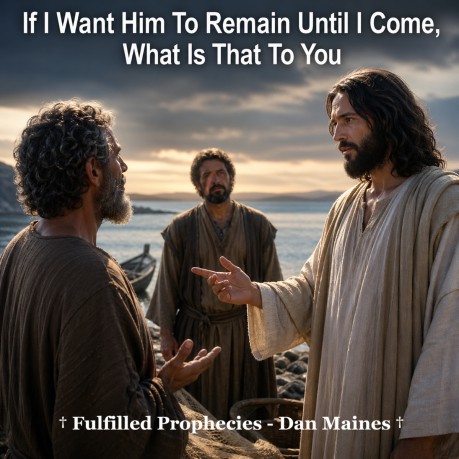
If
I Want Him To Remain Until I Come, What Is That To You Introduction † Jesus didn't
leave Peter guessing here, He corrected him directly and shut down
speculation about someone else's path, while pointing him right back
to timing and obedience (John 21:20-22) John
21:22 † Jesus places
His coming within the lifetime of the disciples' generation, because
the statement only makes sense if His coming was within that
generation, not thousands of years later (Matthew 16:27-28) John
21:23 † The text
itself corrects the misunderstanding, Jesus never said John wouldn't
die, people assumed it (John 21:22) † Someone says
this was only a hypothetical statement and removes any timing from
it, but the text never does that, it corrects the misunderstanding
about John's death, not the timing of the coming (John 21:23; Matthew
24:34) Matthew
20:22-23 † Jesus tells
both James and John they will drink His cup, meaning they will share
in His suffering and death (Mark 10:38-39) Mark
10:38-39 † Jesus
confirms again that both brothers would share in His suffering,
reinforcing that John was not exempt from death (Matthew 20:23) † Some say
John lived long enough to reach the coming, others say he died
earlier, possibly during Nero's persecution around AD 64, but either
way the point remains, Jesus never promised he would not die, only
that the coming was within that generation (John 21:23; Matthew
24:34) Matthew
16:27-28 "Truly I say to you, there are
some of those who are standing here who will not taste death until
they see the Son of Man coming in His kingdom." † Jesus
already told them some standing there wouldn't die before seeing His
coming, which aligns perfectly with what He tells Peter about John
(Mark 9:1) Matthew
24:34 † Jesus
defines the timeframe clearly, His coming and all related events
would happen within that generation, not a future distant age (Luke
21:20-22) John 14:18 † Jesus
repeatedly told them He was coming to them, not to a distant future
group thousands of years later (John 14:3) Revelation
1:7 † This coming
is directed at those who pierced Him, the first-century generation,
not a distant future world (Matthew 23:35-36) Hebrews
10:37 † The writer
of Hebrews says the coming would not delay, reinforcing imminence
(Hebrews 10:25) James
5:8-9 † At hand and
before the doors means imminent, not distant (Matthew 24:33) 2 Peter 3:3-4 † Even in the
first century, people were already questioning the timing, which
shows they were expecting it soon, not thousands of years later (1
Peter 4:7) † If John died
before AD 70, as some accounts suggest during Nero's persecution,
then the claim that he wrote Revelation in the 90s collapses, because
a man cannot write decades after his death, which means the late-date
assumption fails and the book belongs in the first-century context it
describes (John 21:23; Matthew 24:34; Revelation 1:1)
Historical References † Eusebius
records that the early church connected Christ's coming with the
destruction of Jerusalem, recognizing it as a fulfillment of His
words in that generation (Matthew 24:34) How it applies to us
today † We don't
compare our path to others, Jesus already made it clear, follow Him
and trust His timing (John 21:22) Q & A Appendix Q
Does John 21:22 teach that John would never die? Q
What does till I come refer to? Q
Why did people misunderstand this statement? Q
Does John 21:22 mean John had to stay alive until the coming of
Christ? Q
Why would Jesus even mention His coming in response to Peter? Q
Does this passage teach that the coming of Christ is still future? Q
Could John have lived until AD 70? Q
What if John died earlier, around AD 64? Q
Does this verse support a late date for the book of Revelation? Q
What does till I come actually refer to? Q
Why did early believers misunderstand Jesus' words? † This is the fulfilled
perspective we proclaim at Fulfilled Prophecies † Source Index † John
21:22-23; Matthew 20:22-23; Mark 10:38-39; Matthew 16:27-28; Matthew
24:34; John 14:18; Revelation 1:7; Hebrews 10:37; James 5:8-9; 2
Peter 3:3-4; Luke 21:20-22; Mark 9:1; Luke 21:32; John 14:3; 1 Peter
4:7; Mark 13:30; Matthew 24:30; Luke 21:27-28; Matthew 23:35-36;
Hebrews 10:25; 2 Peter 3:10; Matthew 24:2; Colossians 2:8
By Dan Maines
†
This moment isn't random, it's connected to everything Jesus already
said about His coming, and it fits perfectly within the first-century
fulfillment He had already promised (Matthew 16:27-28; Matthew
24:34)
†
What Peter heard, and what others misunderstood, reveals how easily
people miss timing when they shift focus away from Christ's own words
(2 Peter 3:3-4)
Jesus
*said to him, "If I want him to remain until I come, what is
that to you? You follow Me!"
†
The focus isn't on John living forever, it's on Peter minding his own
calling, while Christ affirms that His coming was something within
that generation (John 14:18; Matthew 24:34)
†
This does not allow for a distant fulfillment, because if Jesus knew
His coming was thousands of years away, this statement would be
misleading instead of corrective (Matthew 24:34; Luke 21:32)
Therefore
this account went out among the brothers, that that disciple would
not die; yet Jesus did not say to him that he would not die, but
only, "If I want him to remain until I come, what is that to
you?"
†
This proves the issue was misinterpretation even in the first
century, not a failed prophecy (2 Peter 3:3-4)
†
It also shows the focus was never about immortality, but about the
nearness of His coming (Matthew 16:27-28)
†
If you remove the time element, the statement loses its meaning,
because Jesus answers Peter by pointing to His coming, which only
makes sense if it was relevant to their lifetime (Matthew 16:27-28;
Luke 21:32)
†
The phrase if I will that he tarry till I come only has meaning if
the coming was within a timeframe John could remain alive, otherwise
it becomes meaningless (Matthew 24:34; James 5:8-9)
But
Jesus replied, "You do not know what you are asking. Are you
able to drink the cup that I am about to drink?" They *said to
Him, "We are able." He *said to them, "My cup you
shall drink; but to sit at My right and at My left is not Mine to
give, but it is for those for whom it has been prepared by My
Father."
†
This proves ahead of time that John was not being promised escape
from death in John 21:22 (John 21:23)
†
The statement about tarrying cannot mean John would live
indefinitely, because Jesus already declared he would suffer as well
(Acts 12:2)
But
Jesus said to them, "You do not know what you are asking. Are
you able to drink the cup that I drink, or to be baptized with the
baptism with which I am baptized?" They said to Him, "We
are able." And Jesus said to them, "The cup that I drink
you shall drink; and you shall be baptized with the baptism with
which I am baptized.
†
James was killed early, and John also suffered persecution, showing
the fulfillment of Jesus' words (Acts 12:2; Revelation 1:9)
†
This completely removes any idea that John 21:22 was about physical
survival, it was about timing of Christ's coming (Matthew 24:34)
†
Whether John died before AD 70 or lived through it doesn't change the
meaning, because the focus of the passage is the nearness of Christ's
coming, not the length of John's life (Matthew 16:27-28; James 5:8-9)
For
the Son of Man is going to come in the glory of His Father with His
angels, and will
then repay every person according to his
deeds.
†
This wasn't symbolic language stretched across thousands of years, it
was a direct time statement tied to real people standing there (Luke
21:32)
†
That means John 21:22 isn't introducing a new idea, it's reinforcing
the same timeframe Jesus had already declared (Matthew 24:34)
Truly I
say to you, this generation will not pass away until all these things
take place.
†
When we read John 21:22 through this lens, it becomes consistent
instead of confusing (John 21:22)
†
The problem isn't the text, it's later traditions that tried to
extend the timing beyond what Jesus actually said (Mark 13:30)
"I
will not leave you as orphans; I am coming to you.
†
This coming is tied to covenant fulfillment, not a physical descent
to remain on earth (Matthew 24:30)
†
It connects directly to judgment, resurrection, and the establishment
of the fulfilled kingdom in their time (Luke 21:27-28)
Behold,
He
is coming with the clouds,
and every eye will see Him, even those who pierced Him; and all the
tribes of the earth will mourn over Him. So it is to be. Amen.
†
It matches the same judgment language Jesus used in Matthew 24
(Matthew 24:30)
†
This confirms that till I come is tied to that same covenant judgment
event (Luke 21:20-22)
For
yet in a very little while,
He
who is coming will come,
and
will not delay.
†
This lines up perfectly with John 21:22 and removes any room for a
delayed fulfillment beyond what was stated (James 5:8-9)
†
The early church lived in expectation because it was actually near (1
Peter 4:7)
You too
be patient; strengthen your hearts, for the coming of the Lord is
near. Do not complain, brothers and sisters, against one another, so
that you may not be judged; behold, the Judge is standing right at
the door.
†
This is the same coming Jesus referred to in John 21:22 (Matthew
16:27-28)
†
It proves the apostles all taught the same timeframe Jesus gave (Luke
21:32)
Knowing
this first, that in the last days mockers shall come with mockery,
walking after their own lusts, and saying, Where is the promise of
his coming? for, from the day that the fathers fell asleep, all
things continue as they were from the beginning of the creation.
†
Peter doesn't extend it into the distant future, he reinforces that
it was near and already unfolding (2 Peter 3:10)
†
This matches the tension seen in John 21:22, people trying to figure
out timing instead of trusting Christ's words (John 21:23)
†
Josephus documents the events of AD 70 in detail, showing the
judgment that aligns with Jesus' predictions of His coming in power
and judgment (Luke 21:20-22)
†
Tacitus confirms the devastation of Judea and Jerusalem, supporting
the historical reality of what Jesus said would happen within that
generation (Matthew 24:2)
†
We don't delay the fulfillment beyond what was stated, we stand on
what He said and what was fulfilled (Matthew 24:34)
†
We stay grounded in Scripture instead of tradition, because once you
see the timing clearly, everything else falls into place (Colossians
2:8)
A
No, Jesus wasn't promising immortality, He was correcting Peter and
reinforcing that His coming was near, within that generation (Matthew
16:27-28)
A
It refers to Christ's coming in judgment and kingdom fulfillment in
the first century, culminating in the destruction of Jerusalem
(Matthew 24:34; Luke 21:20-22)
A
Because they focused on John instead of Christ's timing, just like
many do today by ignoring the clear time statements Jesus gave (2
Peter 3:3-4)
A
No, Jesus did not say John would remain alive, He corrected that
misunderstanding in John 21:23, but the statement still assumes the
coming was within that generation (John 21:23; Matthew 24:34)
A
Because His coming was relevant to their lifetime, otherwise it would
not answer Peter's question, Jesus always answered with purpose and
clarity (Matthew 16:27-28; Luke 21:32)
A
No, it places the coming within the lifetime of the disciples, which
aligns with every other time statement Jesus gave (Matthew 24:34;
Mark 9:1)
A
Possibly, but it is not required, because Jesus never promised he
would not die, only that His coming was within that generation (John
21:23; Matthew 24:34)
A
That does not change the meaning of the passage, because the focus is
on the nearness of Christ's coming, not the length of John's life
(Matthew 16:27-28; James 5:8-9)
A
No, if John died before AD 70, then a late date becomes impossible,
and even if he lived longer, the internal time statements of
Revelation still place it near (Revelation 1:1; Revelation 22:6-7)
A
It refers to Christ's coming in judgment and kingdom fulfillment in
the first century, culminating in the destruction of Jerusalem
(Matthew 24:30; Luke 21:20-22)
A
Because they assumed physical outcomes instead of listening carefully
to what Jesus actually said, just like many do today (John 21:23; 2
Peter 3:3-4)
©
Fulfilled Prophecies - Dan Maines.
†
Eusebius, Ecclesiastical History; Josephus, Wars of the Jews;
Tacitus, Histories
Links