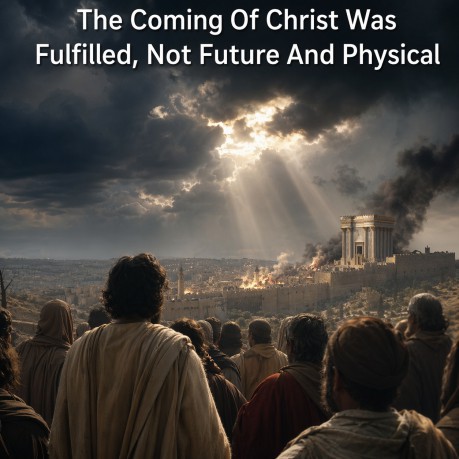
The
Coming Of Christ Was Fulfilled, Not Future And Physical Introduction † Many today
are still looking for a future physical return of Christ, a rebuilt
temple, animal sacrifices, and an earthly throne in Jerusalem (2
Corinthians 5:16). Acts
1:11 † They assume
like manner means a physical return to earth, but the text says
nothing about location, only manner (Matthew 24:30). Revelation
1:7 † This verse
places the coming in the lifetime of those who pierced Him, which was
first century Israel (Matthew 23:35-36). Matthew
24:30-34
"Now learn the parable from the fig tree: as soon as its branch
has become tender and sprouts its leaves, you know that summer is
near; so you too, when you see all these things, recognize that He is
near, right at the door. Truly I say to you, this generation will not
pass away until all these things take place.
† Jesus
directly defines the timing, it would happen in that generation, not
thousands of years later (Matthew 16:27-28). Acts
2:30-31 † The throne
of David was fulfilled in the resurrection, not postponed to a future
earthly reign (Acts 13:32-33).
Revelation 20:4-6 † The text
explicitly says souls, not physical bodies ruling on earth
(Revelation 6:9). Hebrews
10:12 † A future
temple with sacrifices would contradict the finished work of Christ
(Hebrews 10:18). Ephesians
2:21-22 † The true
temple is not a future building, it is the body of Christ (1
Corinthians 3:16).
Job 19:25-27 † Job is
speaking about vindication and seeing God, not a future global
resurrection event (Job 42:5). Zechariah
14:4 † This is
prophetic judgment language, not a literal geological event (Micah
1:3-4). Hebrews
8:13 † If Ezekiel's
temple is future, then the old covenant system returns, which
Scripture says has vanished (Hebrews 7:12). Historical References † Josephus
records the destruction of Jerusalem in AD 70, fulfilling Jesus'
prophecy of judgment (Luke 21:20-22). How It Applies To Us
Today † We are not
waiting for Christ to begin ruling, He is already reigning now (Acts
2:36). Q & A Appendix Q:
Does Acts 1:11 prove a physical return of Christ? Q:
How can Revelation 1:7 already be fulfilled if every eye sees Him? Q:
Is Jesus ruling from David's throne right now? Q:
Is the thousand-year reign future and physical? Q:
Will there be a future temple with sacrifices? Q:
If this is already fulfilled, what are we waiting for? Q:
Does "like manner" in Acts 1:11 mean Jesus must return
physically to earth? Q:
What does it mean that "every eye will see Him"? Q:
Did Jesus already come on the clouds? Q:
Is the Mount of Olives prophecy meant to be taken literally? Q:
Does Job teach a future bodily resurrection on earth? Q:
If Jesus is already on David's throne, where is He ruling from? Q:
Are we still waiting for the kingdom to begin? Q:
Why can't Ezekiel's temple be future? Q:
What is the first resurrection? Q:
What does it mean that Christ is reigning now? Q:
If prophecy is fulfilled, why do people still expect a future
return? Q:
What replaces the physical temple in God's plan? † This is the fulfilled
perspective we proclaim at Fulfilled Prophecies † Source Index † Acts 1:11;
Revelation 1:7; Matthew 24:30-34; Acts 2:30-31; Revelation 20:4-6;
Hebrews 10:12; Ephesians 2:21-22; Job 19:25-27; Zechariah 14:4;
Hebrews 8:13
By Dan Maines
†
This confusion comes from reading Old Testament prophecy without
letting the New Testament interpret it (2 Peter 1:20-21).
†
When we let Scripture interpret Scripture, we see that everything
they are expecting was already fulfilled in the first century (Luke
21:22).
†
We are going to walk through the exact verses used to argue for a
physical return and show clearly where the misunderstanding is (Acts
17:11).
†
The timing was never left open ended, Jesus said these things would
happen in their generation (Matthew 16:27-28).
and they
said, "Men of Galilee, why do you stand looking into the sky?
This Jesus, who has been taken up from you into heaven, will come in
the same way as you have watched Him go into heaven."
†
Jesus went into a cloud, and throughout Scripture clouds represent
divine judgment, not physical transportation (Isaiah 19:1).
†
The same coming in clouds is explained by Jesus Himself and tied to
their generation, not ours (Matthew 24:34).
Behold,
He
is coming with the clouds,
and every eye will see Him, even those who pierced Him; and all the
tribes of the earth will mourn over Him. So it is to be. Amen.
†
Every eye is covenant language referring to those under judgment, not
a global modern audience (Isaiah 26:11).
†
The mourning of the tribes matches Jesus' Olivet Discourse and is
tied to the fall of Jerusalem (Matthew 24:30).
And
then the sign of the Son of Man will appear in the sky, and then all
the tribes of the earth will mourn, and they will see the Son
of Man coming on the clouds of the sky
with power and great glory. And He will send forth His angels with a
great trumpet blast,
and they
will gather together
His elect from the four winds, from one end of the sky to the other.
†
The coming on clouds is drawn from Old Testament judgment language,
not a physical descent (Daniel 7:13).
†
This event is tied to the destruction of Jerusalem, which
historically happened in AD 70 (Luke 21:20-22).
So
because he was a prophet and knew that God had sworn to him with an
oath to seat one of his descendants on his throne, he looked ahead
and spoke of the resurrection of the Christ, that He was neither
abandoned to Hades, nor did His flesh suffer decay.
†
Jesus is already seated and reigning, not waiting to begin ruling
(Ephesians 1:20-21).
†
The kingdom is present and active, not future and physical
(Colossians 1:13).
Then
I saw thrones, and they sat on them, and judgment was given to them.
And I saw the souls of those who had been beheaded because of their
testimony of Jesus and because of the word of God, and those who had
not worshiped the beast or his image, and had not received the mark
on their foreheads and on their hands; and they came to life and
reigned with Christ for a thousand years. The rest of the dead did
not come to life until the thousand years were completed. This is the
first resurrection. Blessed and holy is the one who has a part in the
first resurrection; over these the second death has no power, but
they will be priests of God and of Christ, and will reign with Him
for a thousand years.
†
This is a spiritual reign with Christ, not an earthly political
kingdom (Ephesians 2:6).
†
The first resurrection is spiritual life in Christ, not a future
bodily resurrection event (John 5:24-25).
but He,
having offered one sacrifice for sins for all time, sat
down at the right hand of God,
†
The sacrificial system is fulfilled and ended, not waiting to be
restarted (Daniel 9:27).
†
Christ's work is complete, not partial or awaiting future completion
(John 19:30).
in whom
the whole building, being fitted together, is growing into a holy
temple in the Lord, in whom you also are being built together into a
dwelling of God in the Spirit.
†
God dwells in His people, not in a physical structure made with hands
(Acts 7:48).
†
All temple prophecies find their fulfillment in Christ and His people
(John 2:19-21).
†
Jesus Himself declared the temple would be replaced by His body, not
rebuilt in the future (John 2:19-21).
Yet
as for me, I know that my Redeemer lives,
And at the last, He
will take His stand on the earth.
Even after my skin is
destroyed,
Yet from my flesh I will see God,
Whom I, on my
part, shall behold for myself,
And whom my eyes will see, and
not another.
My heart faints within me!
†
Seeing God is covenant and relational language, not necessarily
physical sight (Psalm 17:15).
†
Job's expectation is rooted in his own context of deliverance, not a
distant future timeline (Job 42:10).
On that
day His feet will stand on the Mount of Olives, which is in front of
Jerusalem on the east; and the Mount of Olives will be split in its
middle from east to west forming a very large valley. Half of the
mountain will move toward the north, and the other half toward the
south.
†
Mountains splitting and melting consistently represent divine
judgment throughout Scripture (Nahum 1:5).
†
Jesus gave this prophecy from the Mount of Olives, tying it directly
to the judgment on Jerusalem in that generation (Matthew 24:3).
When He
said, "A new covenant," He has made the first obsolete. But
whatever is becoming obsolete and growing old is about to disappear.
†
A return to priests, sacrifices, and rituals would contradict the
finished work of Christ (Hebrews 10:18).
†
The old system ended, it is not waiting to be restored in the future
(Colossians 2:14).
†
Eusebius wrote that the church understood these events as fulfillment
of Christ's words (Matthew 24:33-34).
†
Tacitus confirms the catastrophic fall of Jerusalem, aligning with
the tribulation described by Jesus (Luke 21:22-23).
†
We are not looking for a physical temple, we are the temple of God (1
Corinthians 3:16).
†
We trust in a finished work, not a future system of sacrifices
(Hebrews 10:14).
†
We live in the established kingdom, not a postponed one (Matthew
28:18).
†
This gives us confidence, stability, and clarity in how we understand
prophecy today (Luke 21:32).
A:
No, it speaks of the manner of His coming, not a physical descent,
and must be interpreted with Matthew 24:30-34.
A:
It specifically includes those who pierced Him, proving it happened
in their lifetime (Matthew 23:36).
A:
Yes, Acts 2:30-31 shows the throne was fulfilled in the resurrection
and ascension.
A:
No, Revelation 20 shows souls reigning, indicating a spiritual reign,
not an earthly kingdom (Ephesians 2:6).
A:
No, Hebrews 10:12 shows Christ's sacrifice was once for all, ending
the sacrificial system completely (Hebrews 10:18).
A:
We are not waiting for Christ to return to establish His kingdom, we
are living in it now (Colossians 1:13), and we await the full
outworking of what has already been accomplished (Hebrews 9:28).
A:
No, it refers to the manner of His coming, which is in the clouds,
consistent with judgment language already defined by Jesus (Matthew
24:30-34).
A:
It refers to those under judgment in that generation, specifically
those who pierced Him, not every individual on the planet (Revelation
1:7, Matthew 23:36).
A:
Yes, He came in judgment on Jerusalem just as He said He would in
that generation (Matthew 24:30-34, Luke 21:20-22).
A:
No, it follows established prophetic language where mountains
splitting represents divine judgment, not a physical geological event
(Micah 1:3-4, Nahum 1:5).
A:
No, Job speaks of seeing God in vindication, which is covenant
language, not a timeline for a future global resurrection (Job 42:5,
Psalm 17:15).
A:
He is seated at the right hand of God, ruling from heaven as King now
(Acts 2:30-31, Ephesians 1:20-21).
A:
No, the kingdom has already been established and we are in it now
(Colossians 1:13, Matthew 28:18).
A:
Because it includes sin offerings and Levitical priests, which would
contradict the finished work of Christ (Hebrews 10:18, Hebrews 7:12).
A:
It is spiritual life in Christ, passing from death to life, not a
future bodily event (John 5:24-25, Ephesians 2:5-6).
A:
It means all authority has already been given to Him and His kingdom
is active and present (Matthew 28:18, Acts 2:36).
A:
Because they read Old Testament prophecy without letting the New
Testament define its fulfillment (2 Peter 1:20-21, Luke 24:44).
A:
Christ and His people are the true temple where God dwells (Ephesians
2:21-22, 1 Corinthians 3:16).
©
Fulfilled Prophecies - Dan Maines.
†
Josephus, Wars of the Jews 6.4-5; Eusebius, Ecclesiastical History
3.5; Tacitus, Histories 5.13
Links