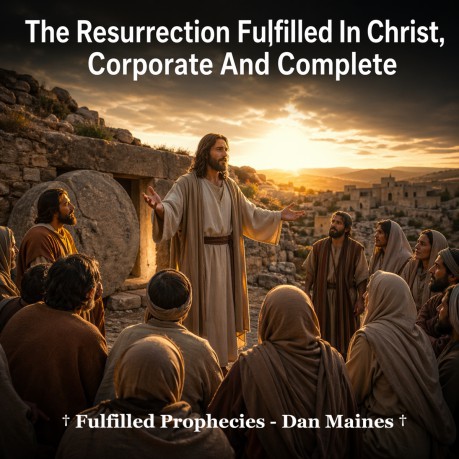
The
Resurrection Fulfilled In Christ, Corporate And Complete Introduction † The question
being asked is whether the resurrection is individual or corporate,
and whether it applied only to Old Covenant Israel, so we're going to
let Scripture answer that clearly and in context (1 Corinthians
15:12-23) † The
resurrection was never about decayed physical bodies coming out of
graves at the end of time, it was about the raising of a covenant
people from death into life in Christ (Ezekiel 37:11-14) † What we're
going to see is that the resurrection was both corporate in nature
and personally experienced, and that it was fulfilled in their
generation just as Jesus said (Matthew 24:34) 1
Corinthians 15:12-13 † Paul ties
the resurrection directly to Christ, meaning you can't separate the
resurrection of the people from the resurrection of Christ (1
Corinthians 15:20-23) † The issue
wasn't future biology, it was covenant life versus covenant death,
Christ brought life where there was death (Romans 6:4-5) † If Christ
was raised, then His body must also be raised, and that body is His
people (Ephesians 1:22-23) 1
Corinthians 15:22-23 † Notice the
timing, those who belong to Christ are made alive at His coming, not
thousands of years later (1 Corinthians 15:23) † His coming
was within that generation, meaning the resurrection had to be as
well (Matthew 16:27-28) † This shows a
corporate resurrection tied to a specific covenant transition, not an
ongoing endless event Daniel
12:1-2 † This is the
clearest Old Testament resurrection text, and it is tied to a
specific time, the time of the great tribulation (Daniel 12:1) † Jesus places
that same tribulation in His generation, proving the resurrection of
Daniel 12 belongs there as well (Matthew 24:21,34) † This locks
resurrection into the first century timeline, not a future event
1 Corinthians 15:42-44 † The contrast
is not between physical and non existence, but between natural and
spiritual, old covenant and new covenant (2 Corinthians 5:1-4) † The natural
body refers to the Adamic, earthly condition under the law, the
spiritual body is the corporate body of Christ (Romans 7:5-6) † This is why
Paul says flesh and blood cannot inherit the kingdom, it was about
covenant identity, not material substance (1 Corinthians 15:50) † Paul never
once says bodies come out of graves, he explains transformation, not
resuscitation (1 Corinthians 15:51-52) † The change
is from one covenant condition to another, not from corpse to flesh
again (2 Corinthians 5:17) † If this were
about physical bodies, then Paul contradicts himself when he says
flesh and blood cannot inherit the kingdom (1 Corinthians 15:50) Ezekiel
37:11-12 † God defines
the resurrection as the restoration of Israel, showing it is
covenantal and corporate (Ezekiel 37:11) † This wasn't
about literal graves opening worldwide, it was about a people being
brought from death to life (Hosea 6:1-2) † This same
language is used in the New Testament to describe what Christ
accomplished (John 5:24-25) John 5:24-25 Truly, truly, I say to you, a time is
coming and even now has arrived, when the dead will hear the voice of
the Son of God, and those who hear will live.
† Notice Jesus
said the hour is coming and now is, meaning the resurrection was
already beginning in His time (John 5:25) † This proves
it wasn't a distant future event, it was unfolding in that generation
(John 11:25-26) † Passing from
death to life is resurrection language, and it was happening then Ephesians
2:5-6 † Notice this
is already past tense, raised us up, not will raise us up (Ephesians
2:6) † This proves
resurrection was already in process before AD 70 and reached
completion at His coming † This is
corporate language, we were raised together as one body Revelation
20:4-5 † The first
resurrection is clearly spiritual, these are souls living and
reigning, not physical bodies walking around (Revelation 20:4) † This
resurrection happened in connection with judgment on the old system
(Revelation 19:1-3) † It shows
again that resurrection is about entering life in Christ, not future
grave resuscitation † If the first
resurrection is spiritual, then the second cannot suddenly switch to
physical without breaking the context (Revelation 20:5-6) † This
destroys the idea of a future physical resurrection at the end of
time Historical References † Josephus
describes Israel as being cut off and destroyed in AD 70, matching
the covenant death and judgment language found in Scripture (Wars of
the Jews, Book 6) † Eusebius
records that the church understood the fall of Jerusalem as the
fulfillment of Christ's words, including judgment and transition
(Ecclesiastical History, Book 3) † Early
writers like Clement of Alexandria spoke of resurrection in terms of
spiritual transformation rather than physical reconstruction † Irenaeus
connected resurrection language with the restoration and
transformation of God's people, not merely physical reanimation
(Against Heresies, Book 5) How It Applies To Us
Today † We're not
waiting for resurrection, we're living in it, we've already passed
from death into life in Christ (John 5:24) † Our identity
is not in Adam, but in Christ, meaning we are part of the raised,
living body now (1 Corinthians 15:22) † There's no
fear of future judgment or waiting for life, we already have it, and
we walk in it daily (Romans 8:1-2) † The kingdom
is present, the resurrection is complete, and we live as those who
have been made alive Q & A Appendix Q:
Is the resurrection individual or corporate? Q:
Was the resurrection only for Old Covenant Israel? Q:
Are we still waiting for resurrection today? Q:
What kind of body do we have now? Q:
What about people coming out of graves in Matthew 27? Q:
Does the Bible ever describe resurrection as corporate instead of
individual? Q:
If resurrection is corporate, how do individuals experience it? Q:
Why does Paul use singular language like the body in 1 Corinthians
15? Q:
Doesn't each in his own order prove individual resurrection? Q:
If this were about individual physical bodies, why does Paul never
mention graves opening? Q:
How does Ephesians prove a corporate resurrection? Q:
What is the strongest proof against the individual body view? Q:
Does Daniel 12 support corporate resurrection? Q:
Is the resurrection connected to the end of the Old Covenant? Q:
Why is the corporate body view stronger than the individual body
view? Q:
How does this affect how we read resurrection today? † This is the fulfilled
perspective we proclaim at Fulfilled Prophecies † Source Index † 1
Corinthians 15, Daniel 12:1-2, John 5:24-25, Ezekiel 37:11-12,
Ephesians 2:5-6, Revelation 20:4-5, Matthew 16:27-28, Matthew
24:21,34, Hebrews 9:26, Ephesians 2:6, 11-16 † Josephus,
Wars of the Jews, Book 6; Eusebius, Ecclesiastical History, Book 3;
Clement of Alexandria, Stromata; Irenaeus, Against Heresies, Book 5
By Dan Maines
Now
if Christ is preached, that He has been raised from the dead, how do
some among you say that there is no resurrection of the dead? But if
there is no resurrection of the dead, then not even Christ has been
raised;
For
as in Adam all die, so also in Christ all will be made alive. But
each in his own order: Christ the first fruits, after that those who
are Christ's at His coming,
"Now
at that time Michael, the great prince who stands guard over the sons
of your people, will arise. And there will be a time of distress such
as never occurred since there was a nation until that time; and at
that time your people, everyone who is found written in the book,
will be rescued. And many of those who sleep in the dust of the
ground will awake, these to everlasting life, but the others to
disgrace and everlasting contempt.
So
also is the resurrection of the dead. It is sown a perishable body,
it is raised an imperishable body; it is sown in dishonor, it is
raised in glory; it is sown in weakness, it is raised in power; it is
sown a natural body, it is raised a spiritual body. If there is a
natural body, there is also a spiritual body.
Then
He said to me, "Son of man, these bones are the entire house of
Israel; behold, they say, 'Our bones are dried up and our hope has
perished. We are completely cut off.' Therefore prophesy and say to
them, 'This is what the Lord God
says: "Behold, I am going to open your graves and cause you to
come up out of your graves, My people; and I will bring you into the
land of Israel.
"Truly,
truly, I say to you, the one who hears My word, and believes Him who
sent Me, has eternal life, and does not come into judgment, but has
passed out of death into life.
even when
we were dead in our wrongdoings, made us alive together with Christ
(by grace you have been saved), and raised us up with Him, and seated
us with Him in the heavenly places in Christ Jesus,
Then I
saw thrones, and they sat on them, and judgment was given to them.
And I saw the souls of those who had been beheaded because of their
testimony of Jesus and because of the word of God, and those who had
not worshiped the beast or his image, and had not received the mark
on their foreheads and on their hands; and they came to life and
reigned with Christ for a thousand years. The rest of the dead did
not come to life until the thousand years were completed. This is the
first resurrection.
A:
It's both, it's corporate as the body of Christ being raised, and
individual as each believer participates in that life (1 Corinthians
12:27; 1 Corinthians 15:23)
A:
It was centered on Israel because they were under the covenant of
death, but it opened the door for all nations to enter life in Christ
(Ephesians 2:11-16)
A:
No, Jesus said it was happening in His time, and Scripture shows it
was fulfilled at His coming (John 5:25; Matthew 16:27-28)
A:
A spiritual body, meaning we are part of Christ's living body, not
bound to the old covenant identity (1 Corinthians 15:44; Ephesians
2:6)
A:
That was a sign tied to Christ's death, not the final resurrection,
and it happened in that generation, not at the end of time (Matthew
27:52-53; Hebrews 9:26)
A:
Yes, very clearly. Ezekiel 37 defines resurrection as the whole house
of Israel being raised together, not individuals coming out of graves
one by one (Ezekiel 37:11-14). Paul carries that same idea forward by
calling believers one body in Christ, meaning the resurrection is the
raising of that body (1 Corinthians 12:27; Ephesians 2:5-6)
A:
Individuals participate by being placed into the body of Christ. When
the body is raised, everyone in it shares that life (1 Corinthians
12:13; Colossians 2:12-13). It is one resurrection with many
participants, not millions of separate events
A:
Because he is speaking of one corporate body, not billions of
separate physical bodies. He says it is sown and it is raised in the
singular, showing one covenant body being transformed (1 Corinthians
15:42-44). That matches his teaching that we are one body in Christ
(Romans 12:5)
A:
No, it shows sequence, not separation. Christ first, then those who
belong to Him at His coming, that is still one united resurrection
event tied to His return in that generation (1 Corinthians 15:23;
Matthew 16:27-28)
A:
Because that is not his subject. He explains transformation from
natural to spiritual, not bodies leaving tombs (1 Corinthians
15:51-52). The focus is covenant change, not biological revival
A:
Paul says God raised us up together and seated us together in Christ.
That is corporate language, not isolated individuals (Ephesians
2:5-6). The whole body is raised as one
A:
Paul says flesh and blood cannot inherit the kingdom of God. If
physical bodies were raised, they still could not enter the kingdom
(1 Corinthians 15:50). That forces the resurrection to be spiritual
and covenantal, not physical
A:
Yes, it speaks about your people being delivered and raised, tying
resurrection to the covenant people as a group, not isolated
individuals (Daniel 12:1-2)
A:
Yes, it is directly tied to the time of distress and deliverance of
Israel, which Jesus places in the destruction of Jerusalem (Matthew
24:21,34; Daniel 12:1-2). That marks the end of the Old Covenant and
the full establishment of the new
A:
Because every major resurrection text defines it in covenant, body,
and people language, not cemetery language. The Bible consistently
speaks of a people being raised, a body being transformed, and a
covenant being fulfilled, not skeletons being rebuilt (Ezekiel 37:11;
1 Corinthians 15:42-44; Ephesians 2:5-6)
A:
It removes the confusion of waiting for a future event and shows that
we are already part of the raised body in Christ. We live in
resurrection life now, not waiting for it later (John 5:24;
Colossians 3:1)
©
Fulfilled Prophecies - Dan Maines.
Links