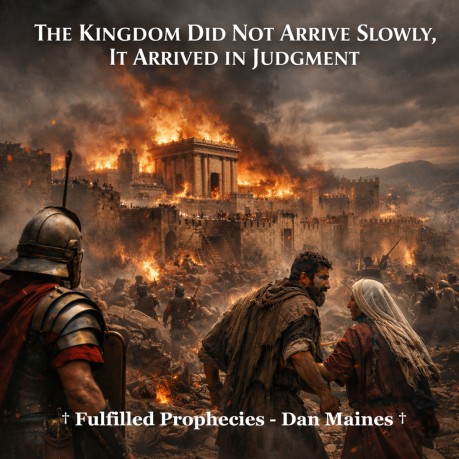
The Kingdom Did Not Arrive
Slowly, It Arrived In Judgment Introduction † The modern idea says the kingdom came slowly
over time, growing quietly until some future completion, but Jesus
never taught that (Luke 21:31-32). † He tied the arrival of the kingdom directly
to a visible, historical judgment that would happen in that
generation (Luke 21:32). † Luke 21 shows exactly when and how the
kingdom fully arrived, not gradually, but in a decisive end of the
old covenant system (Luke 21:22). Luke 21:20-22 † Jesus did not point to a distant future, He
gave a clear, observable sign, armies surrounding Jerusalem, showing
the kingdom would come through judgment (Luke 21:20). † He said these were days of punishment,
meaning God was executing covenant judgment against the old system
that had rejected Him (Deuteronomy 32:35; Hosea 9:7). † He declared that all things written would be
fulfilled in this event, not partially, not gradually, but completely
(Luke 21:22). † This is the moment the old covenant order
ended, and the kingdom stood fully established with nothing left to
replace (Hebrews 8:13). Luke 21:31-32 † Jesus tied the nearness of the kingdom
directly to the destruction events He just described, not to a slow
process over centuries (Luke 21:31). † He defined the timeframe clearly, this
generation, the very people hearing Him, would see it completed (Luke
21:32). † This destroys the idea of a delayed or still
future kingdom, because Jesus anchored it in a first century
fulfillment (Matthew 16:27-28). † The kingdom arrived when the old covenant
world was removed, not when it slowly developed over time (Daniel
2:44). † Jesus repeated this same time limit in
multiple places, confirming it was not symbolic language but a
literal timeframe (Matthew 24:34). † He also told His disciples some standing
there would see the kingdom come in power, proving it was within
their lifetime (Mark 9:1). Luke 21:25-27 † This language is prophetic judgment language
used throughout the Old Testament, not literal cosmic collapse
(Isaiah 13:10; Ezekiel 32:7-8). † The coming of the Son of Man in the clouds is
covenant judgment imagery, just like God coming in judgment against
nations before (Isaiah 19:1). † This was fulfilled in the destruction of
Jerusalem in AD 70, when Christ came in judgment against the system
that rejected Him (Matthew 24:30). † The kingdom did not wait for a future visible
descent, it was revealed in power through this judgment event (Luke
17:20-21). Luke 21:28 † Their redemption was tied to the same event,
the fall of Jerusalem, not something thousands of years later (Luke
21:28). † This was the deliverance from the old
covenant system and its bondage, into the fully established kingdom
(Galatians 4:4-5). † Redemption and judgment happened together,
one ending, one beginning, both in the same moment (Hebrews 9:26). Luke 17:20-21 † Jesus explicitly said the kingdom does not
come with visible observation, which destroys the idea of a slow
outward development over time (Luke 17:20). † He said it was already in their midst,
meaning it was present but not yet fully manifested until the
judgment event (Luke 17:21). † This proves the kingdom was not something
that would gradually become visible over centuries, but something
revealed in power at a specific moment (Luke 21:31). Hebrews 12:26-28 † The writer says the shaking was about to
remove the old covenant system so that the unshakable kingdom could
remain (Hebrews 12:27). † This connects directly to the destruction of
Jerusalem, where the old system was removed completely (Luke 21:22). † The kingdom is not in the process of
arriving, it is what remained after the shaking was finished (Hebrews
12:28). Historical References † Josephus records the Roman armies surrounding
Jerusalem and the complete destruction of the city and temple,
exactly as Jesus said, showing this was a real historical fulfillment
(Josephus, Wars 6.4-6). † Josephus describes the temple burning and the
city completely leveled, confirming that not one stone was left upon
another just as Jesus said (Josephus, Wars 6.4-6; Matthew 24:2). † The historical record shows famine, fear, and
mass death, matching the distress and fear described by Christ (Luke
21:25-26; Josephus, Wars 5.10). † Eusebius records that Christians fled
Jerusalem before its destruction, obeying the words of Christ,
confirming that believers understood this prophecy as immediate and
literal to their time (Eusebius, Ecclesiastical History 3.5). † Tacitus describes the chaos, fear, and
destruction in Judea, matching the distress of nations and fear Jesus
described (Tacitus, Histories 5.13). How It Applies To Us Today † The kingdom is not something we are waiting
to arrive, it already came in full power when the old covenant world
ended (Luke 21:31-32). † We are not living in a partial kingdom, we
are living in the established reign of Christ right now (Colossians
1:13). † There is no future destruction needed to
complete the kingdom, it was completed when all things were fulfilled
(Luke 21:22). † Our focus is not on waiting for the kingdom,
but living in it, understanding that Christ is already reigning (1
Corinthians 15:24-25). Q&A Appendix Q If the kingdom came in AD 70, why does it seem
like the world is still broken? A Jesus said His kingdom is not of this world
system, John 18:36, the kingdom is a spiritual reign that replaced
the old covenant system, not a political takeover of the planet. Q Does this mean prophecy is completely finished? A Yes, Jesus said all things written would be
fulfilled in those days, Luke 21:22, and confirmed it would happen in
that generation, Luke 21:32. Q What about the coming of Christ, wasn't that
supposed to be visible? A The coming in the clouds is judgment language,
just like Isaiah 19:1, and was fulfilled in the destruction of
Jerusalem, Matthew 24:30. Q Are we still waiting for redemption? A No, their redemption was near when those events
happened, Luke 21:28, and believers now live in that completed
redemption reality. Q If the kingdom came in judgment, does that mean
judgment is the same as the kingdom? A Judgment was the event that revealed the
kingdom, not the kingdom itself, God removed the old system so the
unshakable kingdom could stand fully established, Hebrews 12:27-28. Q If the kingdom arrived in AD 70, why did Jesus
say it was near before that? A Because it was about to be revealed in power,
Jesus said it was near, but tied its full arrival to the events they
would see, Luke 21:31, and those events ended the old system,
bringing the kingdom into full manifestation, Luke 21:22. Q Does this mean there is no future coming of
Christ at all? A The coming Jesus spoke of in Luke 21 was His
coming in judgment against Jerusalem, which happened in that
generation, Luke 21:27, 32, and that fulfilled what He said about
coming with power, Matthew 24:30. Q Why did Jesus connect the kingdom with
destruction instead of peace? A Because the old covenant system had to be
removed before the kingdom could stand alone, the judgment was
necessary to clear away what was passing so what could not be shaken
would remain, Hebrews 12:27-28. Q If the kingdom is here, where is it now? A The kingdom is not a physical location, it is
the reign of Christ among His people, Jesus said it was in their
midst, Luke 17:21, and believers are transferred into it now,
Colossians 1:13. Q What ended in AD 70 that made the kingdom fully
established? A The temple, priesthood, sacrifices, and the
entire old covenant order ended, fulfilling all that was written and
leaving only the unshakable kingdom, Luke 21:22, Hebrews 8:13. Q Does this mean we are already in the new
heavens and new earth? A Yes, the old covenant heaven and earth passed
away with that system, and the new covenant order remains, which
cannot be shaken, Hebrews 12:27-28. Q Why did Jesus warn people to flee if this was
about the kingdom? A Because the kingdom was revealed through
judgment, and those who believed Him escaped the destruction, showing
that His words were immediate and real to that generation, Luke
21:20-21. Q How do we know this was not symbolic or future? A Jesus gave clear signs they could see, armies
surrounding Jerusalem, and said it would happen in their generation,
which removes any possibility of it being pushed thousands of years
into the future, Luke 21:20, 32. † This is the fulfilled perspective we proclaim at
Fulfilled Prophecies † Source Index † Luke 21:20-32; Luke 17:20-21; Hebrews
12:26-28; Matthew 16:27-28; Matthew 24:2, 34; Matthew 24:30; Mark
9:1; Luke 21:25-28; Hebrews 8:13; Hebrews 9:26; Daniel 2:44; Isaiah
13:10; Isaiah 19:1; Ezekiel 32:7-8; Deuteronomy 32:35; Hosea 9:7;
Galatians 4:4-5; Colossians 1:13; 1 Corinthians 15:24-25; John 18:36 † Josephus, The Wars of the Jews, Book 5-6
By Dan Maines
But when you see Jerusalem
surrounded by armies, then recognize that her desolation is near.
Then those who are in Judea must flee to the mountains, and those who
are inside the city must leave, and those who are in the country must
not enter the city; because these are days of punishment, so that all
things which have been written will be fulfilled.
So you also, when you see
these things happening, recognize that the kingdom of God is near.
Truly I say to you, this generation will not pass away until all
things take place.
There will be signs in the sun
and moon and stars, and on the earth distress among nations, in
perplexity at the roaring of the sea and the waves, people fainting
from fear and the expectation of the things that are coming upon the
world; for the powers of the heavens will be shaken. And then they
will see the Son of Man coming in a cloud with power and great glory.
But when these things begin to
take place, straighten up and lift up your heads, because your
redemption is drawing near.
Now having been questioned by
the Pharisees as to when the kingdom of God was coming, He answered
them and said, 'The kingdom of God is not coming with signs to be
observed; nor will they say, "Look, here it is!" or, "There
it is!" For behold, the kingdom of God is in your midst.'
And His voice shook the
earth then, but now He has promised, saying, 'Yet once more I will
shake not only the earth, but also the heaven.' This expression, 'Yet
once more,' denotes the removing of those things which can be shaken,
as of created things, so that those things which cannot be shaken may
remain. Therefore, since we receive a kingdom which cannot be shaken,
let us show gratitude, by which we may offer to God an acceptable
service with reverence and awe.
© Fulfilled Prophecies - Dan
Maines.
†
Eusebius, Ecclesiastical History, Book 3
†
Tacitus, Histories 5.13
Links