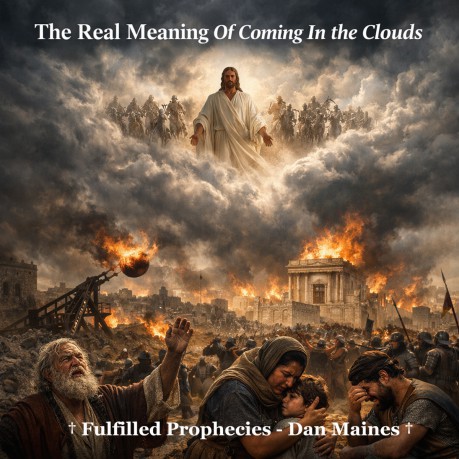
The Real Meaning Of Coming In
The Clouds Introduction † Most people hear coming in the clouds and
immediately think of a physical descent through the sky, but the
Bible defines its own language, and when we let scripture interpret
scripture, we see this is judgment language, authority language, not
a bodily return through the atmosphere (Matthew 24:30). † The Old Testament repeatedly uses cloud
coming language for God judging nations, and no one in those events
saw a literal body riding clouds, yet the judgment was real, visible,
and devastating (Isaiah 19:1). † If we ignore that foundation, we'll
misunderstand what Jesus said in His Olivet discourse, but if we
follow the pattern, everything lines up perfectly with the
destruction of Jerusalem in their generation (Matthew 24:34). Isaiah 19:1 The pronouncement concerning Egypt: Behold, the Lord is riding on
a swift cloud and is about to come to Egypt; The idols of Egypt will
tremble at His presence, And the heart of the Egyptians will melt
within them. † God is said to ride a cloud into Egypt, yet
this wasn't a physical appearance in the sky, it was judgment carried
out through nations, armies, and real historical events (Isaiah
19:1). † The Egyptians didn't look up and see a
visible form of God in the clouds, but they experienced His authority
and judgment unmistakably (Isaiah 19:1). † This establishes the pattern, cloud coming
equals divine judgment, not a literal sky event (Isaiah 19:1). Isaiah 13:9-13 Behold, the day of the Lord is coming, cruel, with fury and
burning anger, to make the land a desolation; and He will exterminate
its sinners from it. For the stars of heaven and their constellations
will not flash forth their light; the sun will be dark when it rises,
and the moon will not shed its light. Thus I will punish the world
for its evil, and the wicked for their iniquity; I will also put an
end to the arrogance of the proud and abase the haughtiness of the
ruthless. I will make mortal man scarcer than pure gold, and mankind
than the gold of Ophir. Therefore I will make the heavens tremble,
and the earth will be shaken from its place at the fury of the Lord
of hosts in the day of His burning anger. † This is judgment on Babylon, yet the sun,
moon, and stars are described as darkened, showing that cosmic
language is symbolic of national judgment (Isaiah 13:10). † No literal collapse of the universe happened,
but Babylon was destroyed, proving this language is covenantal and
political, not physical (Isaiah 13:9). † This directly connects to Matthew 24:29 and
prepares us to understand Jesus correctly (Matthew 24:29). Psalm 104:3 He lays the beams of His upper chambers in the waters; He makes
the clouds His chariot; He walks on the wings of the wind. † The clouds are described as God's chariot,
this is symbolic language showing sovereignty and movement in
judgment, not physical transportation like a man riding a vehicle
(Psalm 104:3). † This imagery reinforces that clouds represent
divine authority and presence, especially in acts of power and
judgment (Psalm 104:3). † When Jesus uses this same language, He's
drawing directly from this well-known Old Testament imagery (Psalm
104:3). Nahum 1:3 The Lord is slow to anger and great in power, And the Lord will by
no means leave the guilty unpunished. In the gale and the storm is
His way, And clouds are the dust beneath His feet. † The clouds are described as the dust of His
feet, again showing symbolic movement and presence, not a literal
physical form traveling in the sky (Nahum 1:3). † This reinforces that cloud language is poetic
and prophetic, used to describe God's authority in judgment (Nahum
1:3). † This is the same language Jesus uses, and His
audience would have understood it this way (Nahum 1:3). Daniel 7:13-14 I kept looking in the night visions, And behold, with the clouds
of heaven One like a son of man was coming, And He came up to the
Ancient of Days And was presented before Him. And to Him was given
dominion, Honor, and a kingdom, So that all the peoples, nations, and
populations of all languages Might serve Him. His dominion is an
everlasting dominion Which will not pass away; And His kingdom is one
Which will not be destroyed. † The Son of Man comes with the clouds, but
notice where He goes, not to earth, but to the Ancient of Days, this
is an ascension scene, not a descent (Daniel 7:13). † The coming in the clouds here is about
receiving authority, dominion, and kingship, not about traveling
through the sky to the planet (Daniel 7:14). † Jesus later applies this exact passage to
Himself, showing that His cloud coming is tied to His authority and
judgment, not a physical return (Matthew 26:64). Matthew 24:30 And then the sign of the Son of Man will appear in the sky, and
then all the tribes of the earth will mourn, and they will see the
Son of Man coming on the clouds of the sky with power and great
glory. † Jesus is quoting directly from Daniel 7, this
is about His authority being revealed in judgment, not Him physically
appearing in the sky (Matthew 24:30). † The tribes mourning matches Old Testament
judgment language, especially against Israel, not a global event but
a covenantal judgment on that nation (Zechariah 12:10-12). † They would see Him coming in the same way
Egypt saw God come, through destruction, through judgment, through
undeniable events in history (Matthew 24:30). Revelation 1:7 Behold, He is coming with the clouds, and every eye will see Him,
even those who pierced Him; and all the tribes of the earth will
mourn over Him. So it is to be. Amen. † This ties directly to those who pierced Him,
meaning the first century generation, not a distant future group
(Revelation 1:7). † The mourning tribes again point to Israel,
confirming this is covenant judgment language (Revelation 1:7). † This matches Matthew 24 perfectly and
confirms the timing (Matthew 24:30). Matthew 26:64 Jesus said to him, You have said it yourself. But I tell you, from
now on you will see the Son of Man sitting at the right hand of
power, and coming on the clouds of heaven. † Jesus told the high priest they would see
this, not people thousands of years later, but that very generation
standing before Him (Matthew 26:64). † The seeing here is not physical eyesight of a
body in the sky, but recognizing His authority in the judgment that
came upon Jerusalem (Matthew 26:64). † This was fulfilled when Jerusalem was
destroyed, proving He was exactly who He claimed to be (Matthew
24:34). Historical References † Josephus records the destruction of Jerusalem
in AD 70 as catastrophic, with signs, fear, and judgment that matched
the warnings Jesus gave (Josephus, Wars of the Jews, Book 6). † Josephus also records chariots and armies
seen in the clouds before the destruction, matching the prophetic
imagery of coming in the clouds (Josephus, Wars of the Jews, Book
6.5.3). † Eusebius confirms that Christians fled the
city before its destruction, recognizing the signs Jesus gave,
showing they understood His words as imminent judgment (Eusebius,
Ecclesiastical History 3.5). † Tacitus, a Roman historian, describes the
devastation and unusual events surrounding the fall of Jerusalem,
reinforcing that this was no ordinary event (Tacitus, Histories
5.13). How It Applies To Us Today † We don't wait for Jesus to come in the
clouds, He already came in judgment and authority, and His kingdom is
fully established (Matthew 28:18). † Christ is reigning now, seated in authority
over all things, not waiting to receive His kingdom (Ephesians
1:20-22). † Understanding this removes fear of future
speculation and grounds us in what Christ has already accomplished
(John 19:30). † We now live under His present reign, called
to walk in that reality, not looking for signs in the sky but living
in His finished kingdom (Ephesians 2:6). Q And A Appendix Q If this already happened, why do people still
expect a future coming? A Because they ignore Old Testament language and
read cloud coming as literal instead of symbolic, but scripture
defines it as judgment and authority, not physical descent (Isaiah
19:1; Daniel 7:13). Q Did anyone actually see Jesus in the clouds? A They saw the result of His coming, the
destruction of Jerusalem, which was the visible proof of His
authority and judgment (Matthew 24:30; Luke 21:20). Q What about Acts 1:9-11, doesn't it say He will
come in the same way? A The same way refers to cloud imagery and
authority, just as Daniel 7 shows, not a physical return to earth,
but His coming in power and judgment (Acts 1:9-11; Daniel 7:13). Q Does this mean Jesus is not returning at all? A It means His coming in the clouds was fulfilled
exactly as He said, in that generation, as a judgment event tied to
the end of the Old Covenant system (Matthew 24:34; Hebrews 8:13). Q If coming in the clouds is judgment language,
why do people picture a literal sky event? A Because they read the New Testament without the
Old Testament foundation, but the prophets already defined cloud
language as God's movement in judgment, not a physical appearance
(Isaiah 19:1; Nahum 1:3). Q What does it mean that the sign of the Son of
Man appears in heaven? A It means the sign was in heaven, not in the
sky, it was proof that Christ had taken His throne and was exercising
authority through judgment on Jerusalem (Matthew 24:30; Daniel
7:13-14). Q Why does it say all the tribes of the earth
will mourn? A The word earth is often land, referring to
Israel, and the tribes mourning connects directly to the tribes of
Israel in Zechariah, not the entire world (Zechariah 12:10-12;
Matthew 24:30). Q How could they see Him if it was not physical? A They saw Him the same way Egypt saw God come,
through the visible effects of judgment, destruction, and fulfilled
prophecy (Isaiah 19:1; Luke 21:20). Q Why is Daniel 7 so important to understanding
this? A Because Jesus is quoting it directly, and
Daniel shows the Son of Man coming to the Ancient of Days to receive
a kingdom, not coming down to earth (Daniel 7:13-14; Matthew 26:64). Q What proves this happened in the first century? A Jesus said those standing before Him would see
it, and He said all these things would happen in that generation,
which was fulfilled in AD 70 (Matthew 26:64; Matthew 24:34). Q Does this mean the coming of Christ was
invisible? A It means it was not a physical descent, but it
was very visible through the destruction of Jerusalem and the end of
the Old Covenant system (Luke 21:22; Hebrews 8:13). Q Why connect this to the destruction of
Jerusalem? A Because Jesus tied His coming, the tribulation,
and the judgment all to that same time period and generation (Matthew
24:21; Matthew 24:34). Q What role did Rome play in this coming? A Rome was the instrument of judgment, just like
other nations were used by God in the Old Testament, carrying out His
will against Jerusalem (Luke 21:20; Isaiah 10:5). Q How does this affect how we read prophecy
today? A It forces us to read prophecy through
scripture's own language instead of modern assumptions, recognizing
symbolic judgment language rather than expecting literal sky events
(Isaiah 13:10; Matthew 24:29). † This is the fulfilled perspective we proclaim at
Fulfilled Prophecies † Source Index † Isaiah 19:1; Isaiah 13:9-13; Psalm 104:3;
Nahum 1:3; Daniel 7:13-14; Matthew 24:30; Matthew 26:64; Revelation
1:7; Zechariah 12:10-12; Matthew 28:18; Ephesians 1:20-22; John
19:30; Ephesians 2:6; Luke 21:20; Hebrews 8:13; Acts 1:9-11 † Josephus, Wars of the Jews, Book 6; Eusebius,
Ecclesiastical History 3.5; Tacitus, Histories 5.13
By Dan Maines
© Fulfilled Prophecies - Dan
Maines.
Links