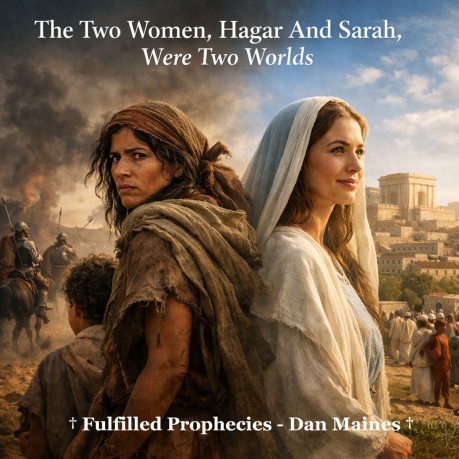
The
Two Women, Hagar And Sarah, Were Two Worlds Introduction † Paul didn't
give us an illustration just to make a point, he revealed two
covenant worlds that existed at the same time, one passing away and
one being established (Hebrews 8:13). † These two
women, Hagar and Sarah, represent two systems, two Jerusalems, and
two outcomes, bondage or freedom (Galatians 4:24-26). † The key is
this, both covenants were present together until the bondwoman was
cast out, and that casting out reached its full end in AD 70 (Matthew
21:43). Galatians 4:21-31
21 Tell me, you who want to be under law, do you not listen to
the Law? 22 For it is written that Abraham had two sons, one by
the slave woman and one by the free woman. 23 But the son by the
slave woman was born according to the flesh, and the son by the free
woman through the promise. 24 This is speaking allegorically,
for these women are two covenants: one coming from Mount Sinai giving
birth to children who are to be slaves; she is Hagar. 25 Now
this Hagar is Mount Sinai in Arabia and corresponds to the present
Jerusalem, for she is enslaved with her children. 26 But the
Jerusalem above is free; she is our mother. 27 For it is
written: "Rejoice,
infertile one, you
who do not give birth;
28 And you, brothers and sisters, like Isaac, are children of
promise. 29 But as at that time the son who was born according
to the flesh persecuted the one who was born according to the Spirit,
so it is even now. 30 But what does the Scripture say? "Drive
out the slave woman and her son, 31 So
then, brothers and sisters, we are not children of a slave woman, but
of the free woman. † Paul says
these are two covenants, not future, not symbolic only, but present
realities in his time (Galatians 4:24). † Hagar
represents Sinai, the Law, and the Jerusalem that now is, meaning
first century earthly Jerusalem still standing at that time
(Galatians 4:25). † Sarah
represents the Jerusalem above, the new covenant people, already
existing while the old covenant still stood (Galatians 4:26). † Paul says
the Jerusalem above is our mother, present tense, meaning believers
were already part of that covenant world before AD 70 (Galatians
4:26). † This matches
Hebrews 12:22, where believers had already come to the heavenly
Jerusalem, not waiting for it later. † This proves
two worlds coexisted, the old covenant world of bondage and the new
covenant world of promise (Hebrews 12:22-24). † The
persecution Paul mentions shows conflict between these two worlds
happening in real time, not something pushed thousands of years into
the future (Galatians 4:29). † The command
to cast out the bondwoman wasn't future, it was imminent, and it
pointed directly to the removal of the old covenant system (Galatians
4:30). † The law
system tied to Hagar depended on the temple, priesthood, and
sacrifices, and when the temple fell, that entire system ended
permanently (Hebrews 7:12). † With no
temple standing after AD 70, the covenant represented by Hagar could
no longer function, proving it was fully cast out (Hebrews 10:1-4). † That casting
out was fulfilled when Jerusalem was destroyed and the temple system
ended in AD 70 (Matthew 24:2). † The son of
the bondwoman could not inherit with the son of the freewoman,
meaning the old covenant could not continue alongside the new forever
(Hebrews 10:9). † This wasn't
about individuals being removed, it was about a covenant system being
judged and removed (Romans 7:4-6). † The old
covenant world was fading and ready to vanish even while it still
stood physically (Hebrews 8:13). † Isaiah
foretold the removal of the old covenant system and the increase of
the children of promise, which Paul directly quotes to prove this
transition (Isaiah 54:1). † AD 70 was
the moment the casting out was completed, removing the old covenant
entirely and leaving only the new covenant standing (Luke 21:22). The Two Sons And Their
Two Outcomes † Abraham had
two sons, Ishmael and Isaac, and their lives show the direction and
outcome of the two covenant worlds (Galatians 4:22-23). † Ishmael was
born after the flesh, meaning he came through human effort and
natural means, just like the law covenant that depended on human
obedience (Galatians 4:23). † Isaac was
born through promise, meaning his birth came by God's power, just
like the new covenant which is based on promise, not human works
(Galatians 4:23). † Ishmael
mocked and persecuted Isaac, showing how the old covenant system
opposed the people of promise in the first century (Galatians 4:29). † This wasn't
just a family conflict, it was a prophetic picture of two covenant
paths moving in opposite directions (Genesis 21:9). † Ishmael and
his mother were cast out, showing that the covenant of the flesh
would not inherit with the covenant of promise (Genesis 21:10). † Isaac
remained and inherited, showing that the covenant of promise would
continue and prevail (Genesis 21:12). † One son led
to bondage and was removed, the other led to freedom and remained,
showing two completely different destinies (Galatians 4:30-31). † This proves
the issue was never about both continuing together, one had to be
removed for the other to fully stand (Hebrews 10:9). † The same
pattern reached its full fulfillment in AD 70, when the old covenant
system was cast out and the promise fully remained (Luke 21:22). Historical References † Josephus
records the destruction of Jerusalem and the temple, showing the
complete end of the old covenant system in AD 70 (Josephus, Wars of
the Jews, Book 6). † Eusebius
confirms that the church recognized the destruction of Jerusalem as
divine judgment and a turning point in covenant history (Eusebius,
Ecclesiastical History 3.5). † Early
Christians fled Jerusalem before its destruction, recognizing the end
of that covenant system, as recorded by Eusebius (Ecclesiastical
History 3.5). † Tacitus, a
Roman historian, documents the same destruction, confirming the
historical reality of what Jesus and Paul spoke about (Tacitus,
Histories 5.13). How It Applies To Us
Today † We're not
living in a mixed covenant world, the bondwoman has already been cast
out, and only the covenant of promise remains (Galatians 4:31). † There's no
return to law, temple, or old covenant system because it has been
fully removed (Hebrews 10:18). † Our identity
is rooted in the freewoman, not bondage, meaning we live in the
fullness of what Christ established (Romans 8:2). † The conflict
Paul described has already been resolved, we now stand in the
completed kingdom where the old has passed and the new remains (2
Corinthians 5:17). † Understanding
this frees us from confusion about future judgments tied to the old
covenant, because those things were fulfilled in their generation
(Matthew 24:34). Q & A Appendix Q
If both covenants existed at the same time, why don't we see that
today? Q
What does it mean to cast out the bondwoman? Q
Was this about individuals being rejected? Q
How do we know this was fulfilled in AD 70? Q
Why do many still think this is future? Q
Does this mean physical Israel no longer has a covenant role? Q
Why does Paul call it an allegory if it's based on real history? Q
What does Jerusalem that now is specifically refer to? Q
What does Jerusalem above mean in practical terms? Q
Why couldn't the two covenants continue together permanently? Q
What role did persecution play in identifying the two covenants? Q
How does this relate to the end of the age Jesus spoke about? Q
Why is inheritance such a major theme in this passage? Q
Does this teaching eliminate the importance of the Old Testament? Q
What does it mean that we are children of promise? Q
How does this passage connect to the new creation? Q
Why did Paul emphasize this so strongly to the Galatians? Q
How does this passage prove fulfillment instead of futurism? † This is the fulfilled
perspective we proclaim at Fulfilled Prophecies † Source Index † Galatians
4:21-31; Hebrews 8:13; Matthew 21:43; Hebrews 12:22-24; Matthew 24:2,
34; Hebrews 10:9, 18; Romans 7:4-6; Luke 21:22; Isaiah 54:1; Hebrews
7:12; Hebrews 10:1-4; 2 Corinthians 5:17; Galatians 3:28-29; Genesis
21:9-12 † Josephus,
Wars of the Jews, Book 6; Eusebius, Ecclesiastical History 3.5;
Tacitus, Histories 5.13
By Dan Maines
Break
forth and shout, you
who are not in labor;
For
the children of the desolate one are more numerous
Than
those of the one who has a husband."
For
the son of the slave woman
shall not be an heir with the son of the free woman."
A
Because the old covenant was removed in AD 70. Hebrews 8:13 says it
was becoming obsolete and ready to vanish away, and that happened
when the temple was destroyed.
A
It means the complete removal of the old covenant system. Galatians
4:30 connects directly to the end of the law system, and Hebrews 10:9
says He takes away the first to establish the second.
A
No, it was about a covenant system. Romans 7:4-6 shows we died to the
law so we could belong to another, Christ.
A
Jesus tied the destruction of Jerusalem to the end of that age in
Matthew 24:2 and Luke 21:22, calling it days of vengeance when all
things written would be fulfilled.
A
Because they separate the covenants and ignore that Paul said both
existed in his present time. Galatians 4:25 says Jerusalem that now
is, not future.
A
The covenant tied to Sinai ended when it was cast out. Galatians 4:30
says the bondwoman would not inherit. The promise continues in
Christ, not through the old covenant system, as seen in Galatians
3:28-29.
A
Because Paul is showing that real historical events were designed by
God to reveal covenant truth. Galatians 4:24 says these things
contain an allegory, meaning the history of Hagar and Sarah pointed
forward to the two covenants.
A
It refers to the first century city of Jerusalem still standing under
the law system. Galatians 4:25 says she is in bondage with her
children, showing it was a present reality in Paul's time.
A
It refers to the new covenant people in Christ, not a physical city
in the sky. Hebrews 12:22 says believers had already come to Mount
Zion and the heavenly Jerusalem.
A
Because they operate on completely different foundations, one based
on law and the other on promise. Hebrews 10:9 says He takes away the
first to establish the second.
A
The persecution revealed which covenant someone belonged to.
Galatians 4:29 shows the one born after the flesh persecuted the one
born after the Spirit, just like the Jews persecuted the church.
A
The end of the age was the end of the old covenant age, not the end
of the physical world. Matthew 24:3 connects the end of the age with
the destruction of the temple.
A
Because covenant determines inheritance. Galatians 4:30 says the son
of the bondwoman shall not inherit, showing only those in the promise
receive what God established.
A
No, it shows its purpose was fulfilled. Romans 15:4 says the things
written before were for our learning, and Galatians 3:24 says the law
was our tutor to lead us to Christ.
A
It means our standing with God comes through what He promised and
fulfilled in Christ, not through law-keeping. Galatians 4:28 connects
believers directly to Isaac as children of promise.
A
The removal of the old covenant made way for the new. 2 Corinthians
5:17 says if anyone is in Christ, he is a new creature, the old
things passed away.
A
Because they were being pressured to return to the law. Galatians 5:1
warns them to stand fast in liberty and not be entangled again in a
yoke of bondage.
A
Because Paul says these two covenants existed at that present time.
Galatians 4:25 uses present tense language, showing this wasn't a
future-only concept.
©
Fulfilled Prophecies - Dan Maines.
Links