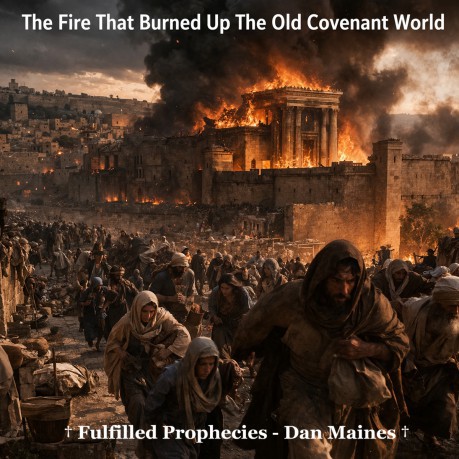
The Fire That Burned Up The
Old Covenant World Introduction † When Peter spoke about the heavens passing
away and the elements melting with fervent heat, he wasn't describing
the end of the physical planet, he was describing the end of the Old
Covenant world centered in Jerusalem (2 Peter 3:10). 2 Peter 3:10-12 Since all these things are going to be destroyed in this way, what
sort of people ought you to be in holy conduct and godliness, looking
for and hastening the coming of the day of God, because of which the
heavens will be set ablaze and will be dissolved, and the elements
will be melted with intense heat? † The "day of the Lord" is not the
end of the physical world, it is a well-established phrase for
covenant judgment on a nation, especially Israel (Isaiah 13:6-13;
Joel 2:1-11). † Paul uses the same word "elements"
to describe the bondage of the law, showing this is covenant
language, not scientific terminology (Galatians 4:9). † The word translated "elements" is
the Greek word Stoicheion, and this is critical to understanding what
is actually being destroyed (2 Peter 3:10). Galatians 4:3 † Stoicheion here clearly refers to bondage
under the Old Covenant system, not physical matter (Galatians 4:1-5). Galatians 4:9 † These elemental principles are something
people return to, proving they are religious systems, not atoms
(Galatians 4:10). Colossians 2:8 † Stoicheion is tied to traditions of men and
religious systems, not the physical universe (Colossians 2:22). Colossians 2:20 † You are not dying to physical creation, you
are dying to a covenant system, proving these elements are covenantal
(Romans 7:4-6; Colossians 2:20).
Hebrews 5:12 † Stoicheion is defined as elementary teachings
or principles, not physical elements (Hebrews 6:1). † Now here's the question that exposes the
whole misunderstanding, how can a principle melt with intense heat (2
Peter 3:10)? † Peter compares this judgment to the flood,
but the flood did not destroy the physical planet, it destroyed a
world order, a society of people (2 Peter 3:5-6). Isaiah 34:4 † This language was used for the judgment of
Edom, yet the physical sky did not literally roll up (Isaiah
34:5-6). Malachi 4:1 † This prophecy speaks of a coming fiery
judgment upon Israel, fulfilled in the first century (Matthew
3:10-12). Matthew 24:16 † Jesus told them to flee, which makes no sense
if the entire planet was going to burn (Matthew 24:15-16). Hebrews 12:27-28 Therefore, since we receive a kingdom which cannot be shaken, let
us be thankful, and through grace, let us serve God acceptably with
reverence and awe. † The writer of Hebrews explains the same event
as a "shaking," not the destruction of the planet (Haggai
2:6-7). † Peter said these things were about to happen
and tied them to the same coming Jesus spoke of, which was to occur
in that generation (2 Peter 3:3-4; Matthew 24:34). Historical References † Josephus describes the destruction of
Jerusalem in AD 70 as a fiery judgment where the temple and city were
completely consumed (Josephus, Wars of the Jews, Book 6). How It Applies To Us Today † We are not waiting for the world to burn,
that judgment already happened in the first century (2 Peter 3:10). Q & A Appendix Q What does Stoicheion mean in 2 Peter 3? Q How can elements melt if they are principles? Q Why did Jesus tell people to flee if the earth
was going to burn? Q What exactly was destroyed in 2 Peter 3? Q Does "elements melting" mean the
periodic table elements are burning? Q Why does Peter use fire language if it's not
literal? Q What does "the earth and the works in it
will be exposed" mean? Q How do we know Peter is not talking about the
end of the world? Q What are the "heavens" that passed
away? Q What are the "elements" that were
destroyed? Q Why compare it to the flood if it's not global
destruction? Q If this already happened, why do people still
expect a future event? Q What was actually burned in AD 70? Q Does this mean the physical earth will never be
destroyed? † This is the fulfilled perspective we proclaim at
Fulfilled Prophecies † Source Index † 2 Peter 3:10-12; Galatians 4:3, 9; Colossians
2:8, 20; Hebrews 5:12; Hebrews 6:1; Hebrews 7:18-19; Hebrews 8:13;
Hebrews 12:27-28; Isaiah 34:4-6; Isaiah 13:10; Matthew 23:36; Matthew
24:15-16, 34; Luke 21:20-21, 32; Haggai 2:6-7; Romans 7:4-6;
Galatians 2:19; Colossians 2:14, 22; Genesis 8:21-22; Ecclesiastes
1:4; 2 Peter 3:3-6; Deuteronomy 31:28 † Josephus, Wars of the Jews, Book 6; Tacitus,
Histories 5.13; Eusebius, Ecclesiastical History, Book 3
By Dan Maines
†
The Bible consistently uses fire and melting language for covenant
judgment, not literal destruction of the earth (Isaiah 13:6-13; Joel
2:1-11).
† If we read 2 Peter 3 in light of
the Old Testament, it becomes clear this is fulfilled prophetic
language, not a future global catastrophe (2 Peter 3:2).
But the day of the Lord will
come like a thief, in which the heavens will pass away with a roar
and the elements will be destroyed with intense heat, and the earth
and the works that are in it will be exposed.
† The "heavens"
represent the ruling authority of Israel, the leadership, priesthood,
and temple system (Isaiah 1:2; Matthew 23:35-36).
†
The "earth" represents the covenant people under that
system, not the physical planet (Deuteronomy 31:28; Isaiah 1:2).
†
The "elements" refers to the basic principles of the Old
Covenant law system, not atomic particles (Galatians 4:3; Colossians
2:8, 20).
†
The melting with intense heat is symbolic of judgment, just like when
God judged nations using the same kind of language (Isaiah 34:4;
Nahum 1:5).
† Peter is pulling directly from
Old Testament prophetic language, not introducing a new idea about
the destruction of the universe (2 Peter 3:2).
†
Stoicheion appears seven times in the New Testament, and not one time
does it refer to physical elements of the earth or universe
(Galatians 4:3; Colossians 2:8; Hebrews 5:12).
†
Without studying Stoicheion, people assume Peter is talking about the
planet burning, but scripture already defines the word for us (2
Peter 3:16).
So also we, when we were
children, were enslaved under the elemental principles of the world.
But now that you have come to
know God—or rather to be known by God—how is it that you turn
back again to the weak and worthless elemental principles of the
world, to which you desire to be enslaved once more?
See to it that no one takes
you captive through philosophy and empty deception, according to the
tradition of men, according to the elemental principles of the world,
rather than according to Christ.
If you have died with Christ
to the elemental principles of the world, why, as if you were still
living in the world, do you submit to regulations?
For though by this time you
ought to be teachers, you have need again for someone to teach you
the elementary principles of the oracles of God, and you have come to
need milk and not solid food.
† It can't physically, because
Peter is using prophetic language describing the destruction of a
covenant system, not a planet (Isaiah 34:4).
†
The things being destroyed were the very elements listed in these
passages, the law, ordinances, traditions, and Old Covenant structure
(Hebrews 8:13; Colossians 2:14).
†
The "world" that perished in Noah's day was the people and
system, not the earth itself, since the earth remained after the
flood (Genesis 8:21-22).
† This establishes
the pattern, world-ending language refers to covenantal or societal
destruction, not the annihilation of the planet (Ecclesiastes 1:4).
All the host of heaven will be
dissolved, and the heavens will be rolled up like a scroll; all their
stars will fall like the withered leaves from the vine, and like the
fallen figs from the fig tree.
† This proves that "heavens
dissolving" is symbolic of political and covenantal collapse
(Isaiah 13:10).
† Peter is using the same
imagery, applying it to the destruction of Jerusalem and the Old
Covenant system (2 Peter 3:10).
For behold, the day is coming,
burning like a furnace, when all the arrogant and all who do evil
will be stubble; and the day that is coming will set them ablaze,
says the Lord of hosts, so that it will leave them neither root nor
branch.
† Jesus tied this judgment directly
to His generation (Matthew 23:36).
† The fire
is not literal combustion of the earth, it is the complete removal of
the Old Covenant order (Hebrews 8:13).
But when you see the
abomination of desolation, which was spoken of by Daniel the prophet,
standing in the holy place (let the reader understand), then those
who are in Judea must flee to the mountains.
†
You can't escape global destruction by running to the mountains, this
was a localized covenant judgment (Luke 21:20-21).
†
This proves the fire of judgment was focused on Jerusalem and its
system, not the earth itself (Matthew 23:36).
†
If the earth was going to be burned up, there would be nowhere to
flee, yet Jesus told them to flee, proving this was a localized
judgment, not global destruction (Matthew 24:16; Luke 21:20-21).
Now this phrase, 'Yet once
more,' indicates the removal of things that are shaken, as of created
things, so that the things which cannot be shaken may remain.
† What was removed was the Old
Covenant system, what remained was the unshakable kingdom of Christ
(Hebrews 8:13).
† This matches Peter's
description of elements dissolving, it is covenant transition
language (2 Peter 3:10-12).
†
Moses called Israel "heaven and earth," showing this
language refers to a covenant people, not the physical universe
(Deuteronomy 31:28).
† This proves Peter is
using established covenant language, not introducing a new idea about
the destruction of the planet (2 Peter 3:2).
†
Tacitus records the Roman assault and burning of the temple,
confirming the historical fulfillment of this prophecy (Tacitus,
Histories 5.13).
† Eusebius affirms that
these events fulfilled Jesus' warnings about that generation
(Eusebius, Ecclesiastical History, Book 3).
†
We live in the unshakable kingdom that cannot be destroyed,
established after the Old Covenant was removed (Hebrews 12:28).
†
This gives us confidence and clarity, we are not looking for
destruction, we are living in fulfillment (Luke 21:32).
†
It calls us to holy living because we are already part of God's
eternal kingdom (2 Peter 3:11).
† The Old
Covenant world was consumed in fire in AD 70, and what remained is
the unshakable kingdom we live in today (Hebrews 12:28).
A
It means elemental principles or basic components of a system,
referring to the Old Covenant law and its ordinances, not physical
elements (Galatians 4:3; Colossians 2:20).
A
The melting is symbolic language for judgment and removal, just like
Old Testament prophecies describing nations falling (Isaiah 34:4).
A Because the judgment was
local to Judea and Jerusalem, not global, confirming this was
covenant judgment (Luke 21:20-21).
A
The Old Covenant world, including the temple, priesthood, law system,
and all its ordinances (Hebrews 8:13; Colossians 2:14).
A No, the
Greek word Stoicheion is never used for physical elements in the New
Testament, it always refers to basic principles or systems,
especially the Old Covenant law (Galatians 4:3; Colossians 2:8;
Hebrews 5:12).
A Because the Old Testament repeatedly
uses fire to describe covenant judgment on nations, not literal
destruction of the planet (Isaiah 34:4; Malachi 4:1).
A It means the
works of the Old Covenant system, especially centered in Jerusalem,
were brought to judgment and laid bare (Ecclesiastes 12:14; Hebrews
4:13).
A Because he is quoting Old
Testament prophetic language that was always used for national
judgment, not the end of the physical creation (Isaiah 13:10; Isaiah
34:4).
A They represent the ruling authority and
covenant structure of Israel, including the priesthood and temple
system (Isaiah 1:2; Matthew 23:35-36).
A The elementary principles of the
Old Covenant system, the law, ordinances, and traditions that people
were in bondage to (Galatians 4:3; Colossians 2:20).
A Because the flood destroyed a
world of people and a system, not the planet itself, and Peter is
using that same pattern (2 Peter 3:5-6; Genesis 8:21-22).
A Because they read the
language literally instead of understanding how the Bible uses
symbolic and covenantal language for judgment (2 Peter 3:16).
A
The temple, the city of Jerusalem, and the entire Old Covenant system
that depended on it (Matthew 24:2; Hebrews 8:13).
A Scripture teaches the earth
remains, while covenant worlds rise and fall (Ecclesiastes 1:4; Psalm
104:5).
© Fulfilled Prophecies - Dan
Maines.
Links