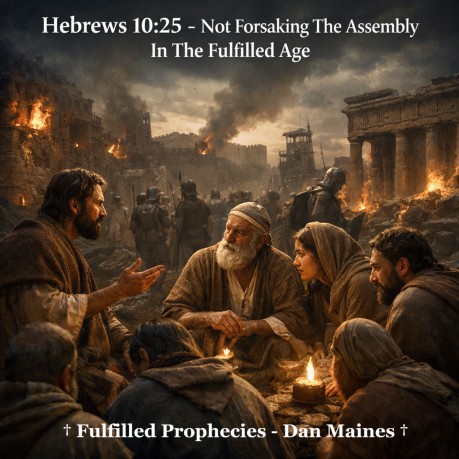
Hebrews 10:25 - Not Forsaking
The Assembly In The Fulfilled Age Introduction † Hebrews 10:25 is constantly used today to
push church attendance, but when we read it in its full context, it's
speaking to a very specific time, a very specific people, and a very
specific approaching day. † The writer of Hebrews was addressing first
century believers who were standing at the edge of covenant
transition, the Old Covenant was fading, the New Covenant was about
to be fully established. † This verse isn't about modern institutional
gatherings, it's about remaining faithful during the final days of
the Old Covenant system that was about to vanish. † The entire letter of Hebrews opens by placing
them in the last days of that Old Covenant age, showing the urgency
of everything being written (Hebrews 1:2). Hebrews 10:25 † The immediate context shows this is about
covenant access and confidence before God, not a weekly meeting
structure (Hebrews 10:19-22). † The "assembling together" was not
about attending a weekly building service, it was about remaining
united in Christ during a time of intense pressure and persecution
(Hebrews 10:23-24). † Many were being tempted to return to the
temple system, the sacrifices, and the Old Covenant practices, this
warning was telling them not to abandon the body of Christ for a
system that was about to be destroyed (Hebrews 10:1-3). † "The day drawing near" was not a
future end of the world, it was the imminent judgment coming upon
Jerusalem in AD 70 (Matthew 24:34). † The writer makes the timing undeniable by
saying it would happen in a very little while, not thousands of years
later (Hebrews 10:37). † They could literally see the signs of that
day approaching, just as Jesus said they would (Luke 21:20-22). † This was about staying grounded in the New
Covenant reality and not drifting back into a system that could no
longer give life (Hebrews 8:13). † The exhortation to encourage one another was
critical because the pressure to fall away was real and increasing as
that day approached (Hebrews 3:12-14). Historical References † Eusebius recorded that believers in Judea
fled before the destruction of Jerusalem, showing they recognized the
approaching day and remained faithful instead of returning to the
temple system (Eusebius, Ecclesiastical History 3.5). † Josephus described the chaos, famine, and
destruction leading up to AD 70, confirming the severity of the
judgment that was drawing near (Josephus, Wars of the Jews, Book 6). † Tacitus also recorded the destruction of
Jerusalem, reinforcing that this was a real historical event, not a
future global end (Tacitus, Histories 5.13). † Early Christian writings like the Didache
reflect the expectation of imminent fulfillment, showing the early
believers lived with urgency consistent with the timing statements in
Hebrews (Didache 16). How it applies to us today † We're not waiting for that day, it already
happened, the Old Covenant system is gone, and the New Covenant is
fully established. † Today, assembling isn't about a location,
it's about our identity and unity in Christ, we're already part of
His body (Ephesians 2:19-22). † We still encourage one another, but not out
of fear of a coming destruction like they faced, instead it's because
we're living in the fullness of what Christ already accomplished. † Encouragement still matters, but it's no
longer tied to watching for an approaching covenant judgment, it's
grounded in the finished work of Christ. † We don't go back to dead systems, traditions,
or man-made religion, because those things were fulfilled and removed
(Colossians 2:14). † Our focus is staying grounded in the finished
work of Christ, not trying to rebuild what God already judged and
removed. Q & A Appendix Q: Does this verse command us to attend church
buildings every week? Q: What is "the day" in Hebrews
10:25? Q: Are believers today still supposed to
gather? Q: Does "assembling together" mean a
physical gathering only? † This is the fulfilled perspective we proclaim at
Fulfilled Prophecies † Source Index † Hebrews 10:25; Hebrews 10:19-22; Hebrews
10:23-24; Hebrews 10:1-3; Hebrews 10:37; Hebrews 8:13; Hebrews
3:12-14; Hebrews 1:2; Matthew 24:34; Luke 21:20-22; Ephesians
2:19-22; Hebrews 12:22-24; Colossians 2:14 † Eusebius, Ecclesiastical History 3.5;
Josephus, Wars of the Jews Book 6; Tacitus, Histories 5.13; Didache
16
By Dan Maines
not abandoning our own
assembling together, as is the habit of some people, but encouraging
one another, and all the more as you see the day drawing near.
A: No. The context shows
it was about first century believers remaining faithful and not
returning to the Old Covenant system as judgment approached (Hebrews
10:1-3, Hebrews 8:13).
A: It is the judgment on Jerusalem in AD
70, which Jesus said would happen in that generation (Matthew 24:34,
Luke 21:20-22).
A: Yes, but not as a requirement tied
to salvation or fear of judgment, we gather in unity as the body of
Christ because we are already established in Him (Ephesians 2:19-22).
A: No, the focus is
covenantal unity in Christ, not a location or building, we are
already gathered in Him (Ephesians 2:19-22, Hebrews 12:22-24).
© Fulfilled Prophecies - Dan
Maines.
Links