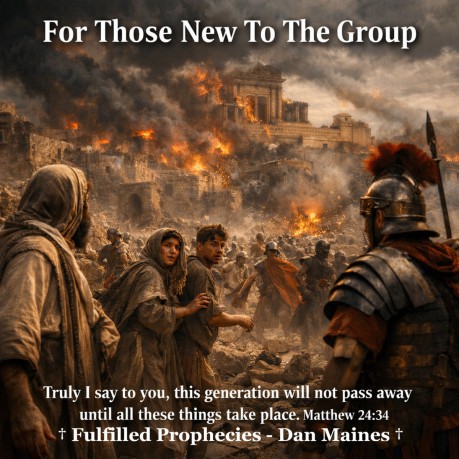
For
Those New To The Group Introduction † This
group is about eschatology, and we're not guessing about the future,
we're standing on what Jesus already said and what Scripture confirms
was fulfilled. † Eschatology
simply means the study of last things, but from the fulfilled
perspective, we're not looking ahead to unfinished prophecy, we're
looking back at what was completed in the first century just as Jesus
said. † This
group takes Jesus at His word, we don't stretch His timing, we don't
redefine generation, and we don't move His promises thousands of
years into the future. † As
the group grows, more posts are being denied. Every post MUST
include Scripture because truth is established by the Word of God,
not opinions. † If
you want your posts approved, base them on clear time statements from
Jesus and the apostles, because Scripture interprets Scripture. † When
we say fulfilled, we mean fulfilled in the first century, especially
in the destruction of Jerusalem in AD 70, exactly as Jesus prophesied
(Luke 21:20-22). The
Time Statements Of Jesus And Fulfillment Matthew
10:23 † Jesus
told His apostles they wouldn't finish preaching in Israel before He
came, that's a direct time limit placed in their lifetime (Matthew
10:23). † That
means His coming wasn't thousands of years away, it was imminent to
those He was speaking to (Luke 18:7-8). † If
that didn't happen in their lifetime, then His words failed, and we
know that's not possible (John 14:29). Matthew
16:27-28 † Jesus
clearly said some standing there wouldn't die before seeing His
coming, that's not symbolic language, that's a real time indicator
(Matthew 16:28). † That
places His coming firmly in the first century, within the lifetime of
His disciples (Mark 9:1). † This
aligns perfectly with the judgment on Jerusalem in AD 70, where He
came in judgment just like the prophets described (Isaiah 19:1). Matthew
21:43-45 † The
leaders knew Jesus was talking about them, not a future group
thousands of years later (Matthew 21:45). † That
judgment fell on that same generation that rejected Him (Matthew
23:38). † The
kingdom was transferred to a new covenant people producing fruit, the
church (1 Peter 2:9). Matthew
23:35-36 † Jesus
said all that guilt would come on that generation, not a future one
(Matthew 23:36). † That
includes all covenant judgment culminating in AD 70 (Luke 11:50-51). † You
can't move generation 2000 years forward without changing His words. Matthew
24:34 † Jesus
said all things would happen before that generation passed, not some
things, all things (Matthew 24:34). † That
includes His coming, judgment, and the end of the old covenant age
(Hebrews 8:13). † The
destruction of Jerusalem was the visible end of that age (Luke
21:20-22). Matthew
26:64 † Jesus
told the high priest he would see it, meaning it would happen before
he died (Matthew 26:64). † Coming
on clouds is judgment language used throughout the Old Testament
(Isaiah 19:1). † This
was fulfilled when Jerusalem was destroyed and the temple system
ended. Luke
21:22 † All
things written were fulfilled in those days, not partially fulfilled,
not delayed (Luke 21:22). † This
ties directly to the destruction of Jerusalem (Luke 21:20). † There's
no room left for unfinished prophecy after that statement. Luke
21:32 † Again,
Jesus repeats it for clarity, all things fulfilled in that generation
(Luke 21:32). † Repetition
shows emphasis, not uncertainty. † This
confirms the timeline without any ambiguity. Mark
1:14-15 † Jesus
said the time is fulfilled, not starting, not delayed, fulfilled
(Mark 1:15). † The
kingdom was at hand, meaning it was arriving in their lifetime
(Matthew 12:28). † This
sets the stage for everything that followed, leading up to AD 70. Additional
Scriptures Confirming Fulfillment Hebrews
1:1-2 † The
writer says they were already in the last days, not waiting for them
(Hebrews 1:2). † That
places the end of the age in the first century (1 Corinthians 10:11). † The
last days were the last days of the old covenant system. 2
Timothy 4:1 † Paul
speaks of judgment, appearing, and kingdom together as something
imminent in his lifetime context (2 Timothy 4:1). † This
ties directly to Matthew 16:27-28, same event, same timeframe. † It
reinforces that the judgment wasn't future to us, but near to them. 1
John 2:18 † John
didn't say last days are coming, he said it is the last hour (1 John
2:18). † That
completely destroys any future 2000 year timeline. † This
confirms the same first century fulfillment across all writers. Hebrews
8:13 † The
old covenant was about to disappear in their time, not ours (Hebrews
8:13). † That
happened in AD 70 with the destruction of the temple. † This
matches Luke 21:22, all things written fulfilled. Romans
13:11-12 † Paul
said the day was near in his time, not ours (Romans 13:11-12). † This
is the same day of the Lord tied to judgment on Israel. † Again,
consistent first century timing across the board. James
5:8-9 † James
said the coming was near and standing at the door, not far off (James
5:9). † That
audience expected it soon because it was soon. † This
matches everything Jesus said about timing. 1
Peter 4:7 † Peter
said the end of all things is near, again confirming the same
timeframe (1 Peter 4:7). † You
can't stretch near into thousands of years without ignoring the text. † This
is consistent across all New Testament writers. Revelation
1:1 † Revelation
opens with soon, not distant future (Revelation 1:1). † The
events were about to happen, not thousands of years later. † This
is reinforced at the end of the book as well (Revelation 22:6-7). Revelation
22:10 † The
time was near when John wrote it, not thousands of years later. † This
mirrors Daniel where things were sealed for a distant time, but
Revelation was not sealed (Daniel 12:4). † That
shows fulfillment was imminent in the first century. Historical
References † Eusebius
recorded the destruction of Jerusalem in AD 70 as the fulfillment of
Jesus' prophecy, showing early Christians understood these events as
completed (Eusebius, Ecclesiastical History 3.5). † Josephus
documented the siege and destruction of Jerusalem in detail,
confirming the exact events Jesus described (Josephus, Wars of the
Jews 6.4-5). † Tacitus
also recorded the destruction, showing it was a known historical
event, not symbolic or future (Tacitus, Histories 5.13). How
It Applies To Us Today † We're
not waiting for prophecy to be fulfilled, we're living in the
fulfillment of it. † This
changes how we read Scripture, we read it as completed, not pending. † It
strengthens our faith because everything Jesus said came to pass
exactly as He said. † It
keeps us grounded in truth so we don't get pulled into future
speculation. † It
helps keep this group focused on Scripture-based eschatology, not
opinions or traditions. Q &
A Appendix Q:
What is eschatology? Q:
Why must posts include Scripture? Q:
Did Jesus really say it would happen in their generation? Q:
Are we still waiting for prophecy to be fulfilled? Q:
Can I post a meme if it includes Scripture? Q:
Can I post videos in the group? Q:
What kind of posts are most likely to be approved? Q:
Why are some posts denied even if they mention the Bible? Q:
What should I focus on when posting? † This
is the fulfilled perspective we proclaim at Fulfilled Prophecies †
By Dan Maines
But whenever they persecute you in one city, flee
to the next; for truly I say to you, you will not finish going
through the cities of Israel until the Son of Man comes.
For the Son of Man is going to come in the
glory of His Father with His angels, and will then repay every person
according to his deeds.
28 Truly I say to you, there are some of
those who are standing here who will not taste death until they see
the Son of Man coming in His kingdom.
Therefore I say to you, the kingdom of God
will be taken away from you and given to a people producing its
fruit.
44 And the one who falls on this stone will be broken to
pieces; and on whomever it falls, it will crush him.
45 When the
chief priests and the Pharisees heard His parables, they understood
that He was speaking about them.
so that upon you will fall the guilt of all
the righteous blood shed on earth, from the blood of righteous Abel
to the blood of Zechariah, the son of Berechiah, whom you murdered
between the temple and the altar.
36 Truly I say to you, all
these things will come upon this generation.
Truly I say to you, this generation will not pass
away until all these things take place.
Jesus said to him, You have said it yourself. But
I tell you, from now on you will see the Son of Man sitting at the
right hand of power, and coming on the clouds of heaven.
because these are days of punishment, so that all
things which have been written will be fulfilled.
Truly I say to you, this generation will not pass
away until all things take place.
Now after John was taken into custody, Jesus
came into Galilee, preaching the gospel of God,
15 and saying,
The time is fulfilled, and the kingdom of God is at hand; repent and
believe in the gospel.
God, after He spoke long ago to the fathers in
the prophets in many portions and in many ways,
2 in these last
days has spoken to us in His Son, whom He appointed heir of all
things, through whom He also made the world.
I solemnly charge you in the presence of
God and of Christ Jesus, who is to judge the living and the dead, and
by His appearing and His kingdom:
Children, it is the last hour; and just as
you heard that antichrist is coming, even now many antichrists have
appeared; from this we know that it is the last hour.
When He said, A new covenant, He has made the
first obsolete. But whatever is becoming obsolete and growing old is
about to disappear.
Do this, knowing the time, that it is already
the hour for you to awaken from sleep; for now salvation is nearer to
us than when we first believed.
12 The night is almost gone, and
the day is near. Therefore let's rid ourselves of the deeds of
darkness and put on the armor of light.
You too be patient; strengthen your hearts, for
the coming of the Lord is near.
9 Do not complain, brothers and
sisters, against one another, so that you yourselves may not be
judged; behold, the Judge is standing right at the door.
The end of all things is near; therefore, be
of sound judgment and sober spirit for the purpose of prayer.
The Revelation of Jesus Christ, which God gave Him
to show to His bond-servants, the things which must soon take place;
and He sent and communicated it by His angel to His bond-servant
John,
And he said to me, Do not seal up the words of
the prophecy of this book, for the time is near.
A: It's the study of last
things, but from the fulfilled perspective, those last things were
completed in the first century, as shown in Matthew 24:34 and Luke
21:32.
A: Because
truth is established by the Word of God, as seen in Luke 21:22 where
all things written were fulfilled.
A:
Yes, clearly in Matthew 23:36 and Matthew 24:34.
A:
No, Hebrews 1:2 and 1 Peter 4:7 show it was already happening in
their time.
A:
Yes, we will approve posts that include Scripture, but we prefer
posts that actually teach or explain eschatology, as seen in Luke
21:22 and Matthew 24:34 where the focus is on fulfilled prophecy.
A: Yes, videos
are allowed if they include Scripture and relate to fulfilled
eschatology, but content should stay focused on what Jesus said about
His generation, as shown in Matthew 16:27-28 and Luke 21:32.
A:
Posts that clearly teach fulfilled eschatology using Scripture will
always be prioritized, especially those grounded in time statements
like Matthew 10:23 and Matthew 24:34.
A:
Because simply mentioning Scripture isn't enough, posts need to stay
on the topic of fulfilled eschatology and reflect what Jesus said
about timing, as shown in Mark 1:15 and 1 Peter 4:7.
A: Focus
on explaining fulfilled prophecy with clear Scripture support,
especially passages that show timing and fulfillment in the first
century, like Luke 21:22 and Matthew 23:36.
©
Fulfilled Prophecies - Dan Maines.
Source
Index
† Matthew
10:23, Matthew 16:27-28, Matthew 21:43-45, Matthew 23:35-36, Matthew
24:34, Matthew 26:64, Luke 21:22, Luke 21:32, Mark 1:14-15, Hebrews
1:1-2, 2 Timothy 4:1, 1 John 2:18, Hebrews 8:13, Romans 13:11-12,
James 5:8-9, 1 Peter 4:7, Revelation 1:1, Revelation 22:10, Daniel
12:4, Isaiah 19:1, Luke 11:50-51, Luke 21:20-22, 1 Corinthians 10:11,
Matthew 12:28, Mark 9:1, John 14:29
† Eusebius,
Ecclesiastical History 3.5; Josephus, Wars of the Jews 6.4-5;
Tacitus, Histories 5.13
Links