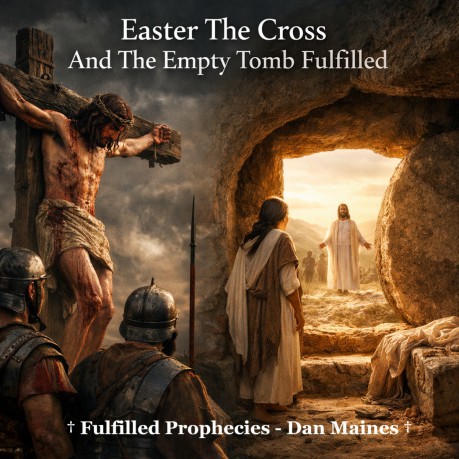
Easter The Cross And The
Empty Tomb Fulfilled Introduction † Easter isn't just a celebration, it's the
turning point of everything God promised coming into reality in their
generation. Isaiah 53:3-5 He was despised and forsaken by men, † This is the sorrow of Easter, the suffering
wasn't symbolic, it was real, brutal, and necessary (Isaiah 53:10). Psalm 22:16-18 For dogs have surrounded me; † This shows that the cross wasn't an accident,
it was foretold in detail long before it happened (Acts 2:23). John 19:30 Therefore, when Jesus had received the sour wine, He said, "It
is finished!" And He bowed His head and gave up His spirit. † This is where sorrow reaches its peak, the
moment of death, but also where victory begins (Colossians 2:14). Matthew 28:5-6 But the angel said to the women, "Do not be afraid; for I
know that you are looking for Jesus who has been crucified. He is not
here, for He has risen, just as He said. Come, see the place where He
was lying." † This is the joy of Easter, death didn't win,
the grave didn't hold Him (Acts 2:24). Daniel 12:2 "Many of those who sleep in the dust of the ground will
awake, these to everlasting life, but the others to disgrace and
everlasting contempt." † The resurrection wasn't about every
individual at the end of time, it was about the covenant people being
raised into new life (John 5:24-25). Matthew 16:27-28 "For the Son of Man is going to come in the glory of His
Father with His angels, and will then repay every person according to
his deeds. Truly I say to you, there are some of those who are
standing here who will not taste death until they see the Son of Man
coming in His kingdom." † Jesus Himself placed His coming and judgment
within the lifetime of His audience, not thousands of years later
(Matthew 24:34). Hebrews 8:13 When He said, "A new covenant," He has made the first
obsolete. But whatever is becoming obsolete and growing old is ready
to disappear. † This shows the Old Covenant was in the
process of passing away in that first century generation (Hebrews
9:10). 1 Corinthians 15:44-46 It is sown a natural body; it is raised a spiritual body. If there
is a natural body, there is also a spiritual body. So also it is
written: "The first man, Adam, became a living being." The
last Adam became a life-giving spirit. However, the spiritual is not
first, but the natural; then the spiritual. † The resurrection is defined as spiritual, not
a return to fleshly life (John 6:63). Historical References † Josephus records the destruction of Jerusalem
in AD 70 in detail, matching the judgment Jesus described in Matthew
24. How It Applies To Us Today † We don't live waiting for victory, we're
living in what Christ already accomplished (2 Corinthians 5:17). Q & A Appendix Q If Christ already rose, what does that mean for
us now? Q Was the resurrection only about Jesus? Q Why is Easter both sad and joyful? Q If everything is fulfilled, why is there still
physical death? Q If Jesus said "It is finished," what
exactly was finished? Q If the resurrection is spiritual, what happens
to the physical body? Q Did Jesus already come in His kingdom? Q What was fulfilled in AD 70? † This is the fulfilled perspective we proclaim at
Fulfilled Prophecies † Source Index † Isaiah 53:3-5; Psalm 22:16-18; John 19:30;
Matthew 28:5-6; Daniel 12:2; Matthew 16:27-28; Hebrews 8:13; 1
Corinthians 15:44-46; John 5:24-25; Luke 21:22; Matthew 24:34; 2
Corinthians 5:17; Ephesians 2:5-6 † Josephus, Wars of the Jews; Eusebius,
Ecclesiastical History; Tacitus, Annals 15.44
By Dan Maines
† It carries both sorrow and joy,
sorrow for the suffering of Christ, and joy for what His death and
resurrection accomplished.
† What many miss
is that while Jesus' resurrection is acknowledged as past, the full
meaning of it, the resurrection of the covenant people, the kingdom,
and the judgment, are still pushed into the future, but scripture
says it was fulfilled in that first-century generation.
A man of sorrows and
acquainted with grief;
And like one from whom men hide their
face
He was despised, and we did not esteem Him.
Surely our
griefs He Himself bore,
And our sorrows He carried;
Yet we
ourselves esteemed Him stricken,
Smitten by God, and
afflicted.
But He was pierced through for our transgressions,
He
was crushed for our iniquities;
The punishment for our
well-being fell upon Him,
And by His scourging we are healed.
†
He wasn't suffering for Himself, He was carrying the sins of His
people to complete the covenant, and we now live in the life that
work accomplished. (Hebrews 9:26).
† This
shows the cost of redemption, it wasn't cheap, it was paid in blood
(1 Peter 1:18-19).
A band of evildoers has
encircled me;
They pierced my hands and my feet.
I can
count all my bones;
They look, they stare at me;
They
divide my garments among them,
And for my clothing they cast
lots.
†
Even the smallest details were fulfilled, proving God's plan was
exact and deliberate (Luke 24:44).
† The
suffering of Christ was the fulfillment of the Law and the Prophets,
not something still waiting to happen (Matthew 5:17).
†
It is finished means the debt was paid in full and the Old Covenant
system was brought to its end in principle, and what was becoming
obsolete was fully removed in that generation (Hebrews 8:13; Matthew
24:2).
† Nothing was left undone, everything
required under the Law was completed right there (Romans 10:4).
† His
resurrection confirmed everything He said was true (Romans 1:4).
†
This wasn't just about Him rising, it was about the beginning of a
new covenant reality (1 Corinthians 15:20-23).
† Many,
not all, showing this was tied to Israel and their transition
(Matthew 24:34).
† This connects directly to
what was fulfilled in that generation, not thousands of years later
(Luke 21:22).
† This awakening is tied to the
time of the end spoken of in Daniel 12:1, which aligns with the
tribulation and judgment leading up to AD 70 (Matthew 24:21-22).
†
The resurrection life began with Christ as the firstfruits, but the
full covenantal transition and separation, life and judgment, was
manifested in that generation (1 Corinthians 15:20-23).
†
This shows a process, not a single moment, the cross secured it, and
the events leading to AD 70 revealed and completed it (Hebrews 8:13).
† This locks the timing of
Easter's fulfillment to that generation, not a future expectation
(Luke 21:22).
† The resurrection and kingdom
were not delayed, they were established just as He said (Mark 9:1).
† The cross and resurrection marked
the transition, but the full removal came with judgment in AD 70
(Matthew 24:2).
† Easter is not isolated, it
is part of the complete covenant shift that was fulfilled.
†
Christ as the life-giving spirit shows the nature of the new life
believers receive (2 Corinthians 5:16-17).
†
This confirms the resurrection fulfillment was about transformation,
not reanimation of physical bodies.
† Eusebius writes that the early
Christians saw these events as fulfillment of Christ's prophecies.
†
Tacitus confirms the historical crucifixion of Christ under Roman
authority.
†
Death has lost its power over us spiritually, we are alive in Him now
(Ephesians 2:5-6).
† The sorrow reminds us of
the cost, the joy reminds us of the victory, both are essential to
understand the gospel fully.
A It means we already share in that
life, John 5:24 says we have passed out of death into life.
A
No, He was the firstfruits, 1 Corinthians 15:20 shows it began a
greater covenant resurrection.
A
Because it shows the suffering of the cross and the victory over
death, Hebrews 12:2 shows both together.
A Because the victory was over
spiritual death, John 5:24 and Ephesians 2:1-6 show we have already
passed into life even while physically alive.
A The work of the Law and
the Old Covenant system was completed, John 19:30 and Hebrews 8:13
show the covenant was made obsolete and ready to disappear.
A The body returns to
dust, but life is in the spirit, 1 Corinthians 15:44-46 and John 6:63
show that the spiritual is what gives life.
A
Yes, He said some standing there would see it before they died,
Matthew 16:27-28 confirms it happened in that generation.
A
The judgment, the end of the Old Covenant age, and all things written
were fulfilled, Luke 21:22 and Matthew 24:2 show the temple's
destruction marked that completion.
© Fulfilled Prophecies - Dan
Maines.
Links