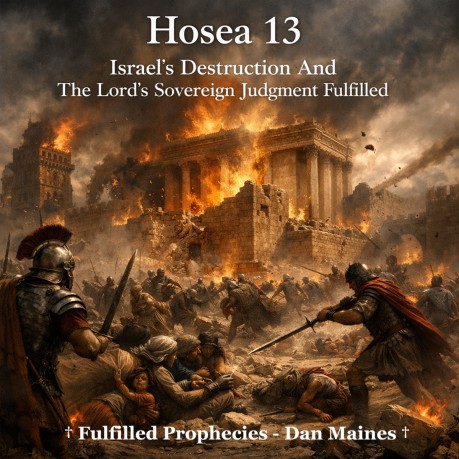
Hosea 13 Israel's Destruction
And The Lord's Sovereign Judgment Fulfilled Introduction † Hosea 13 brings us face to face with the
reason judgment came upon Israel, it wasn't random, it wasn't delayed
into some future age, it was because of their persistent rebellion,
idolatry, and rejection of the One who saved them (Hosea 13). † From the fulfilled perspective, this chapter
is pointing directly toward the first century judgment that Jesus
said would come upon that generation, the same covenant people who
forgot their God and trusted in themselves (Matthew 23:36; Luke
21:22). † What we see here is not just history, it's
the pattern of covenant accountability, God delivers, man forgets,
and judgment follows. Scripture Hosea 13:1 † Ephraim once had authority and influence, but
when he turned to idols, spiritual death followed immediately (Hosea
13:1). † This isn't physical death first, it's
covenant death, separation from God, the same kind of death seen in
Genesis when man sinned (Genesis 2:17). † Jesus addressed this same condition, a people
alive outwardly but dead inwardly, rejecting the truth standing right
in front of them (Matthew 23:27). Hosea 13:2 † Sin doesn't stay still, it multiplies, once
Israel turned away, they kept going deeper into idolatry (Hosea
13:2). † They created gods according to their own
understanding, just like the leaders in Jesus' day who replaced God's
law with their traditions (Mark 7:8). † This shows the danger of self-made religion,
when man defines truth, he always ends up worshiping something false. Hosea 13:3 † Their existence would be temporary and vanish
quickly, like mist, dew, chaff, and smoke (Hosea 13:3). † This language is judgment language, showing
complete removal, which was fulfilled in the destruction of Jerusalem
in AD 70 (Luke 21:20-24). † Jesus used similar imagery, showing that
generation would pass away under judgment (Matthew 24:34). Hosea 13:4 † God reminds them He alone is their Savior,
the one who brought them out of Egypt (Hosea 13:4). † This points forward to Christ, who stands as
the true Savior, yet was rejected by that same covenant people (John
1:11). † Their failure wasn't lack of knowledge, it
was rejection of the truth they already had. Hosea 13:5-6 † God cared for them in their weakness, but
prosperity led to pride and forgetfulness (Hosea 13:5-6). † This is a consistent pattern, blessing
without gratitude leads to rebellion. † In the first century, Israel had the temple,
the law, and the Messiah among them, yet they still forgot God
(Romans 10:21). Hosea 13:7-8 † God shifts from protector to judge, using
violent imagery to show the intensity of coming judgment (Hosea
13:7-8). † This isn't random anger, it's covenant
justice. † Jesus echoed this when He warned of unmatched
tribulation coming upon that generation (Matthew 24:21). Hosea 13:9 † Israel destroyed themselves by rejecting the
One who could save them (Hosea 13:9). † This is exactly what happened when they
rejected Christ, their help stood before them, and they crucified Him
(Acts 2:23). † Judgment wasn't imposed without cause, it was
the result of their own choice. Hosea 13:10-11 † Their trust in earthly leadership failed them
(Hosea 13:10-11). † This ties directly to their rejection of
God's rule in favor of human authority, which culminated in their
alliance with Rome (John 19:15). † The very system they trusted became the
instrument of their destruction. Hosea 13:12-13 † Their sin was stored up, meaning judgment was
certain and unavoidable (Hosea 13:12). † The imagery of childbirth shows something
inevitable, judgment was coming whether they were ready or not (Hosea
13:13). † Jesus said the same, calling it birth pains
leading up to the destruction of Jerusalem (Matthew 24:8). Hosea 13:14 † Even in judgment, there's a promise of
redemption (Hosea 13:14). † Paul quotes this in connection with the
resurrection, showing that Christ fulfilled victory over death (1
Corinthians 15:54-55). † From the fulfilled perspective, this points
to the spiritual resurrection completed in Christ, removing covenant
death and bringing life. Hosea 13:15-16 † Final judgment is described in severe terms,
showing the total devastation that comes from rebellion (Hosea
13:15-16). † This was fulfilled historically, and in the
first century, similar horrors occurred during the Roman siege of
Jerusalem, recorded by Josephus. † This is the consequence of rejecting God, not
because He failed them, but because they abandoned Him. Historical References † Josephus records the destruction of Jerusalem
in AD 70, describing famine, violence, and devastation that matches
the language of covenant judgment seen in Hosea (Josephus, Wars of
the Jews, Book 5-6). † Eusebius notes that believers fled Jerusalem
before its destruction, showing that Christ's warnings were fulfilled
exactly as spoken (Eusebius, Ecclesiastical History, Book 3). † Tacitus confirms the brutality of the Roman
siege, reinforcing that this was not symbolic, but a real historical
judgment (Tacitus, Histories 5). How It Applies To Us Today † We don't repeat Israel's mistake by
forgetting God in times of blessing, it's easy to drift when things
are going well, but that's when we need to stay grounded (Hosea
13:6). † We don't create truth according to our own
understanding, God's word defines reality, not our opinions (Hosea
13:2). † We recognize that judgment has already been
fulfilled, and we now live in the reality of redemption through
Christ, not waiting for future wrath (Hosea 13:14). † We trust in Christ alone as Savior, not
systems, leaders, or institutions, because only He delivers (Hosea
13:4). † We stay faithful, knowing that forgetting God
always leads to destruction, but remaining in Him leads to life. Q & A Appendix Q How do we know Hosea 13 was fulfilled in the
first century? Q What does it mean that Israel "died"
when they sinned? Q How does Hosea 13:14 relate to the
resurrection? Q Why was the judgment so severe? Q What is the main lesson for us today? † This is the fulfilled perspective we proclaim at
Fulfilled Prophecies † Source Index † Hosea 13
By Dan Maines
When Ephraim spoke, there was
trembling. He exalted himself in Israel, but when he became guilty
through Baal, he died.
And now they sin more and more,
and make for themselves cast metal images, idols skillfully made from
their silver, all of them the work of craftsmen. They say of them,
Let the people who sacrifice kiss the calves.
Therefore they will be like the
morning cloud and like dew which soon disappears, like chaff which is
blown away from the threshing floor, and like smoke from a chimney.
Yet I have been the LORD your God
since the land of Egypt, and you were not to know any god except Me,
for there is no savior besides Me.
I cared for you in the
wilderness, in the land of drought. As they had their pasture, they
became satisfied, and being satisfied, their heart became proud.
Therefore they forgot Me.
So I will be like a lion to
them; like a leopard I will lie in wait by the wayside. I will
encounter them like a bear robbed of her cubs, and I will tear open
their chests; there I will devour them like a lioness, as a wild
beast would tear them.
It is to your destruction,
Israel, that you are against Me, against your help.
Where now is your king, that
he may save you in all your cities, and your judges, of whom you
requested, Give me a king and princes? I gave you a king in My anger,
and took him away in My wrath.
The guilt of Ephraim is
stored up; his sin is kept on record. The pains of childbirth come
upon him; he is not a wise son, for it is not the time that he should
delay at the opening of the womb.
Shall I rescue them from the
power of Sheol? Shall I redeem them from death? Where are your
thorns, death? Where is your sting, Sheol? Compassion will be hidden
from My sight.
Though he flourishes among
the reeds, an east wind will come, the wind of the LORD coming up
from the wilderness; and his fountain will become dry and his spring
will be dried up; it will plunder his treasury of every precious
article. Samaria will be held guilty, for she has rebelled against
her God. They will fall by the sword, their little ones will be
dashed in pieces, and their pregnant women will be ripped open.
A Jesus said all these things
would come upon that generation (Matthew 23:36), and the destruction
of Jerusalem in AD 70 matches the judgment language in Hosea.
A It refers to spiritual or
covenant death, separation from God, not immediate physical death
(Genesis 2:17; Hosea 13:1).
A Paul quotes it in 1 Corinthians
15:54-55, showing Christ fulfilled victory over death through
resurrection life.
A
Because it was covenant judgment after repeated rejection of God and
ultimately rejection of Christ (Hosea 13:9; Matthew 23:37-38).
A
Stay faithful, don't forget God, and trust in Christ alone, because
drifting leads to destruction, but abiding in Him leads to life (John
15:5-6).
© Fulfilled Prophecies - Dan
Maines.
† Josephus,
Wars of the Jews, Book 5-6; Eusebius, Ecclesiastical History, Book 3;
Tacitus, Histories 5
Links