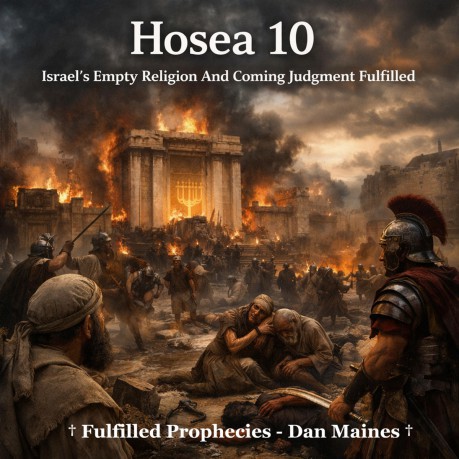
Hosea 10 Israel's Empty
Religion And Coming Judgment Fulfilled Introduction † Hosea 10 exposes Israel's outward prosperity
but inward corruption, showing that their religious system looked
fruitful on the surface, but was empty before God. † From the fulfilled perspective, this chapter
points directly to the condition of first century Israel, a nation
full of temple activity, sacrifices, and outward religion, yet
rejecting Christ and bringing judgment upon themselves. † What Hosea saw in his day reached its full
measure in the generation that crucified Jesus, and that is exactly
when this judgment was fulfilled. Hosea 10:1 † Israel prospered outwardly, but instead of
honoring God, they multiplied altars to idols, showing self-centered
religion. † This same condition existed in the first
century, where the temple system flourished, yet Christ said their
house was left desolate, Matthew 23:38. † Their fruit was for themselves, not for God,
proving their religion was empty, John 15:6. Hosea 10:2 † God identifies the root problem, their heart
was divided, not loyal. † Jesus exposed this exact issue, honoring God
with lips while hearts were far away, Matthew 15:8. † The breaking of altars finds fulfillment in
the destruction of Jerusalem in AD 70, where the entire system was
removed, Luke 21:6. Hosea 10:3 † Israel rejected God's authority and placed
trust in human rulers. † This reached its climax when they said, We
have no king but Caesar, John 19:15. † By rejecting Christ, they sealed their own
judgment and proved they had no true king. Hosea 10:4 † Their words were empty, their promises false,
and their justice corrupt. † Jesus rebuked this hypocrisy in the religious
leaders, calling them blind guides, Matthew 23:16. † Their corrupt judgment led to the
condemnation of the righteous, especially Christ Himself, Acts 2:23. Hosea 10:5 † Their idol became their source of fear and
sorrow. † In the fulfilled sense, their trust in the
temple and system failed them when judgment came. † What they trusted in was taken away, just as
Jesus warned, Luke 19:44. Hosea 10:6 † Their idols would be taken away, exposing
their shame. † In fulfillment, their entire religious
structure was removed, leaving them without the system they trusted. † Their counsel failed, just as their rejection
of Christ proved disastrous, Romans 10:3. Hosea 10:7 † Their leadership was powerless and easily
swept away. † This mirrors the fall of leadership in
Jerusalem during AD 70, as recorded by Josephus. † Their kings and rulers could not save them
from what was coming. Hosea 10:8 † Their places of worship would become
desolate. † Jesus directly quoted this in Luke 23:30,
pointing to the coming judgment. † This was fulfilled when Jerusalem fell, and
the people cried out in terror during the siege. Hosea 10:9 † Israel's sin was longstanding and unrepented. † This shows a pattern that continued into the
first century. † Their accumulated sin reached its fullness in
that generation, Matthew 23:32. Hosea 10:10 † God Himself would bring judgment. † The gathering of nations points to the Roman
armies surrounding Jerusalem, Luke 21:20. † Their double guilt included rejecting both
the prophets and Christ. Hosea 10:11 † Israel enjoyed ease but would now experience
bondage. † This transition from ease to burden reflects
the shift from prosperity to destruction in AD 70. † Their rebellion brought them into judgment. Hosea 10:12 † God called them to repentance before judgment
came. † This same call was given by John the Baptist
and Jesus, Matthew 3:2. † The opportunity was there, but they refused
it. Hosea 10:13 † They reaped exactly what they sowed. † Jesus said the same principle applies,
Matthew 7:2. † Their trust in themselves led to their
downfall. Hosea 10:14 † This describes the brutality of judgment. † Josephus records similar horrors during the
siege of Jerusalem. † This was not symbolic, it was real, physical
destruction. Hosea 10:15 † Final judgment was certain because of their
persistent sin. † This was fulfilled when the leadership and
system of Israel were completely removed. † The old covenant system came to its full end
in that generation. Historical References † Josephus, Wars of the Jews, Book 5-6,
describes the siege, famine, and destruction of Jerusalem in detail. † Tacitus, Histories 5.13, confirms the
devastation of the city and temple. † Eusebius, Ecclesiastical History 3.5, records
the fulfillment of Christ's warnings about Jerusalem's fall. How It Applies To Us Today † God isn't impressed with outward religion, He
looks at the heart, John 4:24. † Empty religion leads to judgment, but true
righteousness comes through Christ alone, Romans 3:22. † We've already seen the full weight of
covenant judgment, so now we live in the completed work of Christ,
not in fear of that same destruction. † The lesson is clear, don't trust in systems,
traditions, or appearances, trust in the finished work of Christ. Q & A Appendix Q What does it mean that Israel was a luxuriant
vine? Q When was this judgment fulfilled? Q Why did God destroy their altars? Q What does sowing and reaping refer to? Q What is the main message of Hosea 10? † This is the fulfilled perspective we proclaim at
Fulfilled Prophecies † Source Index † Hosea 10 † Josephus, Wars of the Jews, Book 5-6;
Tacitus, Histories 5.13; Eusebius, Ecclesiastical History 3.5
By Dan Maines
Israel is a luxuriant vine,
He
produces fruit for himself.
The more his fruit,
The more
altars he made;
The richer his land,
The better he made the
memorial stones.
Their heart is faithless;
Now
they must bear their guilt.
The Lord will break down their
altars
And destroy their memorial stones.
Certainly now they will say,
We
have no king,
For we do not revere the Lord.
As for the
king, what can he do for us?
They speak mere words,
With
worthless oaths they make covenants;
And judgment sprouts like
poisonous weeds in the furrows of the field.
The inhabitants of Samaria will
fear
For the calf of Beth-aven.
Indeed, its people will
mourn for it,
And its idolatrous priests will cry out over
it,
Over its glory, since it has departed from it.
The thing itself will be carried
to Assyria
As tribute to King Jareb;
Ephraim will be seized
with shame
And Israel will be ashamed of its own counsel.
Samaria will be eliminated with
her king
Like a twig on the surface of the water.
The high places of Aven, the sin
of Israel, will be destroyed;
Thorn and thistle will grow on
their altars.
Then they will say to the mountains, Cover us!
And
to the hills, Fall on us!
From the days of Gibeah you have
sinned, Israel;
There they have remained.
Will the battle
against the sons of injustice not overtake them in Gibeah?
When it is My desire, I will
punish them;
And the peoples will be gathered against them
When
they are bound for their double guilt.
Ephraim is a trained heifer that
loves to thresh,
But I will come over her fair neck with a
yoke;
I will harness Ephraim, Judah will plow,
Jacob will
harrow for himself.
Sow with a view to
righteousness,
Reap in accordance with kindness;
Break up
your uncultivated ground,
For it is time to seek the Lord
Until
He comes to rain righteousness on you.
You have plowed wickedness, you
have reaped injustice,
You have eaten the fruit of lies
Because
you have trusted in your way, in your numerous warriors.
Therefore a tumult will arise
among your people,
And all your fortresses will be destroyed,
As
Shalman destroyed Beth-arbel on the day of battle,
When mothers
were smashed in pieces with their children.
Thus it will be done to you at
Bethel because of your great wickedness;
At dawn the king of
Israel will be completely cut off.
A It means they prospered outwardly but
used that blessing for themselves, not God, Hosea 10:1, John 15:6.
A
It was fulfilled in the destruction of Jerusalem in AD 70, Luke
21:20-22.
A
Because their worship was corrupt and idolatrous, Hosea 10:2, Matthew
23:38.
A
It refers to the principle that their wickedness produced judgment,
Hosea 10:13, Galatians 6:7.
A
That outward religion without true faith leads to judgment, and that
was fulfilled in the fall of Israel, Matthew 23:32-36.
© Fulfilled Prophecies - Dan
Maines.
Links