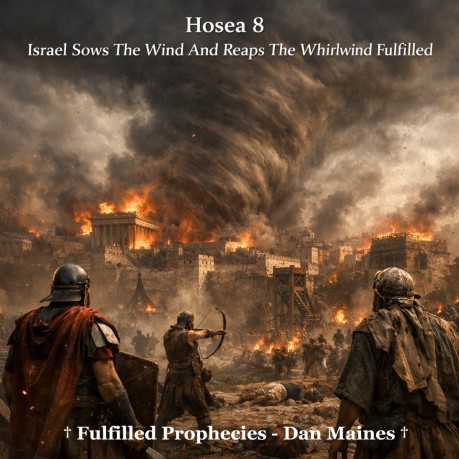
Hosea 8 Israel Sows The Wind
And Reaps The Whirlwind Fulfilled Introduction † Hosea 8 exposes the heart of Israel's
rebellion, they claimed to know God, but their actions proved
otherwise, and this brought judgment upon them. † This chapter shows that outward religion
without obedience is worthless, and that false worship and self-made
authority lead to destruction. † From the fulfilled perspective, this points
directly to the first-century generation, who claimed covenant
identity while rejecting Christ, bringing the covenant curses to
completion in AD 70. Hosea 8:1 † The trumpet signals imminent judgment, this
was about to happen upon them, not thousands of years later (Matthew
24:31). † The eagle represents a swift invading force,
aligning with Rome coming quickly against Jerusalem (Deuteronomy
28:49). † Their judgment is rooted in covenant
violation, they broke the law given to them (Leviticus 26:14-33). Hosea 8:2 † They claimed relationship with God, but it
was empty, their lives contradicted their words (Matthew 7:21-23). † This is the same hypocrisy seen in the first
century, honoring God with lips but not with obedience (Mark 7:6-7). † Knowing God is proven by obedience, not by
claim, and Israel failed this completely (1 John 2:4). Hosea 8:3 † Rejecting the good means rejecting God's
truth and ultimately rejecting Christ (John 1:11). † Because of this rejection, judgment becomes
inevitable, the enemy is covenant consequence (Deuteronomy 28:25). † This was fulfilled when Rome pursued and
destroyed Jerusalem. Hosea 8:4 † Israel established leadership outside of
God's will, showing rebellion even in authority (1 Samuel 8:7). † Their idolatry was tied to wealth and
self-interest, trusting material things rather than God (Ezekiel
7:19). † This reflects corrupt leadership in the first
century, rejecting Christ and leading the people into destruction
(John 11:48). Hosea 8:5 † The calf represents false worship, repeating
the same rebellion seen in the wilderness (Exodus 32:4). † God rejects their worship because it is not
according to truth (Isaiah 1:11-15). † This connects to the first-century temple
system, which outwardly continued but was already rejected (Matthew
23:38). Hosea 8:6 † Idols are man-made and powerless, they cannot
save (Psalm 115:4-8). † What they trusted in would be destroyed,
exposing false religion. † This was fulfilled when everything they
trusted in, including the temple, was torn down (Matthew 24:2). Hosea 8:7 † Their actions were empty, producing nothing
of value. † The whirlwind shows multiplied judgment, what
they sowed returned with greater force (Galatians 6:7). † This was fulfilled in the destruction of
Jerusalem, where everything was consumed. Hosea 8:8 † Israel lost its distinct identity because of
rebellion. † This reflects covenant judgment where they
are scattered among the nations (Deuteronomy 28:64). † In AD 70, the nation was destroyed and
dispersed. Hosea 8:9 † Instead of trusting God, they relied on
foreign alliances, which is spiritual adultery. † This shows independence from God while
claiming to belong to Him. † In the first century, they relied on
political maneuvering instead of submitting to Christ. Hosea 8:10 † Their alliances would not save them, God
Himself brought judgment. † The burden of the king points to oppressive
rule, aligning with Roman domination. † This was fulfilled when Rome gathered against
Jerusalem and crushed it. Hosea 8:11 † More religion did not mean righteousness, it
increased their sin. † Their worship practices added to their guilt. † This mirrors the first-century temple system,
where sacrifices continued but hearts were corrupt (Hebrews 10:1-4). Hosea 8:12 † God's word was clearly given, but they
treated it as foreign. † This shows willful rejection, not ignorance. † The same happened when Christ taught, they
rejected the word of God (John 5:39-40). Hosea 8:13 † God rejected their sacrifices because their
hearts were not right. † Returning to Egypt symbolizes returning to
bondage and judgment. † This was fulfilled in their captivity under
Rome. Hosea 8:14 † They trusted in buildings and defenses
instead of God. † Forgetting their Maker was the root problem. † The fire represents destruction, fulfilled in
the burning of Jerusalem in AD 70. Historical References † Josephus records the destruction of
Jerusalem, describing the fire, famine, and devastation in AD 70. † Tacitus confirms the Roman assault and the
burning of the temple. † Eusebius records the judgment that came upon
Jerusalem as fulfillment of Christ's warnings. How It Applies To Us Today † It's not enough to claim we know God,
obedience proves the relationship. † False worship, even if it looks religious, is
still rejected by God. † Trusting in systems, leaders, or material
things instead of God leads to destruction. † What we sow matters, because we will reap,
often in greater measure. † We must stay grounded in truth, not just
outward appearance. Q & A Appendix Q: Did Israel really know God? Q: What does sowing the wind mean? Q: Who is the enemy like an eagle? Q: Why were their sacrifices rejected? Q: How was this fulfilled? † This is the fulfilled perspective we proclaim at
Fulfilled Prophecies † Source Index † Hosea 8 † Josephus, The Jewish War; Tacitus, Histories;
Eusebius, Ecclesiastical History
By Dan Maines
Put the trumpet to your lips! Like
an eagle the enemy comes against the house of the LORD, Because they
have violated My covenant And rebelled against My Law.
They cry out to Me, My God, we of
Israel know You!
Israel has rejected the good, The
enemy will pursue him.
They have set up kings, but not by
Me, They have appointed princes, but I did not know it. With their
silver and gold they have made idols for themselves, That they might
be eliminated.
He has rejected your calf, O
Samaria, saying, My anger burns against them! How long will they be
incapable of innocence?
For from Israel is even this! A
craftsman made it, so it is not God, Surely the calf of Samaria will
be broken to pieces.
For they sow the wind And they
reap the whirlwind. The standing grain has no heads, It yields no
grain. Should it yield, strangers would swallow it up.
Israel is swallowed up, They are
now among the nations Like a vessel in which no one delights.
For they have gone up to Assyria,
Like a wild donkey all alone, Ephraim has hired lovers.
Even though they hire allies
among the nations, Now I will gather them up, And they will begin to
diminish Because of the burden of the king of princes.
Since Ephraim has multiplied
altars for sin, They have become altars of sinning for him.
Though I wrote for him ten
thousand precepts of My Law, They are regarded as a strange thing.
As for My sacrificial gifts, They
sacrifice the flesh and eat it, But the LORD has taken no delight in
them. Now He will remember their guilt And punish them for their
sins; They will return to Egypt.
For Israel has forgotten his
Maker and built palaces, And Judah has multiplied fortified cities,
But I will send a fire on its cities that it may consume its palatial
dwellings.
A:
No, their claim was empty, as seen in Hosea 8:2 and confirmed by
Matthew 7:21-23.
A:
It means producing nothing of value, leading to greater judgment, as
shown in Hosea 8:7 and Galatians 6:7.
A:
It aligns with Rome, fulfilling Deuteronomy 28:49 and seen in Matthew
24:15-22.
A:
Because their hearts were corrupt, as stated in Hosea 8:13 and Isaiah
1:11-15.
A:
In the destruction of Jerusalem in AD 70, fulfilling Matthew 24:2 and
Luke 21:20-22.
© Fulfilled Prophecies - Dan
Maines.
Links