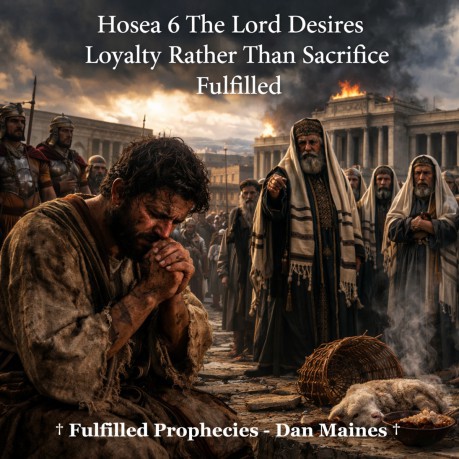
Hosea 6 The Lord Desires
Loyalty Rather Than Sacrifice Fulfilled Introduction † Hosea 6 shows Israel speaking words of
repentance, but God exposes that their repentance isn't genuine. From
the fulfilled perspective, this points directly to the first-century
generation that outwardly claimed covenant faithfulness while
rejecting Christ. † This chapter reveals the difference between
surface-level religion and true covenant faithfulness, and it shows
why judgment came upon that generation exactly as Jesus said it
would. † The message is simple and direct, God isn't
looking for empty rituals, He's looking for loyalty, truth, and
knowledge of Him. Hosea 6:1-3 † This sounds like repentance, but it's shallow
and temporary, they acknowledge God's power but not their sin (Hosea
6:1-3). † The third day language points forward to
restoration through Christ, but Israel as a nation rejected that true
restoration (Luke 24:46). † Their desire to know the Lord wasn't matched
by obedience, which is exactly what Jesus rebuked in that generation
(Matthew 23:27-28). Hosea 6:4-6 † Their goodness disappears quickly, just like
morning dew, meaning their covenant loyalty isn't real (Hosea 6:4). † God judged them through the prophets, and
ultimately through Christ's words, which brought covenant judgment on
that generation (John 12:48). † This is the key verse, God desires loyalty,
not sacrifice, and knowledge of Him, not empty ritual, which Jesus
directly quoted against the Pharisees (Matthew 9:13). † This proves that first-century Israel
repeated the same failure as Hosea's audience, outward religion
without inward truth. Hosea 6:7-10 † Israel broke covenant just like Adam, showing
a pattern of rebellion from the beginning (Hosea 6:7). † The priests themselves are corrupt, even
violent, which matches the leadership in Jesus' day who killed the
prophets and ultimately Christ (Matthew 23:31-35). † The entire system is defiled, not just
individuals, this is why total covenant judgment was necessary. † This explains why the temple system was
destroyed in AD 70, because it had become completely corrupt. Hosea 6:11 † The harvest points to judgment, not blessing,
which aligns with Jesus' language about the harvest at the end of the
age (Matthew 13:39). † This was fulfilled in the first century when
judgment came upon Judah, while true restoration came through Christ
for His people. † The captivity being reversed points to the
gathering of the true people of God into the new covenant. Historical References † Josephus records the corruption of the
priesthood and the violence within Jerusalem leading up to its
destruction, confirming Hosea's description (Josephus, Wars of the
Jews, Book 5-6). † Eusebius writes about the judgment that fell
on Jerusalem as a direct result of rejecting Christ, aligning with
this prophetic pattern (Eusebius, Ecclesiastical History, Book 3). † Tacitus also confirms the internal corruption
and chaos among the Jewish leadership before the fall of Jerusalem
(Tacitus, Histories 5.12-13). How It Applies To Us Today † God still isn't impressed by outward
religion, it's not about appearances, it's about real loyalty to Him
(Hosea 6:6). † We can't rely on temporary repentance, it
must be genuine and lasting. † Knowing God means walking in truth, not just
claiming belief. † The judgment of that generation stands as
proof that God keeps His word, both in warning and in promise. † We now live in the fulfilled reality of the
new covenant, where access to God isn't through ritual, but through
Christ. Q & A Appendix Q Was Hosea 6 fulfilled in the first century? Q What does God mean by desiring mercy and not
sacrifice? Q Who were the corrupt priests mentioned here? Q What is the harvest in verse 11? Q How do we know this applies to Jesus'
generation? † This is the fulfilled perspective we proclaim at
Fulfilled Prophecies † Source Index † Hosea 6
By Dan Maines
Come, let us return to the
Lord.
For He has torn us, but He will heal us;
He has
wounded us, but He will bandage us.
He will revive us after two
days;
On the third day He will raise us up,
So that we may
live before Him.
So let us know, let us press on to know the
Lord.
His going forth is as certain as the dawn;
And He
will come to us like the rain,
Like the spring rain watering the
earth.
What shall I do with you,
Ephraim?
What shall I do with you, Judah?
For your loyalty
is like a morning cloud
And like the dew which goes away
early.
Therefore I have cut them in pieces by the prophets;
I
have killed them by the words of My mouth;
And the judgments on
you are like the light that goes forth.
For I desire loyalty
rather than sacrifice,
And the knowledge of God rather than
burnt offerings.
But like Adam they have
violated the covenant;
There they have dealt treacherously
against Me.
Gilead is a city of wrongdoers,
Tracked with
bloody footprints.
And as raiders wait for a person,
So a
band of priests murder on the way to Shechem;
Certainly they
have committed crimes.
In the house of Israel I have seen a
horrible thing;
Ephraim's prostitution is there, Israel has
defiled itself.
Also, Judah, there is a harvest
appointed for you,
When I restore the fortunes of My people.
A
Yes, the pattern of false repentance and corrupt leadership was fully
manifested in that generation, leading to the judgment of AD 70,
Matthew 23:36, Matthew 24:34.
A He means obedience and covenant
loyalty matter more than ritual, Matthew 9:13, Hosea 6:6.
A
They represent the leadership of Israel, which was fully corrupt by
Jesus' time, Matthew 23:2-7.
A
It refers to covenant judgment, fulfilled in the destruction of
Jerusalem, Matthew 13:39-42.
A Jesus directly connects these
same sins to His generation and declares their judgment, Matthew
23:29-36.
© Fulfilled Prophecies - Dan
Maines.
† Josephus,
Wars of the Jews, Book 5-6; Eusebius, Ecclesiastical History, Book 3;
Tacitus, Histories 5.12-13
Links