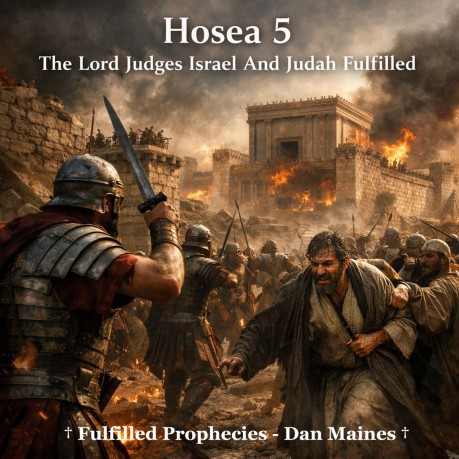
Hosea 5 The Lord Judges
Israel And Judah Fulfilled Introduction † Hosea 5 continues the Lord's case against
Israel, showing that judgment was not random, it was deserved and
fully revealed beforehand (Hosea 4:1). † The leaders, priests, and kings were
responsible for leading the people into corruption, and because of
that, judgment was certain (Matthew 23:13). † From the fulfilled perspective, this finds
its complete end in the judgment of that generation, when the
covenant system collapsed and the Lord's warnings came to pass
(Matthew 24:34). Hosea 5:1 † The Lord calls out the leadership first
because judgment always begins with those entrusted with authority (1
Peter 4:17). † The priests and rulers became traps instead
of guides, leading the people into sin rather than righteousness
(Matthew 23:15). † This was fulfilled when those same leaders
rejected Christ and led the nation into destruction (John 11:47-53). Hosea 5:2 † Their rebellion wasn't shallow, it was deeply
rooted and deliberate (Isaiah 1:4). † God declares that none escape His rebuke,
showing that judgment is comprehensive (Luke 12:2). † This was fulfilled when the entire corrupt
system was exposed and judged in that generation (Luke 19:41-44). Hosea 5:3 † Nothing is hidden from God, their corruption
was fully known (Hebrews 4:13). † Spiritual adultery here refers to covenant
unfaithfulness, not physical immorality alone (James 4:4). † This reached its peak when Israel rejected
their Messiah, proving their unfaithfulness (John 1:11). Hosea 5:4 † Their actions hardened them, showing how sin
traps people in blindness (John 12:39-40). † They claimed to know God but didn't truly
know Him, just like the leaders in Jesus' day (John 8:19). † This explains why that generation couldn't
repent, their hearts were already set (Matthew 23:37). Hosea 5:5 † Pride was the root of their downfall, not
ignorance (Proverbs 16:18). † Both Israel and Judah are included, showing
this judgment would be widespread (Matthew 21:43). † This was fulfilled when both the northern
identity and southern system were judged through Rome (Luke
21:20-22). Hosea 5:6 † Religious activity without truth cannot reach
God (Isaiah 1:11-15). † God withdrawing means covenant rejection, not
absence everywhere (Amos 8:11-12). † This was fulfilled when temple worship became
empty and judgment fell (Matthew 23:38). Hosea 5:7 † Their unfaithfulness produced corruption in
the next generation (Matthew 23:32). † The mention of new moon shows their religious
calendar would not save them (Colossians 2:16-17). † This was fulfilled when their system was
destroyed despite continued rituals (Hebrews 8:13). Hosea 5:8 † This is a call to alarm, judgment is
approaching fast (Joel 2:1). † The locations show judgment moving through
the land step by step (Luke 21:24). † This was fulfilled in the Roman invasion,
when destruction spread across Judea (Josephus, Wars of the Jews). Hosea 5:9 † God always warned before judgment, nothing
came without notice (Amos 3:7). † Desolation was certain, not conditional at
this point (Luke 13:34-35). † This was fulfilled in AD 70 when Jerusalem
was left desolate (Matthew 24:2). Hosea 5:10 † Removing landmarks means corrupting truth and
boundaries (Deuteronomy 19:14). † Leadership had distorted God's law for their
own gain (Mark 7:9). † This was fulfilled when leaders twisted the
law to reject Christ (Matthew 26:59-60). Hosea 5:11 † They followed human tradition instead of
God's word (Mark 7:7). † Judgment came because they chose man over God
(Acts 5:29). † This was fulfilled when traditions blinded
them to the Messiah (John 5:39-40). Hosea 5:12 † God describes gradual judgment, decay from
within (Luke 12:1). † This wasn't sudden at first, it was a slow
corruption leading to collapse (Matthew 23:27). † This was fulfilled as their system
deteriorated before its final destruction (Hebrews 10:25-27). Hosea 5:13 † They trusted foreign powers instead of God
(Isaiah 31:1). † External solutions cannot fix spiritual
problems (Jeremiah 2:13). † This was fulfilled when reliance on Rome led
to their destruction (John 19:15). Hosea 5:14 † God Himself is the one bringing judgment, not
just using nations (Isaiah 10:5-6). † The image of a lion shows power and
inevitability (Revelation 6:16). † This was fulfilled when no one could escape
the Roman siege (Luke 21:23). Hosea 5:15 † God withdraws until repentance, showing His
justice and patience (Isaiah 55:6). † Affliction leads to realization, but for that
generation, it came too late (Luke 23:28-30). † This was fulfilled in the final distress of
Jerusalem when they recognized their condition (Luke 19:42). Historical References † Josephus describes the siege of Jerusalem,
showing famine, internal corruption, and destruction exactly as Hosea
warned (Wars of the Jews, Book 5-6). † Tacitus confirms the devastation and collapse
of the Jewish system under Roman power (Histories 5.13). † Eusebius records that believers fled before
the destruction, showing that the warnings were understood and
fulfilled (Ecclesiastical History 3.5). How It Applies To Us Today † We see that religious leadership carries
serious responsibility, and corruption leads to destruction. † External religion without truth is empty, God
isn't reached through rituals alone. † Pride blinds people to truth, and that hasn't
changed. † God always warns before judgment, and His
word never fails. † We must follow God's word, not human
traditions, or we'll fall into the same trap. Q & A Appendix Q: Who is Hosea 5 primarily addressing? Q: What does the harlotry represent? Q: Why couldn't they return to God? Q: What does God withdrawing mean? Q: When was this fulfilled? † This is the fulfilled perspective we proclaim at
Fulfilled Prophecies † Source Index † Hosea 5
By Dan Maines
Hear this, you priests! Pay
attention, house of Israel! Listen, house of the king! For the
judgment applies to you, for you have been a snare at Mizpah and a
net spread out on Tabor.
The revolters have gone deep in
depravity, but I will punish all of them.
I know Ephraim, and Israel is not
hidden from Me, for now, Ephraim, you have played the prostitute;
Israel has defiled itself.
Their deeds will not allow them to
return to their God, for a spirit of prostitution is within them, and
they do not know the Lord.
And the pride of Israel testifies
against him; therefore Israel and Ephraim stumble in their guilt,
Judah has also stumbled with them.
They will go with their flocks and
herds to seek the Lord, but they will not find Him; He has withdrawn
from them.
They have dealt treacherously
against the Lord, for they have given birth to illegitimate children.
Now the new moon will devour them with their land.
Blow the horn in Gibeah, the
trumpet in Ramah. Sound an alarm at Beth-aven: Behind you, Benjamin!
Ephraim will become a desolation
on the day of rebuke; among the tribes of Israel I make known what is
certain.
The leaders of Judah have become
like those who move a boundary; on them I will pour out My wrath like
water.
Ephraim is oppressed, crushed in
judgment, because he was determined to follow man's command.
Therefore I am like a moth to
Ephraim, and like rottenness to the house of Judah.
When Ephraim saw his sickness,
and Judah his wound, then Ephraim went to Assyria and sent word to
King Jareb. But he is unable to heal you, and he will not cure you of
your wound.
For I will be like a lion to
Ephraim, and like a young lion to the house of Judah. I, yes I, will
tear them to pieces and leave; I will carry them away, and there will
be no one to rescue them.
I will go away and return to My
place until they acknowledge their guilt and seek My face; in their
distress they will eagerly seek Me.
A:
The priests, rulers, and people of Israel and Judah, especially
leadership, Hosea 5:1.
A:
Covenant unfaithfulness, rejecting God and His truth, Hosea 5:3,
James 4:4.
A:
Their actions hardened them, and they were spiritually blind, Hosea
5:4, John 12:39-40.
A:
Covenant rejection and loss of His favor, not His absence everywhere,
Hosea 5:6, Matthew 23:38.
A:
In the destruction of Jerusalem in AD 70, Matthew 24:2, Luke
21:20-22.
© Fulfilled Prophecies - Dan
Maines.
† Josephus,
Wars of the Jews, Book 5-6; Tacitus, Histories 5.13; Eusebius,
Ecclesiastical History 3.5
Links