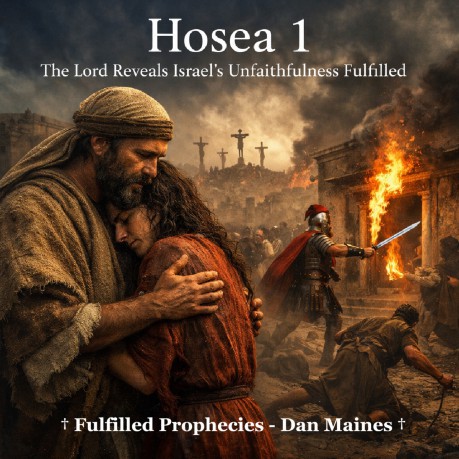
Hosea 1 The Lord Reveals
Israel's Unfaithfulness Fulfilled Introduction † Hosea 1 opens with a powerful sign, God
commands the prophet to live out a message through his own life. This
isn't symbolic fiction, it's a real prophetic act showing Israel's
covenant unfaithfulness. † From the fulfilled perspective, this chapter
is pointing directly to the first-century judgment that came upon
Israel, when their long-standing spiritual adultery reached its full
measure. † God isn't reacting suddenly, He's revealing
what Israel had become, and what was about to happen within that
generation. Hosea 1:1 The word of the Lord that came to Hosea the son of Beeri, during
the days of Uzziah, Jotham, Ahaz, and Hezekiah, kings of Judah, and
during the days of Jeroboam the son of Joash, king of Israel. † This places Hosea in a real historical
setting, during a time of outward prosperity but inward corruption. † Israel looked strong politically, but
spiritually they were already collapsing, which is exactly what Jesus
later exposes in Matthew 23:27. † The same pattern continues into the first
century, outward religion, inward rebellion, leading to judgment. Hosea 1:2 When the Lord first spoke through Hosea, the Lord said to Hosea,
Go, take for yourself a wife of prostitution and children of
prostitution; for the land commits blatant prostitution, abandoning
the Lord. † God commands Hosea to marry a woman who
represents Israel's spiritual condition. † This isn't about Hosea's personal life alone,
it's a living prophecy showing Israel has broken covenant. † James 4:4 later confirms this same language,
calling covenant unfaithfulness adultery. † By the first century, this spiritual adultery
reached its fullness, rejecting Christ Himself. Hosea 1:3 So he went and took Gomer the daughter of Diblaim, and she
conceived and bore him a son. † Hosea obeys without hesitation, showing that
God's message must be carried out exactly. † Gomer represents Israel, and her actions
reflect the nation's ongoing unfaithfulness. † This mirrors how Israel continually rejected
the prophets, culminating in rejecting Christ, as seen in Matthew
21:37-39. Hosea 1:4 And the Lord said to him, Name him Jezreel; for in just a little
while I will punish the house of Jehu for the bloodshed of Jezreel,
and I will put an end to the kingdom of the house of Israel. † Jezreel means God will scatter, pointing to
coming judgment. † This isn't just about Jehu's past actions,
it's about the ongoing guilt of Israel that would bring national
collapse. † Luke 21:22 confirms this fulfillment, these
are days of vengeance, so that all things which are written will be
fulfilled. † The kingdom did cease in AD 70 when Jerusalem
was destroyed. Hosea 1:5 On that day I will break the bow of Israel in the Valley of
Jezreel. † The bow represents military strength, and God
declares it will be broken. † Israel trusted in physical power, but
judgment would strip that away. † This is fulfilled when Rome crushed
Jerusalem, completely ending their national power. † Luke 19:43-44 shows this exact outcome,
enemies surrounding and destroying the city. Hosea 1:6 Then she conceived again and gave birth to a daughter. And the
Lord said to him, Name her Lo-ruhamah, for I will no longer have
compassion on the house of Israel, that I would ever forgive them. † Lo-ruhamah means no mercy, showing a turning
point. † This isn't God abandoning His nature, it's
covenant judgment on a rebellious people. † Jesus echoes this in Matthew 23:38, your
house is being left to you desolate. † Mercy was extended for generations, but they
rejected it fully in Christ. Hosea 1:7 But I will have compassion on the house of Judah and save them by
the Lord their God, and will not save them by bow, sword, battle,
horses, or horsemen. † Judah is preserved for a time, not by
military power but by God's intervention. † This points forward to salvation through
Christ, not through physical means. † Luke 24:47 shows repentance and forgiveness
beginning from Jerusalem, fulfilling this mercy. † But even Judah would later face judgment when
they rejected Christ. Hosea 1:8 When she had weaned Lo-ruhamah, she conceived and gave birth to a
son. † The progression of children shows a worsening
condition. † Israel's rebellion wasn't improving, it was
intensifying. † This builds toward the final declaration of
covenant separation. Hosea 1:9 And the Lord said, Name him Lo-ammi, for you are not My people and
I am not your God. † Lo-ammi means not my people, this is covenant
language. † This reflects a breaking of the old covenant
relationship due to unfaithfulness. † Romans 9:25 shows this being fulfilled and
reversed in Christ, calling a new people. † The old covenant identity was judged and
replaced with the new covenant people. Hosea 1:10 Yet the number of the sons of Israel will be like the sand of the
sea, which cannot be measured or counted; and in the place where it
is said to them, You are not My people, it will be said to them, You
are the sons of the living God. † This shows restoration, but not through the
old system. † It's fulfilled in Christ where both Jew and
Gentile become God's people. † 1 Peter 2:10 directly applies this, once you
were not a people, but now you are the people of God. † This is the true fulfillment, not national
Israel restored, but covenant people restored. Hosea 1:11 And the sons of Judah and the sons of Israel will be gathered
together, and they will appoint for themselves one head, and they
will go up from the land; for great will be the day of Jezreel. † The one head is Christ, uniting all under
Him. † This is not a future political kingdom, it's
the established kingdom through Christ. † Ephesians 2:14-16 shows this unity, breaking
down the dividing wall. † The day of Jezreel becomes a day of
restoration through judgment. Historical References † Josephus records the destruction of Jerusalem
in AD 70, confirming the breaking of Israel's power and scattering of
the people. † Eusebius writes that believers fled Jerusalem
before its destruction, showing God's mercy preserved a remnant. † Tacitus describes the Roman siege and
devastation, aligning with the judgment foretold by the prophets. How It Applies To Us Today † We see that God is faithful to His word,
judgment came exactly as promised, and so does salvation. † Covenant identity isn't about lineage, it's
about being in Christ, that's where we stand today. † Just like Israel, outward religion means
nothing if the heart is unfaithful, God sees through it. † We live in the fulfilled kingdom now, not
waiting for it, and that should shape how we live every day. Q & A Appendix Q Was Hosea's marriage literal or symbolic? Q What does Jezreel represent? Q Why does God say no mercy? Q What does not my people mean? Q Who is the one head in verse 11? † This is the fulfilled perspective we proclaim at
Fulfilled Prophecies † Source Index † Hosea 1
By Dan Maines
A
It was literal, but it carried a prophetic message about Israel's
unfaithfulness, Hosea 1:2.
A
It represents judgment and scattering, fulfilled in the fall of
Israel, Hosea 1:4, Luke 21:22.
A
Because Israel had fully rejected Him, bringing covenant judgment,
Hosea 1:6, Matthew 23:38.
A
It shows covenant separation, later fulfilled in forming a new people
in Christ, Hosea 1:9, Romans 9:25.
A
Christ, who unites all believers into one body, Hosea 1:11, Ephesians
2:14-16.
© Fulfilled Prophecies - Dan
Maines.
† Josephus,
Wars of the Jews, Book 6
† Eusebius,
Ecclesiastical History, Book 3
† Tacitus,
Histories 5.13
Links