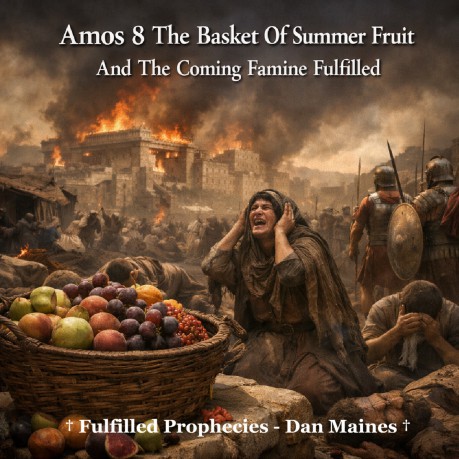
Amos 8 The Basket Of Summer
Fruit And The Coming Famine Fulfilled Introduction † Amos 8 brings us face to face with the final
stage of Israel's covenant judgment, the fruit is ripe, the time is
up, and the Lord declares the end has come (Amos 8:2) † This isn't about the end of the physical
world, it's about the end of the Old Covenant system centered in
Israel, fulfilled in the first century with the destruction of
Jerusalem † The vision of summer fruit shows that Israel
had reached full maturity in sin, and judgment was no longer delayed
(Matthew 23:32, Luke 21:22) Amos 8:1-2 † The basket of summer fruit represents
something fully ripened, Israel's sin had reached its full measure
(Genesis 15:16, Matthew 23:32) † The statement I will no longer spare them
shows that mercy had reached its limit under that covenant system
(Luke 19:41-44) † This directly connects to Jesus weeping over
Jerusalem, declaring their destruction was certain because they did
not recognize their time of visitation (Luke 19:44) Amos 8:3 † The temple songs turning into wailing points
to the destruction of the temple in AD 70 (Matthew 24:1-2) † Josephus records that the streets of
Jerusalem were filled with dead bodies during the siege, fulfilling
this imagery exactly † Silence reflects shock and devastation, the
complete collapse of the old religious system (Lamentations 2:10) Amos 8:4-6 † Israel's leaders were exploiting the poor
while pretending to be religious, showing outward obedience but
inward corruption (Isaiah 1:13-17) † They couldn't wait for Sabbath to end so they
could go back to dishonest gain, revealing their hearts were far from
God (Matthew 15:8) † This is exactly what Jesus condemned in the
Pharisees, devouring widows' houses while appearing righteous
(Matthew 23:14) Amos 8:7-8 † God declaring He will not forget their works
shows judgment is based on covenant accountability (Ecclesiastes
12:14) † The trembling land symbolizes national
upheaval, not a global earthquake, but the shaking of Israel's world
(Hebrews 12:26-28) † This language is consistently used in
scripture for covenant judgment, not the end of the physical planet
(Isaiah 13:13) Amos 8:9-10 † The darkening of the sun is prophetic
language of judgment, not literal cosmic collapse (Isaiah 13:10,
Ezekiel 32:7) † Jesus used the same language in Matthew 24:29
describing the fall of Jerusalem, confirming the connection † Mourning as for an only son reflects the
depth of the national tragedy in AD 70 (Zechariah 12:10) Amos 8:11-12 † This famine is not physical but spiritual,
the removal of God's word from an unfaithful people (Proverbs
1:28-29) † Jesus warned that the kingdom would be taken
from them and given to a nation producing its fruit (Matthew 21:43) † After AD 70, the temple system ended, and
with it their covenant access as they knew it, fulfilling this famine Amos 8:13-14 † The thirst here connects to the famine of
hearing God's word, spiritual collapse among the people (Hosea 4:6) † Idolatry in Samaria and Dan shows their
long-standing rebellion that led to this judgment (1 Kings 12:28-30) † They will fall and not rise again refers to
the end of that covenant system, not individual annihilation (Hebrews
8:13) Historical References † Josephus, Wars of the Jews 5.12-13 describes
famine, death, and devastation in Jerusalem during the Roman siege † Tacitus, Histories 5.12 records the collapse
and suffering of the Jewish nation in that period † Eusebius, Ecclesiastical History 3.5 confirms
the destruction of Jerusalem as a fulfillment of Christ's prophecy How it applies to us today † We see that God is patient, but there is a
point when judgment comes, Israel had centuries of warning before the
end came (2 Peter 3:9) † External religion without a changed heart
leads to judgment, not blessing (Matthew 23:27-28) † We live in the fulfilled kingdom today, not
under fear of that covenant judgment, but in the life Christ has
already secured (Luke 17:20-21) † The famine of hearing the word no longer
applies to us in Christ, because He is the living Word dwelling in us
(John 1:14) † We must walk in truth and not repeat the
hypocrisy of Israel, because God sees the heart (Hebrews 4:13) Q & A Appendix Q: What does the basket of summer fruit
represent? Q: Is the darkening of the sun literal? Q: What is the famine of hearing the word? Q: Did this happen in the first century? Q: Does this apply to us today? † This is the fulfilled perspective we proclaim at
Fulfilled Prophecies † Source Index † Amos 8 † Josephus, Wars of the Jews 5.12-13; Tacitus,
Histories 5.12; Eusebius, Ecclesiastical History 3.5
By Dan Maines
This is what the Lord GOD showed
me, and behold, there was a basket of summer fruit. And He said, What
do you see, Amos? And I said, A basket of summer fruit. Then the LORD
said to me, The end has come for My people Israel. I will no longer
spare them.
The songs of the palace will turn
to wailing on that day, declares the Lord GOD. The corpses will be
many, and in every place they will throw them out in silence.
Hear this, you who trample the
needy, to put an end to the humble of the land, saying, When will the
new moon be over, so that we may sell grain, and the Sabbath, so that
we may open the wheat market, to make the bushel smaller and the
shekel bigger, and to cheat with dishonest scales, so as to buy the
helpless for money and the needy for a pair of sandals, and that we
may sell the refuse of the wheat?
The LORD has sworn by the pride
of Jacob, Indeed, I will never forget any of their deeds. Because of
this will the land not quake and everyone who lives in it mourn?
Indeed, all of it will rise up like the Nile, and it will be tossed
about and subside like the Nile of Egypt.
And it will come about on that
day, declares the Lord GOD, that I will make the sun go down at noon
and make the earth dark in broad daylight. Then I will turn your
festivals into mourning and all your songs into songs of mourning;
and I will bring sackcloth on everyone's waist and baldness on every
head. And I will make it like a time of mourning for an only son, and
the end of it will be like a bitter day.
Behold, days are coming,
declares the Lord GOD, when I will send a famine on the land, not a
famine for bread or a thirst for water, but rather for hearing the
words of the LORD. People will stagger from sea to sea and from the
north even to the east; they will wander about seeking the word of
the LORD, but they will not find it.
On that day the beautiful
virgins and the young men will faint from thirst. As for those who
swear by the guilt of Samaria, who say, As your god lives, Dan, and,
As the way of Beersheba lives, they will fall and not rise again.
A: It represents Israel being fully
ripe for judgment, their sin had reached its full measure (Matthew
23:32)
A:
No, it's prophetic language of judgment used throughout scripture
(Isaiah 13:10, Matthew 24:29)
A:
It's the removal of God's voice from an unfaithful covenant people
(Proverbs 1:28-29)
A:
Yes, it was fulfilled in the destruction of Jerusalem in AD 70 (Luke
21:22)
A:
Not as judgment, but as a warning to walk faithfully in the fulfilled
kingdom (Hebrews 12:28)
© Fulfilled Prophecies - Dan
Maines.
Links