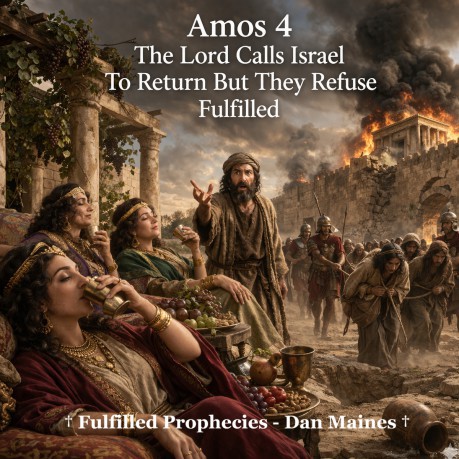
Amos 4 The Lord Calls Israel
To Return But They Refuse Fulfilled Introduction † Amos 4 exposes the stubbornness of Israel,
even after repeated warnings and discipline from God (Amos 4:6-11) Amos 4:1 † These women represent the wealthy and corrupt
leaders living in luxury while oppressing others (Amos 2:6-7) Amos 4:2-3 † This is a picture of captivity, the people
will be dragged away like fish, helpless and humiliated (2 Kings
17:6) Amos 4:4-5 † God is exposing empty religion, they continue
rituals while living in rebellion (Isaiah 29:13) Amos 4:6 † Cleanness of teeth means famine, no food to
eat, yet they still refused to return (Deuteronomy 28:48) Amos 4:7-8 † God controlled the rain to show His authority
and call them back (1 Kings 17:1) Amos 4:9 † Agricultural judgment struck their economy
and livelihood (Haggai 1:11) Amos 4:10 † This recalls the plagues of Egypt, showing
God was treating them like enemies, not covenant keepers (Exodus
9:3) Amos 4:11 † God spared a remnant, a brand pulled from
fire, yet even that mercy didn't lead to repentance (Zechariah 3:2) Amos 4:12 † This is a warning of imminent judgment, not a
future distant event (Luke 21:22) Amos 4:13 † This closing verse reminds them who they're
dealing with, the Creator, not a powerless idol (Psalm 104:3-4) Historical References † Josephus records famine, internal violence,
and destruction in Jerusalem leading up to AD 70, matching the
warnings of repeated judgment How It Applies To Us Today † God is patient, but repeated rejection of
truth leads to judgment, not because He fails, but because people
refuse to return Q & A Appendix Q What does prepare to meet your God mean in Amos
4:12 Q Why did God send famine and drought Q Who are the cows of Bashan Q Was this fulfilled historically Q What is the main message of Amos 4 † This is the fulfilled perspective we proclaim at
Fulfilled Prophecies † Source Index † Amos 4 † Josephus, Wars of the Jews; Tacitus,
Histories; Eusebius, Ecclesiastical History
By Dan Maines
†
This chapter shows that judgment wasn't sudden or unfair, it came
after mercy, patience, and repeated calls to repent (Romans 2:4)
†
From the fulfilled perspective, this points directly to the
first-century generation who also refused to return, even when Christ
stood before them (Matthew 23:37-38)
Hear this word, you cows of Bashan
who are on the mountain of Samaria, who oppress the poor, who crush
the needy, who say to your husbands, Bring now, that we may drink!
†
Their indulgence reflects a system built on injustice, just like the
leaders in Jesus' day who devoured widows' houses (Matthew 23:14)
†
The phrase shows moral decay, they demand pleasure while ignoring
righteousness, revealing a heart far from God (Isaiah 1:23)
The Lord GOD has sworn by His
holiness, For behold, the days are coming upon you when they will
take you away with meat hooks, And the last of you with fish hooks.
You will go out through breaches in the walls, Each one straight
before her, And you will be hurled to Harmon, declares the LORD.
† The imagery reflects Assyrian
practices, fulfilled historically, but also foreshadows the total
destruction of Jerusalem in AD 70 (Luke 21:24)
†
The breaches show their defenses failing, just as the temple and city
walls fell under Roman siege (Josephus, Wars 6.4)
Enter Bethel and do wrong, In
Gilgal multiply wrongdoing! Bring your sacrifices every morning, Your
tithes every three days. Offer a thanksgiving offering also from that
which is leavened, And proclaim voluntary offerings, make them known.
For so you love to do, you sons of Israel, Declares the Lord GOD.
†
Their worship isn't obedience, it's hypocrisy, just like the
Pharisees who honored God with their lips but not their hearts
(Matthew 15:8)
† This shows that religious
activity without righteousness only increases guilt, not favor (Micah
6:6-8)
But I gave you also cleanness of
teeth in all your cities And lack of bread in all your places, Yet
you have not returned to Me, declares the LORD.
†
God used discipline to awaken repentance, but their hearts remained
hard (Hebrews 12:6)
† This pattern repeats in
the first century, despite signs and warnings, they still rejected
Christ (John 12:37)
Furthermore, I withheld the rain
from you While there were still three months until harvest. Then I
would send rain on one city And on another city I would not send
rain; One part would be rained on, While the part not rained on would
dry up. So two or three cities would stagger to another city to drink
water, But would not be satisfied; Yet you have not returned to Me,
declares the LORD.
† Even
selective blessing and judgment didn't move them to repentance
(Jeremiah 5:3)
† Their wandering for water
shows desperation without transformation, they wanted relief, not
repentance (Isaiah 55:2)
I struck you with scorching wind
and mildew; The caterpillar was devouring Your many gardens and
vineyards, fig trees and olive trees; Yet you have not returned to
Me, declares the LORD.
† The
destruction of crops parallels covenant curses for disobedience
(Deuteronomy 28:38-40)
† Even loss of
provision didn't bring them back, showing how deep their rebellion
was (Jeremiah 8:7)
I sent a plague among you as in
Egypt; I killed your young men with the sword along with your
captured horses, And I made the stench of your camp rise up in your
nostrils; Yet you have not returned to Me, declares the LORD.
† War, death, and disease were all
warnings meant to bring repentance (Leviticus 26:25)
†
The same pattern appears before AD 70, with wars, famine, and
pestilence leading up to Jerusalem's fall (Luke 21:11)
I overthrew you, as God overthrew
Sodom and Gomorrah, And you were like a firebrand rescued from a
blaze; Yet you have not returned to Me, declares the LORD.
†
This directly parallels the first-century remnant who escaped
judgment by following Christ (Matthew 24:16)
†
The rest hardened themselves and were destroyed, fulfilling covenant
judgment (Luke 19:44)
Therefore so I will do to you,
Israel; Because I will do this to you, Prepare to meet your God,
Israel.
† To meet
God here is to face Him in judgment, not comfort (Isaiah 13:6)
†
This was fulfilled when Jerusalem faced the Lord's judgment through
the Roman armies (Matthew 22:7)
For behold, He who forms mountains
and creates the wind, And declares to a person what are His thoughts,
He who makes dawn into darkness And treads on the high places of the
earth, The LORD God of armies is His name.
†
The One who controls creation also controls judgment, and His word
cannot fail (Isaiah 46:10)
† This emphasizes
that what was coming upon them was certain and unstoppable (Luke
21:33)
† Tacitus
confirms widespread devastation, war, and suffering in Judea during
the Roman siege
† Eusebius records that
believers fled Jerusalem before its destruction, showing the remnant
preserved just as Amos described
† Religious activity without
obedience still means nothing, it's the same warning then and now
†
We've already seen the fulfillment of covenant judgment, so we now
live in the reality of a completed transition, not waiting for it
†
The call isn't future, it's always present, return to God while He
reveals Himself, not after judgment falls
A It means facing God in judgment, not a
future end-of-world event, but the coming destruction of Israel,
fulfilled in AD 70 (Luke 21:22)
A
These were covenant curses meant to bring repentance, but Israel
refused to return (Deuteronomy 28:23-24)
A
They represent the wealthy, corrupt leaders of Israel who lived in
luxury while oppressing others (Amos 2:6-7)
A
Yes, it was fulfilled in stages, first through Assyrian judgment, and
ultimately in the destruction of Jerusalem in AD 70 (Luke 19:44)
A
God repeatedly called His people to return, but they refused, showing
that judgment comes after persistent rejection (Romans 2:5)
© Fulfilled Prophecies - Dan
Maines.
Links