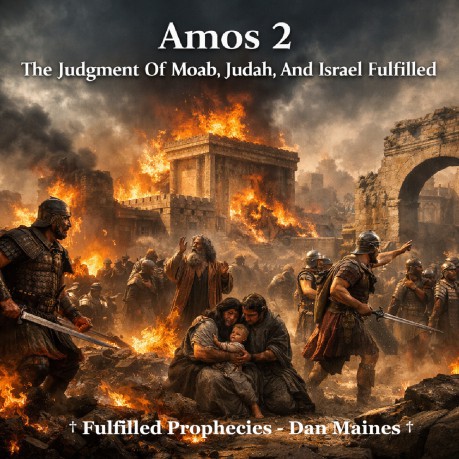
Amos 2 The Judgment Of Moab,
Judah, And Israel Fulfilled Introduction † Amos 2 continues the pattern of judgment, but
now the focus moves from the surrounding nations to Judah and then
directly to Israel. † This shows that God's judgment begins with
His covenant people, the ones who were given the Law and knew His
ways. † From the fulfilled perspective, this chapter
points forward to the covenant judgment that came upon Israel in the
first century, culminating in AD 70 just as Jesus said. Amos 2:1 † Moab's sin shows extreme contempt, even
dishonoring the dead, revealing a hardened and lawless heart. † Sin doesn't stay small, when truth is
rejected it grows worse, just as seen later in Romans 1. † This establishes the pattern, God judges real
actions, not just intentions. Amos 2:2-3 † Judgment here is complete, leadership and
structure fall together. † When authority rejects God, the entire system
collapses with it. † This same pattern shows up later in Israel's
fall in the first century. Amos 2:4 † Now the focus shifts to Judah, and the issue
is clear, they rejected God's Law. † Judgment isn't only for violence, it's for
rejecting truth. † This connects directly to the rejection of
Christ and the prophets in Jesus' generation. Amos 2:5 † This points directly to Jerusalem's
destruction. † From the fulfilled perspective, this was
completed in AD 70 when the city was burned. † Jesus confirmed this judgment would come in
His generation. Amos 2:6-7 † Israel's sins include injustice, oppression,
and immorality. † They failed both in loving others and
honoring God. † This same corruption is exposed by Jesus in
Matthew 23. Amos 2:8 † Worship became corrupted by greed and
exploitation. † Religion was used as a cover for sin instead
of a call to righteousness. † This is exactly what Jesus confronted when He
cleansed the temple. Amos 2:9-10 † God reminds them of His power and past
deliverance. † Their judgment wasn't because God failed, but
because they forgot Him. † This mirrors Israel in the first century, who
had the Law and prophets yet rejected Christ. Amos 2:11-12 † They didn't just ignore God's messengers,
they tried to silence them. † This directly parallels Jesus' words about
killing the prophets. † Rejecting truth always leads to suppressing
it. Amos 2:13-16 † This describes total judgment with no escape. † Strength, speed, and power won't save anyone. † This was fulfilled in the siege of Jerusalem
where none could escape. Historical References † Josephus records the destruction of Jerusalem
with famine, chaos, and total collapse, matching this prophecy. † Eusebius writes that believers recognized the
signs and fled before the destruction. † Tacitus confirms the Roman devastation and
complete overthrow of the city. How It Applies To Us Today † Having truth doesn't guarantee obedience,
Israel had everything and still fell. † God holds people accountable to the truth
they've been given. † Religion without righteousness is empty. † God's Word is proven true because everything
happened exactly as He said. † We now live in the fulfilled kingdom and are
called to walk in truth. Q & A Appendix Q: Why does judgment begin with Judah and
Israel? Q: Was this fulfilled already? Q: What was Israel's main sin? Q: How do we know this connects to AD 70? Q: What does this teach us today? † This is the fulfilled perspective we proclaim at
Fulfilled Prophecies † Source Index † Amos 2
By Dan Maines
This is what the LORD says: For
three offenses of Moab, and for four, I will not revoke its
punishment, because he burned the bones of the king of Edom to lime.
So I will send fire upon Moab,
and it will consume the citadels of Kerioth; and Moab will die amid
the tumult, with war cries and the sound of a trumpet. I will also
eliminate the judge from her midst and slay all her leaders with him,
says the LORD.
This is what the LORD says: For
three offenses of Judah, and for four, I will not revoke its
punishment, because they rejected the Law of the LORD and have not
kept His statutes; their lies have also led them astray, those which
their fathers followed.
So I will send fire upon Judah, and
it will consume the citadels of Jerusalem.
This is what the LORD says: For
three offenses of Israel, and for four, I will not revoke its
punishment, because they sell the righteous for money, and the needy
for a pair of sandals. These who pant after the very dust of the
earth on the head of the helpless also turn aside the way of the
humble; and a man and his father resort to the same girl in order to
profane My holy name.
And on garments seized as pledges
they stretch out beside every altar, and in the house of their God
they drink the wine of those who have been fined.
Yet it was I who destroyed the
Amorite before them, though his height was like the height of cedars
and he was strong as the oaks; I even destroyed his fruit above and
his root below. It was I who brought you up from the land of Egypt,
and I led you in the wilderness forty years so that you might take
possession of the land of the Amorite.
Then I raised up some of your
sons to be prophets and some of your young men to be Nazirites. Is
this not so, you sons of Israel? declares the LORD. But you made the
Nazirites drink wine, and you commanded the prophets, saying, You
shall not prophesy.
Behold, I am weighted down
beneath you as a wagon is weighted down when filled with sheaves.
Flight will perish from the swift, and the strong will not strengthen
his power, nor will the warrior save his life. The one who grasps the
bow will not stand his ground, the swift of foot will not escape, nor
will the one who rides the horse save his life. Even the bravest
among the warriors will flee naked on that day, declares the LORD.
A: Because they had the Law and
rejected it, Luke 12:48.
A:
Yes, it was fulfilled in the first century, Matthew 24:34.
A:
Rejecting truth and oppressing others, Amos 2:6-7.
A:
Jesus tied the judgment of Jerusalem to His generation, Luke
21:20-24.
A:
We must live out truth, not just hear it, James 1:22.
© Fulfilled Prophecies - Dan
Maines.
† Josephus,
Wars of the Jews; Eusebius, Ecclesiastical History; Tacitus,
Histories
Links