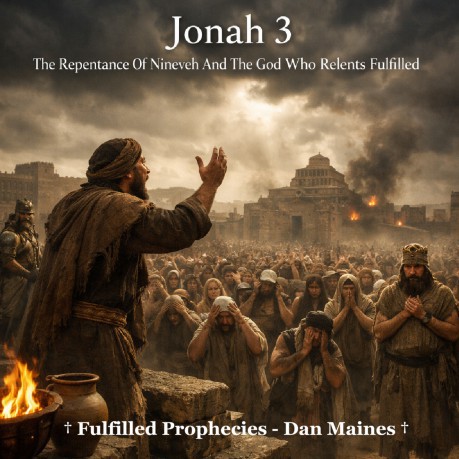
Jonah 3 The Repentance Of
Nineveh And The God Who Relents Fulfilled Introduction † Jonah 3 shows us that God's mercy isn't
limited to Israel, it extends to the nations, and that was always the
plan from the beginning Jonah 3:1-2 Now the word of the LORD came to Jonah the second time, saying,
Get up, go to Nineveh the great city and proclaim to it the
proclamation which I am going to tell you. † God gives Jonah another chance, showing that
His purpose isn't stopped by human failure (Jonah 3:1-2) Jonah 3:3 So Jonah got up and went to Nineveh according to the word of the
LORD. Now Nineveh was an exceedingly large city, a three days walk. † Jonah finally obeys, showing that God's will
will be carried out one way or another (Psalm 115:3) Jonah 3:4 Then Jonah began to go through the city one days walk, and he
cried out and said, Yet forty days and Nineveh will be overthrown. † The message is simple and direct, judgment is
coming, no compromise (Amos 3:8) Jonah 3:5 Then the people of Nineveh believed in God, and they called a fast
and put on sackcloth from the greatest to the least of them. † The entire city responds, from top to bottom,
showing true repentance (Joel 2:12-13) Jonah 3:6-7 When the word reached the king of Nineveh, he got up from his
throne, removed his robe from himself, covered himself with
sackcloth, and sat on the dust. And he issued a proclamation and it
said, In Nineveh by the decree of the king and his nobles: no person,
animal, herd, or flock is to taste anything. They are not to eat or
drink water. † Even the king humbles himself, showing that
no one is above repentance (James 4:10) Jonah 3:8 But both people and animals must be covered with sackcloth, and
people are to call on God earnestly that each may turn from his evil
way and from the violence which is in his hands. † Repentance isn't just words, it involves
turning from sin (Ezekiel 18:30) Jonah 3:9 Who knows, God may turn and relent, and withdraw His burning anger
so that we will not perish. † They understood God's mercy, even without
full covenant knowledge (Psalm 103:8) Jonah 3:10 When God saw their deeds, that they turned from their evil way,
then God relented of the disaster which He had declared He would
bring upon them. So He did not do it. † God responds to repentance, showing His
justice and mercy working together (Jeremiah 18:7-8) Historical References † Josephus records how repentance and national
fasting were known practices among ancient peoples during times of
crisis How It Applies To Us Today † God's word still calls people to repentance
today, and it still brings real change Q & A Appendix Q: Why did God give Nineveh a second chance? Q: What does Nineveh represent? Q: Why is the 40 days important? Q: Did God change His mind? Q: How does this connect to Jesus? † This is the fulfilled perspective we proclaim at
Fulfilled Prophecies † Source Index † Jonah 3
By Dan Maines
† What we're seeing
here isn't just a story about Nineveh, it's a prophetic picture of
repentance being opened to the Gentiles in fulfillment
†
This chapter proves that when God sends His word, it brings real
response, real repentance, and real change
†
The message didn't change, Jonah still had to preach what God said,
not what he wanted (Jeremiah 1:7)
† This
reflects how God sent the gospel again after Israel rejected it, now
going out to the nations (Acts 13:46)
†
Nineveh's size highlights the scale of what God's about to do, this
isn't a small event (Jonah 4:11)
† This
points forward to the global reach of the gospel, not limited to one
nation (Matthew 28:19)
† The forty
days shows a set time frame, just like the generation Jesus spoke of
before judgment (Matthew 24:34)
† This
mirrors the warning given before AD 70, a clear call before
destruction came (Luke 21:20-22)
† They
believed God first, repentance followed belief, not the other way
around (Hebrews 11:6)
† This foreshadows the
Gentiles receiving the word and responding in faith (Acts 11:18)
†
Authority submits to God's word, which is exactly what Israel's
leaders refused to do (Matthew 23:37)
† This
shows the contrast between Nineveh and Jerusalem, one repented, the
other rejected (Matthew 12:41)
† They
recognized their violence and wickedness, showing real conviction
(Psalm 51:17)
† This lines up with the call
of the gospel, repentance and turning to God (Acts 3:19)
†
There's humility here, no demand, just hope in God's character (Micah
7:18)
† This reflects the same mercy shown in
Christ, where judgment is withheld through repentance (Luke 13:3)
†
The turning from sin is what God saw, not just outward actions (1
Samuel 16:7)
† This reveals God's consistent
character, He desires repentance, not destruction (2 Peter 3:9)
† Justin Martyr pointed to Nineveh as
proof that Gentiles were always included in God's redemptive plan
†
Irenaeus referenced Jonah as a sign pointing to Christ and the
inclusion of the nations
† It
isn't about outward religion, it's about turning from sin and
trusting God
† We're seeing here that God's
mercy isn't limited, it's extended to all who respond
†
Just like Nineveh, people today are given time to respond before
judgment
† This reminds us that God's
patience has a purpose, it's leading people to repentance
A:
Because God is merciful and desires repentance, not destruction,
Ezekiel 18:23
A:
The Gentile nations responding to God's word, Acts 11:18
A:
It shows a set period of warning before judgment, like Matthew 24:34
A:
No, He responded according to His nature, which includes mercy toward
repentance, Jeremiah 18:8
A:
Jesus said the men of Nineveh will stand up at the judgment with this
generation and condemn it, because they repented at the preaching of
Jonah, and behold, something greater than Jonah is here, Matthew
12:41
© Fulfilled Prophecies - Dan
Maines.
† Josephus
Antiquities; Justin Martyr First Apology; Irenaeus Against Heresies
Links