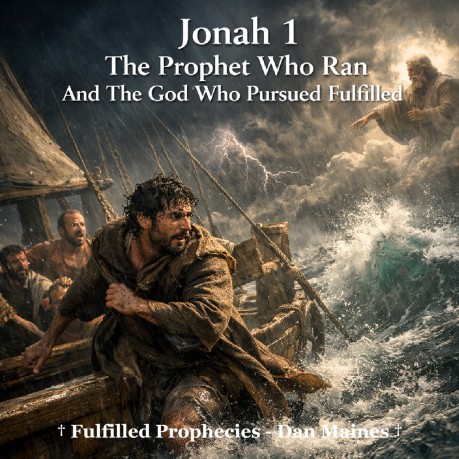
Jonah 1 The Prophet Who Ran
And The God Who Pursued Fulfilled Introduction † Jonah 1 opens with a clear command from God,
yet it immediately shows man's resistance to that command, this sets
the stage for understanding God's sovereignty over both His prophet
and the nations (Jonah 1:1-2). † From the fulfilled perspective, this chapter
isn't just about Jonah, it's about Israel as a whole, called to be a
light to the nations but unwilling to go (Isaiah 49:6). † Jonah's flight represents covenant
unfaithfulness, and God's pursuit shows that His purpose will not
fail, even when His people resist (Romans 3:3-4). Jonah 1:1-2 Now the word of the Lord came to Jonah the son of Amittai, saying,
Arise, go to Nineveh the great city and cry against it, because their
wickedness has come up before Me. † God sends Jonah to Nineveh, a Gentile city,
showing that His concern has always included the nations, not just
Israel (Genesis 12:3). † The command to cry against it shows that
judgment is near, yet warning itself is mercy, God gives opportunity
for repentance (Ezekiel 18:23). † From the fulfilled perspective, this
foreshadows the Gospel going to the nations before Jerusalem's fall,
showing God's consistent plan (Matthew 24:14). Jonah 1:3 But Jonah set out to flee to Tarshish from the presence of the
Lord. So he went down to Joppa, found a ship which was going to
Tarshish, paid the fare, and went down into it to go with them to
Tarshish from the presence of the Lord. † Jonah doesn't just hesitate, he runs in the
opposite direction, showing open rebellion against God's command
(Psalm 139:7-10). † The phrase from the presence of the Lord
shows his mindset, he thinks he can escape God's authority, which is
impossible. † This reflects Israel's refusal to bring truth
to the nations, choosing instead separation and disobedience (Acts
7:51-52). Jonah 1:4 However, the Lord hurled a great wind on the sea and there was a
great storm on the sea so that the ship was about to break up. † God intervenes directly, showing that He
controls creation, even storms obey His will (Psalm 107:25). † The storm isn't random, it's purposeful
judgment aimed at correcting Jonah (Hebrews 12:6). † This mirrors the coming judgment upon Israel,
not random destruction, but divine discipline leading to covenant
fulfillment (Luke 21:22). Jonah 1:5 Then the sailors became afraid and every man cried out to his god,
and they hurled the cargo which was in the ship into the sea to
lighten it for them. But Jonah had gone below into the hold of the
ship, lain down, and fallen sound asleep. † The Gentile sailors fear and pray, while
Jonah, the prophet of God, sleeps, this reverses expectations (Romans
2:21). † Their actions show desperation, but also
sincerity, they respond to danger while Jonah ignores it. † This highlights Israel's spiritual blindness,
while the nations begin to respond to God (Matthew 8:10). Jonah 1:6 So the captain approached him and said, How is it that you are
sleeping? Get up, call on your god. Perhaps your god will be
concerned about us so that we will not perish. † A pagan rebukes God's prophet, calling him to
pray, this shows how far Jonah has fallen (1 Corinthians 14:24-25). † God uses unexpected voices to bring
conviction, even unbelievers can expose disobedience. † This reflects how Gentiles would later
respond to truth while Israel resisted it (Acts 13:46). Jonah 1:7 And each man said to his mate, Come, let’s cast lots so we may
find out on whose account this catastrophe has struck us. So they
cast lots, and the lot fell on Jonah. † Even through casting lots, God directs the
outcome, nothing is outside His control (Proverbs 16:33). † Jonah's sin is exposed publicly, showing that
hidden disobedience will always be revealed. † This mirrors how Israel's guilt would be
exposed before judgment in AD 70 (Luke 12:2). Jonah 1:8-9 Then they said to him, Tell us now, on whose account has this
catastrophe struck us? What is your occupation? And where do you come
from? What is your country? From what people are you? And he said to
them, I am a Hebrew, and I fear the Lord God of heaven who made the
sea and the dry land. † Jonah confesses truth, but his actions
contradict his words, he claims to fear God while fleeing Him (Titus
1:16). † He acknowledges God as Creator, which makes
his attempt to escape even more irrational. † This reflects Israel's condition, knowing
God, yet not obeying Him (Romans 10:2). Jonah 1:10-11 Then the men became extremely frightened and they said to him, How
could you do this? For the men knew that he was fleeing from the
presence of the Lord, because he had told them. So they said to him,
What should we do to you so that the sea will become calm for us? For
the sea was becoming increasingly stormy. † The sailors recognize the seriousness of
Jonah's rebellion more than Jonah himself. † Sin affects others, Jonah's disobedience puts
everyone in danger (Joshua 7:20-25). † This shows how Israel's unfaithfulness
brought judgment that impacted the whole nation. Jonah 1:12 He said to them, Pick me up and throw me into the sea, then the
sea will become calm for you, because I know that on account of me
this great storm has come upon you. † Jonah admits responsibility, showing
awareness but still not repentance. † His willingness to be thrown overboard points
forward to substitution, one for many. † This foreshadows Christ, who willingly gave
Himself to calm the storm of judgment (Matthew 12:40). Jonah 1:13-14 However, the men rowed desperately to return to land but they
could not, because the sea was becoming even stormier against them.
Then they called on the Lord and said, We earnestly pray, Lord, do
not let us perish on account of this man’s life and do not put
innocent blood on us, for You, Lord, have done as You have pleased. † The sailors show compassion, trying to save
Jonah instead of immediately casting him out. † They turn to the true God, showing that
exposure to truth leads to real faith (Romans 10:17). † Their prayer acknowledges God's sovereignty,
recognizing that He alone controls events. Jonah 1:15-16 So they picked up Jonah, threw him into the sea, and the sea
stopped its raging. Then the men became extremely frightened of the
Lord, and they offered a sacrifice to the Lord and made vows. † The storm stops immediately, proving God's
direct involvement. † The Gentiles respond with fear, sacrifice,
and vows, showing true conversion. † This anticipates the inclusion of the
nations, responding to God while Israel resisted (Acts 28:28). Jonah 1:17 And the Lord designated a great fish to swallow Jonah, and Jonah
was in the stomach of the fish for three days and three nights. † God prepares the fish, showing His control
extends even to the depths of the sea. † This is not random, it's a designed act of
deliverance through judgment. † Jesus identifies this as a sign pointing to
His own death and resurrection, fulfilled in that generation (Matthew
12:40). Historical References † Josephus records the reputation of prophets
being sent with warnings of judgment, showing this pattern was well
understood in Jewish history. † Justin Martyr saw Jonah as a type of Christ,
pointing to the death and resurrection within a defined time frame. † Eusebius connects prophetic warnings like
Jonah's with the eventual judgment of Jerusalem, showing continuity
in God's dealings. How It Applies To Us Today † We can't run from God's calling, even if we
try, He's still sovereign over every direction we take. † Disobedience doesn't just affect us, it
impacts others around us, just like Jonah endangered the sailors. † God uses even our failures to accomplish His
purpose, His plan doesn't fail because of human weakness. † The nations responding to God in Jonah's
story reminds us that truth isn't limited, God has always called all
people. † Just like Jonah pointed to Christ, everything
in Scripture leads to fulfillment, not delay. Q & A Appendix Q Was Jonah really trying to escape God? Q Why did God send Jonah to Nineveh? Q What does the storm represent? Q Why did the sailors turn to God? Q How does Jonah point to Christ? † This is the fulfilled perspective we proclaim at
Fulfilled Prophecies † Source Index † Jonah 1
By Dan Maines
A
Yes, but he couldn't, Psalm 139:7-10 shows no one can escape God's
presence.
A
Because God has always cared about the nations, Genesis 12:3.
A
God's direct intervention and discipline, Hebrews 12:6.
A
Because they witnessed His power, Romans 1:20.
A
Through the three days and nights, Matthew 12:40.
© Fulfilled Prophecies - Dan
Maines.
† Josephus,
Antiquities of the Jews
† Justin Martyr,
Dialogue with Trypho
† Eusebius,
Ecclesiastical History
Links