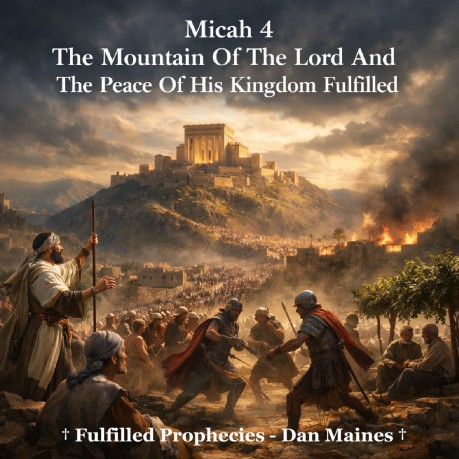
Micah 4 The Mountain Of The
Lord And The Peace Of His Kingdom Fulfilled Introduction † Micah 4 shifts from judgment to restoration,
showing what God was bringing about through Christ during the last
days of the Old Covenant system. † This is not about a future earthly kingdom,
it's about God's kingdom already present in Christ before AD 70. † The prophecy points to Mount Zion, the New
Jerusalem, which believers had already come to in Christ before AD
70, and which was fully vindicated when the Old Covenant system was
removed. Micah 4:1 † The last days refers to the last days of the
Old Covenant system, not the end of the world (Hebrews 1:1-2). † The mountain of the house of the LORD is
Mount Zion, the heavenly Jerusalem believers had already come to
(Hebrews 12:22-23). † Peoples streaming to it shows the nations
already coming into the kingdom through the gospel before AD 70 (Acts
2:5-11). Micah 4:2 † This was fulfilled as the gospel went out
from Jerusalem in the first century (Luke 24:47). † The law going forth is the law of Christ,
already active in the apostolic age (Galatians 6:2). † The nations coming proves this was already
happening before AD 70 (Acts 13:46-48). Micah 4:3 † This is spiritual peace established through
Christ, already present before AD 70 (Ephesians 2:14-16). † The warfare that ended is the division
between Jew and Gentile, removed at the cross (Colossians 2:14). † This is peace with God, not the removal of
all earthly conflict (Romans 5:1). Micah 4:4 † This represents covenant security already
experienced in Christ (Romans 8:1). † The imagery points to rest in Christ, not
physical land (Matthew 11:28). † No fear means freedom from the condemnation
of the law that was passing away (Hebrews 8:13). Micah 4:5 † This shows the distinction between the world
and God's people. † Walking in His name is living under Christ's
authority already present in the first century (Colossians 3:17). † Forever confirms the enduring nature of the
kingdom already established. Micah 4:6 † This gathering was already taking place in
Christ's ministry and the apostolic age (John 10:16). † The lame and afflicted represent the outcasts
being brought in (Luke 14:21). † God was actively gathering His people before
AD 70. Micah 4:7 † The remnant became the church already
established in the first century (Romans 9:27). † Mount Zion is the heavenly Jerusalem
believers had already come to (Hebrews 12:22-23). † God was already reigning through Christ
before AD 70 (Acts 2:30-36). Micah 4:8 † The dominion was restored in Christ's reign
already in effect before AD 70 (Matthew 28:18). † This is not political Israel restored, it's
Christ ruling His kingdom. † The daughter of Jerusalem points to the
covenant people fulfilled in Christ. Micah 4:9 † This reflects Israel rejecting their true
King, Christ (John 19:15). † The childbirth imagery points to the
transition period leading up to AD 70 (Matthew 24:8). † This was happening before the fall, not
after. Micah 4:10 † This has a near historical layer but
ultimately points to redemption in Christ. † The rescue is salvation already accomplished
through the cross (Galatians 1:4). † God's people were already being delivered
before AD 70. Micah 4:11 † This aligns with the Roman siege of Jerusalem
leading up to AD 70. † Nations gathered against her in fulfillment
of Jesus' words (Luke 21:20). † This shows the judgment of the Old Covenant
city. Micah 4:12 † God used those nations as instruments of
judgment (Luke 21:22). † They were unaware they were fulfilling God's
plan. † This is covenant judgment imagery (Matthew
3:12). Micah 4:13 † This speaks of victory through God's power,
not physical warfare. † The church overcomes through Christ, not
military force (2 Corinthians 10:3-5). † God establishes His authority over all
nations through Christ's reign. Historical References † Josephus records the events leading to the
destruction of Jerusalem, confirming the gathering of nations and
judgment. † Eusebius records that believers recognized
the signs and fled Jerusalem before its fall. † Tacitus describes the Roman siege, aligning
with the prophetic gathering against the city. † Justin Martyr and Irenaeus affirm that
believers were already the people of God prior to Jerusalem's fall. How It Applies To Us Today † We've already come to Mount Zion in Christ,
we're not waiting for it. † Our identity is in the heavenly Jerusalem,
not in an earthly system. † The kingdom is already established, so we
live under Christ's reign now. † Our peace is with God through Christ, not
dependent on world events. † We walk in His ways now, showing the
fulfillment of Micah 4. Q & A Appendix Q When are the last days in Micah 4? Q Have believers already come to Mount Zion? Q Is the New Jerusalem future? Q Was the kingdom already established before AD
70? Q What did AD 70 accomplish? † This is the fulfilled perspective we proclaim at
Fulfilled Prophecies † Source Index † Micah 4 † Josephus, Wars of the Jews; Eusebius,
Ecclesiastical History; Tacitus, Histories; Justin Martyr, Dialogue
with Trypho; Irenaeus, Against Heresies
By Dan Maines
And it will come about in the last
days that the mountain of the house of the LORD will be established
as the chief of the mountains. It will be raised above the hills, and
the peoples will stream to it.
And many nations will come and
say, Come and let us go up to the mountain of the LORD and to the
house of the God of Jacob, that He may teach us about His ways and
that we may walk in His paths. For from Zion will go forth the Law,
even the word of the LORD from Jerusalem.
And He will judge between many
peoples and render decisions for mighty, distant nations. Then they
will hammer their swords into plowshares and their spears into
pruning hooks, nation will not lift up sword against nation, and
never again will they train for war.
Each of them will sit under his
vine and under his fig tree, with no one to make them afraid, for the
mouth of the LORD of armies has spoken.
Though all the peoples walk, each
in the name of his god, as for us, we will walk in the name of the
LORD our God forever and ever.
On that day, declares the LORD, I
will assemble the lame and gather the scattered, those whom I have
afflicted.
I will make the lame a remnant and
the scattered a strong nation, and the LORD will reign over them in
Mount Zion from now on and forever.
As for you, tower of the flock,
hill of the daughter of Zion, to you it will come, even the former
dominion will come, the kingdom of the daughter of Jerusalem.
Now, why do you cry out loudly? Is
there no king among you, or has your counselor perished, that agony
has gripped you like a woman in childbirth?
Writhe and labor to give birth,
daughter of Zion, like a woman in childbirth, for now you will go out
of the city, dwell in the field, and go to Babylon. There you will be
rescued, there the LORD will redeem you from the hand of your
enemies.
And now many nations have been
assembled against you who say, Let her be defiled, and let our eyes
gloat over Zion.
But they do not know the thoughts
of the LORD, and they do not understand His plan, for He has gathered
them like sheaves to the threshing floor.
Arise and thresh, daughter of
Zion, for your horn I will make iron and your hooves I will make
bronze, that you may pulverize many peoples, that you may devote to
the LORD their unjust gain and their wealth to the Lord of all the
earth.
A
The last days of the Old Covenant system already taking place in the
first century (Hebrews 1:1-2).
A
Yes, Scripture says you have come, making it a present reality before
AD 70 (Hebrews 12:22-23).
A
No, it was already present in Paul's time as the Jerusalem above
(Galatians 4:26).
A Yes, Christ had all authority and was
already reigning (Matthew 28:18).
A
It marked the removal of the Old Covenant system that was already
becoming obsolete (Hebrews 8:13).
© Fulfilled Prophecies - Dan
Maines.
Links