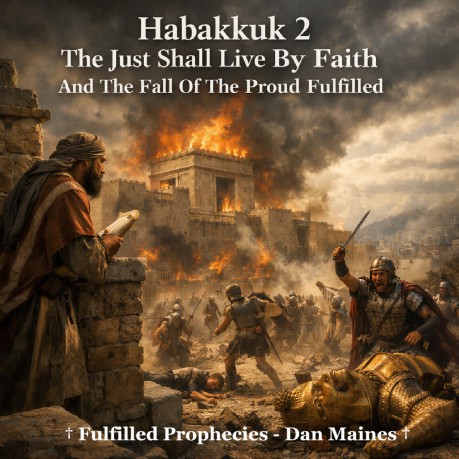
Habakkuk 2 The Just Shall
Live By Faith And The Fall Of The Proud Fulfilled Introduction † Habakkuk stood watching, waiting for God to
answer how judgment would unfold, and what he received wasn't
confusion but clarity about timing, justice, and faith. (Habakkuk
2:1) † The message makes it clear that God's
judgment wasn't random or delayed, it was appointed and certain, and
it would come within their generation. (Habakkuk 2:3) † From the fulfilled perspective, this chapter
points directly to the coming judgment against Jerusalem and the end
of the Old Covenant system, exposing pride and establishing faith as
the way of life. (Habakkuk 2:4) Habakkuk 2:1 † Habakkuk positions himself to receive
revelation, showing expectation, not doubt, God was going to answer.
(Habakkuk 2:1) † This reflects the prophetic role, standing
watch for what God is about to reveal concerning judgment. (Ezekiel
3:17) † It shows that what follows is not
speculation, it's divine revelation about events that were about to
unfold. (Habakkuk 2:2) Habakkuk 2:2-3 † The vision was to be written clearly because
it was urgent and meant to be understood by those living in that
time. (Habakkuk 2:2) † The phrase appointed time shows that God had
already set when this judgment would happen, it wasn't open-ended.
(Habakkuk 2:3) † It will not delay confirms that the
fulfillment would not be pushed thousands of years into the future,
it was imminent to them. (Hebrews 10:37) Habakkuk 2:4 † The contrast is between pride and faith, the
proud trust in themselves, but the righteous trust in God. (Habakkuk
2:4) † This verse is foundational, later quoted in
the New Testament to show that life comes through faith, not through
the law. (Romans 1:17) † In the fulfilled perspective, this marked the
transition from the Old Covenant system to a faith-based relationship
in Christ. (Galatians 3:11) Habakkuk 2:5-8 † The proud are never satisfied, they consume
and take, which describes corrupt leadership and systems. (Habakkuk
2:5) † The woe statements show that judgment would
come back on those who oppressed others. (Habakkuk 2:6) † This directly applies to Jerusalem's
leadership, who had become violent and corrupt, bringing judgment
upon themselves. (Matthew 23:35-36) Habakkuk 2:9-11 † These verses expose false security, people
thought they could build themselves above judgment. (Habakkuk 2:9) † But their own works testify against them,
even the stones cry out against their corruption. (Habakkuk 2:11) † Jesus echoes this idea when He says the
stones would cry out, pointing to undeniable judgment. (Luke 19:40) Habakkuk 2:12-14 † Cities built on injustice will not stand,
they are destined for destruction. (Habakkuk 2:12) † Their labor becomes fuel for judgment,
everything they built is burned up. (Habakkuk 2:13) † Yet through judgment, God's glory is
revealed, this was fulfilled as the gospel spread after Jerusalem's
fall. (Habakkuk 2:14) Habakkuk 2:15-17 † This describes manipulation and exploitation,
exposing others while hiding their own guilt. (Habakkuk 2:15) † The cup of judgment is reversed, what they
gave to others comes back on them. (Habakkuk 2:16) † This is consistent with covenant judgment,
what Israel sowed, they reaped in AD 70. (Matthew 26:52) Habakkuk 2:18-20 † Idolatry is exposed as empty, lifeless, and
powerless. (Habakkuk 2:18) † Trusting in anything other than God leads to
destruction. (Habakkuk 2:19) † God remains sovereign, and all creation is
called to recognize His authority, especially in judgment. (Habakkuk
2:20) Historical References † Josephus records the corruption and violence
within Jerusalem before its fall, confirming the judgment described. † Eusebius speaks of the destruction of
Jerusalem as divine judgment, aligning with the prophetic warnings. † Tacitus describes the internal chaos and
moral decay of the city before its destruction. How It Applies To Us Today † Faith is still the dividing line, pride leads
to destruction, but trusting God brings life. (Habakkuk 2:4) † God still exposes injustice, nothing built on
corruption will stand. (Habakkuk 2:12) † We don't wait for future fulfillment, these
things were fulfilled, and we now live in the reality of that
completed work. (Hebrews 12:28) † We walk by faith in what has already been
accomplished, not waiting for something still to come. (2 Corinthians
5:7) Q & A Appendix Q How do we know this was fulfilled and not
future? Q What does it mean that the righteous shall live
by faith? Q Who were the proud in this context? Q What is the significance of the woes? Q How does this connect to AD 70? † This is the fulfilled perspective we proclaim at
Fulfilled Prophecies † Source Index † Habakkuk † Josephus, Wars of the Jews; Eusebius,
Ecclesiastical History; Tacitus, Histories
By Dan Maines
I will stand at my guard
post
And station myself on the rampart;
And I will keep
watch to see what He will speak to me,
And how I may reply when
I am reprimanded.
Then the Lord answered me and
said,
Record the vision
And inscribe it on tablets,
So
that the one who reads it may run.
For the vision is yet for the
appointed time;
It hurries toward the goal and it will not
fail.
Though it delays, wait for it;
For it will certainly
come, it will not delay long.
Behold, as for the impudent
one,
His soul is not right within him;
But the righteous
one will live by his faith.
Furthermore, wine betrays the
haughty man,
So that he does not stay at home.
He enlarges
his appetite like Sheol,
And he is like death, never
satisfied.
He also gathers to himself all nations
And
collects for himself all peoples.
Will all of these not take up
a song of ridicule against him,
Even a saying full of taunts
against him, and say,
Woe to him who increases what is not
his,
For how long,
And makes himself rich with loans?
Will
your creditors not rise up suddenly,
And those who collect from
you awaken?
Indeed, you will become plunder for them.
Because
you have looted many nations,
All the rest of the peoples will
loot you,
Because of human bloodshed and violence done to the
land,
To the town and all its inhabitants.
Woe to him who makes evil
profit for his household,
To put his nest on high,
To be
saved from the hand of catastrophe!
You have planned a shameful
thing for your house
By bringing many peoples to an end;
So
you are sinning against yourself.
Certainly the stone will cry
out from the wall,
And the rafter will answer it from the
framework.
Woe to him who builds a
city with bloodshed,
And founds a town with violence!
Is it
not indeed from the Lord of armies
That peoples labor merely for
fire,
And nations grow weary for nothing?
For the earth
will be filled
With the knowledge of the glory of the Lord,
As
the waters cover the sea.
Woe to you who make your
neighbors drink,
Who mix in your venom even to make them
drunk,
So as to look at their nakedness!
You will be filled
with disgrace rather than honor.
Now you yourself drink and
expose your own foreskin!
The cup in the Lord's right hand will
come around to you,
And utter disgrace will come upon your
glory.
For the violence done to Lebanon will overwhelm you,
And
the devastation of its animals by which you terrified them,
Because
of human bloodshed and violence done to the land,
To the town
and all its inhabitants.
What benefit is a carved
image when its maker has carved it,
Or a cast metal image, a
teacher of falsehood?
For its maker trusts in his own
handiwork
When he fashions speechless idols.
Woe to him who
says to a piece of wood, Awake!
To a mute stone, Arise!
And
that is your teacher?
Behold, it is overlaid with gold and
silver,
And there is no breath at all inside it.
But the
Lord is in His holy temple.
Let all the earth be silent before
Him.
A The vision was for the appointed time
and would not delay, Hebrews 10:37 confirms it was near in their
time.
A It means life comes through
trusting God, not through the law, Romans 1:17.
A
The corrupt leadership and system of Jerusalem that rejected God,
Matthew 23:37-38.
A
They declare covenant judgment against sin and injustice, showing
accountability, Habakkuk 2:6.
A
The judgment described matches the destruction of Jerusalem,
fulfilling the prophetic warnings, Luke 21:20-22.
© Fulfilled Prophecies - Dan
Maines.
Links