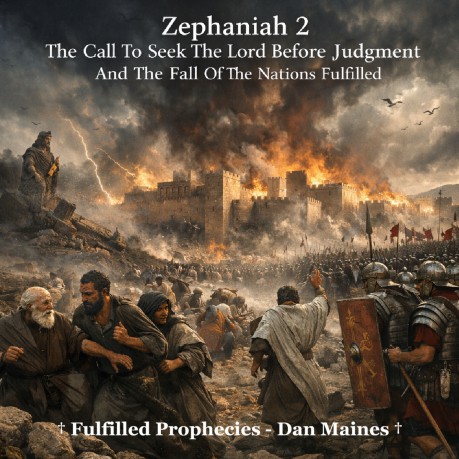
Zephaniah 2 The Call To Seek
The Lord Before Judgment And The Fall Of The Nations Fulfilled Introduction † Zephaniah 2 continues the warning that
judgment was coming, but it also gives a clear call to seek the Lord
before that day arrives. † This wasn't written to a distant future
generation, it was written to those who were about to face the Day of
the Lord in their own time. † From the fulfilled perspective, this chapter
points directly to the events leading up to the destruction of
Jerusalem in AD 70 and the surrounding judgments on the nations. Zephaniah 2:1-3 † The call to gather and seek the Lord shows
there was still time before judgment fully arrived, this matches the
warning period Jesus gave in Matthew 24:15-16 when He told them to
flee. † The phrase it may be ye will be hid connects
directly to the protection of believers who escaped Jerusalem before
its destruction, just as recorded historically (Matthew 24:16, Luke
21:20-21). † This wasn't a vague future warning, it was
urgent and immediate, aimed at that generation who was about to face
covenant judgment (Matthew 23:36). Zephaniah 2:4-7 † The judgment against the Philistine cities
shows that God's Day of the Lord wasn't limited to Jerusalem, it
involved surrounding nations tied to covenant history. † The remnant language shows preservation, not
total destruction, this lines up with the faithful remnant that
survived and entered the New Covenant reality (Romans 11:5). † The promise of restoration points to covenant
transition, not a political rebuilding, but a shift into a new
covenant people under Christ (Hebrews 12:22-24). Zephaniah 2:8-11 † The judgment of Moab and Ammon ties directly
to their pride against God's people, showing that covenant opposition
always brought consequences. † The statement that all the gods of the earth
would be famished points to the collapse of the old religious
systems, fulfilled as the gospel spread and idolatry lost its power
(Acts 17:30-31). † The worship from all nations shows the
expansion of the kingdom beyond Israel, fulfilled in the gathering of
the Gentiles into Christ (Ephesians 2:11-13). Zephaniah 2:12-15 † The fall of Assyria and Nineveh shows a
pattern of how God brings down proud nations, this becomes the
backdrop for understanding Jerusalem's own fall in the first century. † The statement I am, and there is none else
besides me mirrors the arrogance later seen in Jerusalem's
leadership, who rejected Christ and trusted in their own system (John
11:48). † The complete desolation imagery parallels
what Jesus described for Jerusalem, where not one stone would be left
upon another (Matthew 24:2). Historical References † Josephus records that believers fled
Jerusalem before its destruction, preserving a remnant exactly as
warned (Wars of the Jews, Book 6). † Eusebius confirms that the church escaped to
Pella, showing that those who sought the Lord were hidden in the day
of wrath (Ecclesiastical History, Book 3). † Tacitus describes the devastation of
Jerusalem and the surrounding regions, confirming the scale of
judgment that matched prophetic warnings (Histories 5.13). How It Applies To Us Today † The call to seek the Lord still stands, not
for a future destruction, but as a reminder that God always calls His
people to humility and obedience. † The preservation of the remnant shows that
God is faithful to protect His people, even in the midst of judgment. † The fall of proud nations reminds us that no
system, religious or political, can stand against God, only those in
Christ remain. † The expansion to all nations shows that we're
part of the fulfilled kingdom, not waiting for it, but living in it
now. Q&A Appendix Q Was Zephaniah 2 about a future end of the
world? Q What does it mean to be hidden in the day of
wrath? Q Why are the nations mentioned in this
chapter? Q What is the significance of the remnant? Q Has the worship of all nations already been
fulfilled? † This is the fulfilled perspective we proclaim at
Fulfilled Prophecies † Source Index † Zephaniah
By Dan Maines
Gather yourselves together,
yes, gather together, You nation without shame, Before the decree
takes effect, The day passes like chaff, Before the burning anger of
the Lord comes upon you, Before the day of the Lord's anger comes
upon you. Seek the Lord, All you humble of the earth Who have
practiced His ordinances; Seek righteousness, seek humility. Perhaps
you will remain hidden On the day of the Lord's anger.
For Gaza will be abandoned
And Ashkelon a desolation; Ashdod will be driven out at noon, And
Ekron will be uprooted. Woe to the inhabitants of the seacoast, The
nation of the Cherethites! The word of the Lord is against you,
Canaan, land of the Philistines; And I will eliminate you So that
there will be no inhabitant. So the seacoast will become grazing
places, With pastures for shepherds and folds for flocks. And the
coast will be For the remnant of the house of Judah, They will
pasture on it. In the houses of Ashkelon they will lie down at
evening; For the Lord their God will care for them And restore their
fortunes.
I have heard the taunting
of Moab And the abusive speech of the sons of Ammon, With which they
have taunted My people And boasted against their territory.
Therefore, as I live, declares the Lord of armies, The God of Israel,
Moab will assuredly be like Sodom And the sons of Ammon like
Gomorrah, A place possessed by weeds and salt pits, And a permanent
desolation. The remnant of My people will plunder them And the
remainder of My nation will inherit them. This they will have in
return for their pride, because they have taunted and become arrogant
against the people of the Lord of armies. The Lord will be terrifying
to them, For He will starve all the gods of the earth; And all the
coastlands of the nations will bow down to Him, everyone from his own
place.
You Cushites also will be
slain by My sword. And He will stretch out His hand against the north
And eliminate Assyria, And He will make Nineveh a desolation, Parched
like the wilderness. Flocks will lie down in her midst, All kinds of
animals; Both the pelican and the hedgehog Will lodge in the tops of
her pillars; Their voices will sing in the windows; Desolation will
be on the thresholds; For He has stripped the cedar work. This is the
carefree city That dwells securely, That says in her heart, I am, and
there is no one besides me. How she has become a desolation, A
resting place for animals! Everyone who passes by her will hiss And
wave his hand in contempt.
A No, it was about the Day of the Lord
coming upon that generation, fulfilled in the first century (Matthew
24:34).
A It refers to believers escaping the
judgment on Jerusalem, as Jesus instructed (Luke 21:20-21).
A Because God's judgment extended
beyond Israel to all nations connected to covenant history (Acts
17:30-31).
A
It shows that God preserved a faithful people who entered the New
Covenant (Romans 11:5).
A Yes, through the gospel going out
to the Gentiles and forming one body in Christ (Ephesians 2:14-16).
© Fulfilled Prophecies - Dan
Maines.
† Josephus,
Wars of the Jews, Book 6; Eusebius, Ecclesiastical History, Book 3;
Tacitus, Histories 5.13
Links