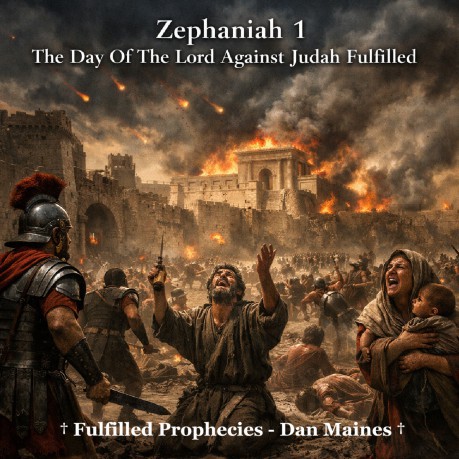
Zephaniah 1 The Day Of The
Lord Against Judah Fulfilled Introduction † Zephaniah 1 is one of the clearest warnings
of judgment against covenant Israel, not the end of the physical
world, but the end of their covenant world. † The language is intense, cosmic, and total,
and that's exactly how God described covenant judgment throughout the
Old Testament. † When we read this from the fulfilled
perspective, we see that this wasn't about some distant future, it
was about the coming destruction of Jerusalem, culminating in AD 70. Zephaniah 1:2-3 † This language echoes Genesis and the flood,
showing total covenant judgment, not literal global destruction
(Zephaniah 1:2-3). † God uses creation language to describe the
removal of a covenant system, just like Isaiah did when speaking of
Babylon (Isaiah 13:10). † This is about the end of Israel's covenant
order, not the annihilation of the planet. Zephaniah 1:4-6 † The judgment is clearly directed at Judah and
Jerusalem, this is not worldwide, it's covenantal (Zephaniah 1:4). † Their sin was mixture, claiming to worship
God while serving idols, which Jesus later condemned in that same
system (Matthew 23:27-28). † This shows the same corrupt system that would
later reject Christ and be judged. Zephaniah 1:7 † The day of the Lord is said to be at hand,
meaning near in their time, not thousands of years later (Zephaniah
1:7). † The sacrifice language points to judgment,
where the people themselves become the sacrifice. † Jesus used similar language when speaking of
Jerusalem's destruction (Luke 19:43-44). Zephaniah 1:8-9 † Leadership is specifically targeted, the
rulers, priests, and elites who corrupted the nation (Zephaniah 1:8). † This matches Jesus' focus on the leaders in
Matthew 23, where judgment begins with them. † Their violence and deceit filled the house,
and that house was the temple system that was about to fall. Zephaniah 1:10-11 † Specific locations in Jerusalem are named,
proving this is a local judgment, not global (Zephaniah 1:10). † The economic collapse is described, which
matches the siege conditions in AD 70. † Those who trusted in wealth and trade were
destroyed along with the city. Zephaniah 1:12-13 † God says He will search Jerusalem, again
confirming the target is covenant Israel (Zephaniah 1:12). † These people believed God wouldn't act, just
like in the first century when they rejected Christ. † Their houses and wealth being taken matches
the Roman destruction described by Josephus. Zephaniah 1:14-16 † The day is described as near repeatedly,
there is no justification to push this thousands of years forward
(Zephaniah 1:14). † The imagery matches Jesus' Olivet Discourse,
where He described the fall of Jerusalem with the same language
(Matthew 24:29-34). † Trumpets, darkness, and distress all point to
covenant judgment, not the end of the physical universe. Zephaniah 1:17-18 † The land being devoured refers to the land of
Israel, not the entire planet (Zephaniah 1:18). † Wealth cannot save them, just like in AD 70
when famine and destruction overtook all classes. † This is a complete end of that covenant
system, exactly what Jesus said would happen within that generation
(Matthew 24:34). Historical References † Josephus describes the destruction of
Jerusalem in AD 70 with famine, bloodshed, and total devastation,
matching Zephaniah's warnings. † Eusebius records how believers fled Jerusalem
before the destruction, recognizing the signs Jesus gave. † Tacitus confirms the Roman siege and the
collapse of the city, aligning with the prophetic language. How It Applies To Us Today † This shows us that God keeps His word, when
He says judgment is near, it happens. † It reminds us that outward religion without
true faith leads to destruction. † It confirms that all of Jesus' warnings were
fulfilled, giving us confidence that we now live in the fulfilled
kingdom. † It calls us to walk in truth, not in mixture
or hypocrisy like they did. Q & A Appendix Q Was Zephaniah 1 about the end of the world? Q What is the day of the Lord here? Q Why does it sound like total destruction? Q How do we know it's near in their time? Q Who were the wicked being judged? † This is the fulfilled perspective we proclaim at
Fulfilled Prophecies † Source Index † Zephaniah 1 † Josephus, Wars of the Jews; Eusebius,
Ecclesiastical History; Tacitus, Histories
By Dan Maines
I will completely remove all
things from the face of the earth, declares the Lord. I will remove
man and animal, I will remove the birds of the sky and the fish of
the sea, and the ruins along with the wicked; and I will eliminate
mankind from the face of the earth, declares the Lord.
So I will stretch out My
hand against Judah and against all the inhabitants of Jerusalem. And
I will eliminate the remnant of Baal from this place, and the names
of the idolatrous priests along with the priests, and those who bow
down on the housetops to the heavenly lights, and those who bow down
and swear to the Lord and yet swear by Milcom, and those who have
turned back from following the Lord, and those who have not sought
the Lord nor inquired of Him.
Be silent before the Lord God!
For the day of the Lord is near, for the Lord has prepared a
sacrifice, He has consecrated His guests.
Then it will come about on
the day of the Lord's sacrifice that I will punish the officials and
the king's sons, and all who clothe themselves with foreign garments.
And I will punish on that day all who leap on the temple threshold,
who fill the house of their lord with violence and deceit.
On that day, declares the
Lord, there will be the sound of a cry from the Fish Gate, a wail
from the Second Quarter, and a loud crash from the hills. Wail,
inhabitants of the Mortar, for all the people of Canaan will be
silenced; all who weigh out silver will be eliminated.
And it will come about at
that time that I will search Jerusalem with lamps, and I will punish
the people who are stagnant in spirit, who say in their hearts, The
Lord will not do good or evil! Moreover, their wealth will become
plunder and their houses desolate; Yes, they will build houses but
not inhabit them, and plant vineyards but not drink their wine.
Near is the great day of
the Lord, near and coming very quickly; listen, the day of the Lord!
In it the warrior cries out bitterly. A day of wrath is that day, a
day of trouble and distress, a day of destruction and desolation, a
day of darkness and gloom, a day of clouds and thick darkness, a day
of trumpet and battle cry against the fortified cities and the high
corner towers.
I will bring distress on
mankind so that they will walk like those who are blind, because they
have sinned against the Lord; and their blood will be poured out like
dust and their flesh like dung. Neither their silver nor their gold
will be able to save them on the day of the Lord's wrath; and all the
earth will be devoured by the fire of His jealousy, for He will make
a complete end, indeed a terrifying one, of all the inhabitants of
the earth.
A
No, it was about the judgment of Judah and Jerusalem, using prophetic
language seen in Isaiah 13:10 and Matthew 24:29-34.
A
It refers to God's judgment on Israel, fulfilled in the destruction
of Jerusalem in AD 70, as confirmed in Luke 21:20-22.
A
Because covenant judgment is described in de-creation language, just
like Genesis reversal imagery, seen in Isaiah 34:4.
A
The text says it repeatedly, and Jesus confirms the same time frame
in Matthew 24:34.
A
The covenant people of Judah who were corrupt, idolatrous, and
rejected God, as also described in Matthew 23:29-36.
© Fulfilled Prophecies - Dan
Maines.
Links