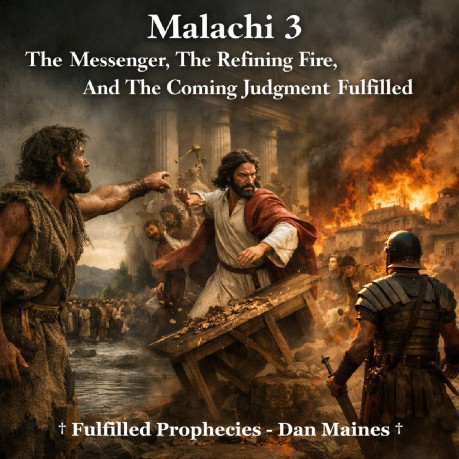
Malachi 3 The Messenger, The
Refining Fire, And The Coming Judgment Fulfilled Introduction † Malachi 3 continues the warning to Israel's
corrupt priesthood and unfaithful people, but now it shifts to the
coming of the Lord in judgment, not in some distant future, but in
their generation. † The chapter reveals a messenger preparing the
way, a refining fire, and a coming day of judgment that would purify
a remnant and destroy the wicked. † From the fulfilled perspective, this is
pointing directly to John the Baptist, Christ, and the judgment that
came upon Jerusalem in AD 70. Malachi 3:1 Behold, I am sending My messenger, and he will clear a way before
Me. And the Lord, whom you are seeking, will suddenly come to His
temple, and the messenger of the covenant in whom you delight,
behold, He is coming, says the LORD of armies. † This is clearly fulfilled in John the Baptist
preparing the way for Christ, as confirmed in Matthew 11:10. † The Lord coming to His temple wasn't
thousands of years later, it happened in that generation when Christ
entered the temple and later judged it. † The messenger of the covenant is Christ
Himself, the one who brings the New Covenant and fulfills all
promises. Malachi 3:2 But who can endure the day of His coming? And who can stand when
He appears? For He is like a refiner's fire and like launderer's
soap. † The coming described here is not gentle, it's
a refining and purifying judgment. † Jesus' ministry exposed hypocrisy, cleansed
the temple, and brought division, showing this refining work had
already begun. † The ultimate fulfillment came in the
destruction of Jerusalem, where only the faithful remnant remained. Malachi 3:3 And He will sit as a smelter and purifier of silver, and He will
purify the sons of Levi and refine them like gold and silver, so that
they may present to the LORD offerings in righteousness. † The sons of Levi represent the priesthood,
which was corrupt in Malachi's day. † Christ purified a new priesthood, not based
on lineage, but on righteousness, fulfilled in the church. † This shows a covenant transition, from the
old corrupt system to a purified people in Christ. Malachi 3:4 Then the offering of Judah and Jerusalem will be pleasing to the
LORD as in the days of old and as in former years. † This is not a return to animal sacrifices,
but a restoration of acceptable worship through Christ. † Hebrews 10 shows that the old sacrifices were
replaced with a better offering. † The true worship restored is spiritual, not
tied to the temple system. Malachi 3:5 Then I will come near to you for judgment, and I will be a swift
witness against the sorcerers and against the adulterers and against
those who swear falsely, and against those who oppress the wage
earner in his wages, the widow and the orphan, and those who turn
away the stranger and do not fear Me, says the LORD of armies. † God says He will come near for judgment, not
far off in time. † These sins were rampant in first-century
Israel, exactly what Jesus rebuked in the Gospels. † The judgment culminated in AD 70 when that
system was removed. Malachi 3:6 For I, the LORD, do not change, therefore you, the sons of Jacob,
have not come to an end. † God's unchanging nature is why a remnant is
preserved. † Even in judgment, He remains faithful to His
promises. † This shows mercy within judgment, not the
absence of judgment. Malachi 3:7 From the days of your fathers you have turned aside from My
statutes and have not kept them. Return to Me, and I will return to
you, says the LORD of armies. But you say, How shall we return? † Israel's pattern of rebellion continued into
the first century. † Jesus called them to repentance repeatedly,
yet most rejected Him. † Their question shows blindness, they didn't
recognize their own sin. Malachi 3:8 Will a man rob God? Yet you are robbing Me! But you say, How have
we robbed You? In tithes and offerings. † Their worship was corrupted, even their
giving was dishonest. † This wasn't about modern tithing systems, but
covenant unfaithfulness. † The leadership had turned God's commands into
empty rituals. Malachi 3:9 You are cursed with a curse, for you are robbing Me, the entire
nation of you! † The curse here ties directly to the covenant
curses of Deuteronomy 28. † This shows they were still under the Old
Covenant system at that time. † That curse reached its climax in the
destruction of Jerusalem. Malachi 3:10 Bring the whole tithe into the storehouse, so that there may be
food in My house, and put Me to the test now in this, says the LORD
of armies, if I do not open for you the windows of heaven and pour
out for you a blessing until it overflows. † This is often misused today, but it was
directed to Israel under the Law. † The promise was tied to covenant obedience
within that system. † It cannot be separated from the temple and
priesthood context. Malachi 3:11 Then I will rebuke the devourer for you, so that it will not
destroy the fruits of the ground; nor will your vine fail to produce
fruit in the field, says the LORD of armies. † These are agricultural blessings tied to
covenant faithfulness. † Again, this is Old Covenant language, not New
Covenant instruction. † It reinforces that Malachi is addressing
Israel under the Law. Malachi 3:12 All the nations will call you blessed, for you shall be a
delightful land, says the LORD of armies. † Israel was meant to be a light to the
nations. † Their failure led to judgment, but the
promise finds fulfillment in the global reach of the gospel. † The nations are now included through Christ. Malachi 3:13 Your words have been arrogant against Me, says the LORD. Yet you
say, What have we spoken against You? † They spoke arrogantly against God while
claiming innocence. † This same attitude is seen in the Pharisees. † Their blindness led to their downfall. Malachi 3:14 You have said, It is useless to serve God, and what benefit is it
that we have kept His requirement and that we have walked in mourning
before the LORD of armies? † They saw no value in serving God, showing a
hardened heart. † This reflects a religion without faith. † Jesus confronted this exact mindset. Malachi 3:15 So now we call the arrogant blessed; not only are the doers of
wickedness built up, but they also put God to the test and escape. † They believed the wicked were prospering
without consequence. † This confusion is common when judgment is
delayed. † But judgment did come, just as God said. Malachi 3:16 Then those who feared the LORD spoke to one another, and the LORD
gave attention and heard it, and a book of remembrance was written
before Him for those who fear the LORD and esteem His name. † Here we see the faithful remnant. † God always preserves those who fear Him. † This group represents those who followed
Christ. Malachi 3:17 They will be Mine, says the LORD of armies, on the day that I
prepare My own possession, and I will spare them as a man spares his
own son who serves him. † This is covenant language fulfilled in the
New Covenant people. † The faithful were spared during the coming
judgment. † History records that Christians fled
Jerusalem before its destruction. Malachi 3:18 So you will again distinguish between the righteous and the
wicked, between one who serves God and one who does not serve Him. † The coming judgment would make this
distinction clear. † AD 70 revealed who truly belonged to God. † The old system ended, and the true people of
God were revealed. Historical References † Josephus records the destruction of Jerusalem
and the suffering that came upon the people, confirming the judgment
described. † Eusebius notes that Christians fled Jerusalem
before its fall, showing the preservation of the faithful. † Tacitus also records the devastation of
Judea, aligning with the prophetic warnings. How It Applies To Us Today † We see that God's promises are sure, He did
exactly what He said He would do. † The New Covenant is established, and we're
not under the old system of law, tithes, and temple worship. † We're part of the refined people, called to
offer spiritual worship in righteousness. † Judgment already came upon that system, and
now we live in the fullness of what was fulfilled. Q & A Appendix Q Who is the messenger in Malachi 3:1 Q When did the Lord come to His temple Q What is the refining fire referring to Q Is Malachi 3:10 about Christians tithing
today Q Who are those written in the book of
remembrance † This is the fulfilled perspective we proclaim at
Fulfilled Prophecies † Source Index † Malachi 3 † Josephus, Wars of the Jews; Eusebius,
Ecclesiastical History; Tacitus, Histories
By Dan Maines
A
John the Baptist, confirmed in Matthew 11:10
A
In the first century, during Jesus' ministry and culminating in
judgment in AD 70, Luke 21:5-6, 20-22
A
The purifying work of Christ and the judgment that removed the
corrupt system, Matthew 3:11-12
A No, it was directed to Israel under the
Law and tied to the temple system, Hebrews 7:12
A The faithful remnant who followed
God and were preserved, Luke 10:20
© Fulfilled Prophecies - Dan
Maines.
Links