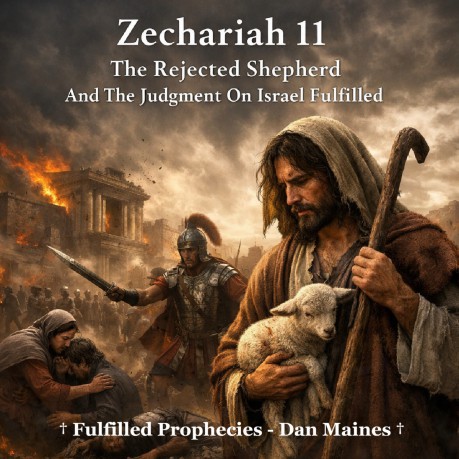
Zechariah 11 The Rejected
Shepherd And The Judgment On Israel Fulfilled Introduction † Zechariah 11 shows Israel rejecting their
true Shepherd and the judgment that followed in their generation. Zechariah 11:1 † Lebanon represents the northern gateway into
the land, showing invasion and judgment entering Israel. (Zechariah
11:1) Zechariah 11:2 † The fall of the "goodly ones"
points to the destruction of Israel's leadership. (Zechariah 11:2) Zechariah 11:3 † The shepherds represent Israel's leaders,
priests and rulers. (Ezekiel 34:2) Zechariah 11:4 † Israel is called a flock of slaughter because
of their coming judgment. (Zechariah 11:4) Zechariah 11:5 † Their leaders exploited them while claiming
they were blessed. (Zechariah 11:5) Zechariah 11:6 † God removes protection, meaning judgment is
certain and unavoidable. (Zechariah 11:6) Zechariah 11:7 † The Shepherd represents Christ caring for the
humble and poor. (Zechariah 11:7) Zechariah 11:8 † The three shepherds represent corrupt
leadership removed under judgment. (Zechariah 11:8) Zechariah 11:9 † This describes famine and desperation during
the siege of Jerusalem. (Zechariah 11:9) Zechariah 11:10 † Breaking Favor shows covenant blessing being
removed from that generation. (Zechariah 11:10) Zechariah 11:11 † The faithful remnant understood what was
happening. (Zechariah 11:11) Zechariah 11:12 † This directly points to Judas betraying
Christ for thirty pieces of silver. (Zechariah 11:12) Zechariah 11:13 † This was fulfilled when Judas threw the money
into the temple and it was used for the potter's field. (Matthew
27:5-7) Zechariah 11:14 † Breaking Union shows division and loss of
unity. (Zechariah 11:14) Zechariah 11:15 † After rejecting the true Shepherd, they were
given over to foolish leaders. (Zechariah 11:15) Zechariah 11:16 † This describes corrupt leadership that
exploits instead of cares. (Zechariah 11:16) Zechariah 11:17 † Judgment is pronounced on worthless
shepherds. (Zechariah 11:17) Historical References † Josephus records the famine, division, and
destruction of Jerusalem in AD 70. How It Applies To Us Today † This shows the danger of rejecting truth when
God reveals it. Q & A Appendix Q Who is the Shepherd in Zechariah 11? Q When was this fulfilled? Q What does the thirty pieces of silver
represent? Q What does breaking the staffs mean? Q Who are the foolish shepherds? † This is the fulfilled perspective we proclaim at
Fulfilled Prophecies † Source Index † Zechariah 11
By Dan Maines
†
This isn't about a distant future, it points directly to the first
century when Christ came and was rejected.
†
The chapter reveals both the value they placed on Him and the
destruction that came because of it.
Open your doors,
Lebanon,
That a fire may feed on your cedars.
† The fire devouring the cedars points
to total destruction of what appeared strong and secure. (Matthew
24:2)
† This aligns with the Roman
destruction of Jerusalem when the entire system collapsed. (Luke
19:43-44)
Wail, juniper tree, for the
cedar has fallen,
Because the majestic trees have been
destroyed;
Wail, oaks of Bashan,
For the impenetrable
forest has come down.
†
The strong forest coming down shows a complete collapse, not partial
judgment. (Isaiah 10:33-34)
† This was
fulfilled when both the temple and ruling class were destroyed in AD
70. (Josephus, Wars of the Jews, Book 6)
There is a sound of the
shepherds' wail,
For their glory is ruined;
There is a
sound of the young lions' roar,
For the pride of the Jordan is
ruined.
† Their
glory being destroyed shows their authority collapsing under
judgment. (Zechariah 11:3)
† The pride of the
land being destroyed reflects the fall of the entire nation. (Luke
21:20)
This is what the Lord my God
says: "Pasture the flock doomed to slaughter.
†
Jesus echoed this when He wept over Jerusalem knowing what was
coming. (Luke 19:41-44)
† This shows covenant
accountability, they rejected the Shepherd sent to them. (Matthew
23:37-38)
Those who buy them slaughter
them and go unpunished, and each of those who sell them says,
"Blessed be the Lord, for I have become rich!" And their
own shepherds have no compassion for them.
† Jesus
rebuked this same hypocrisy among the Pharisees. (Matthew 23:14)
†
Their shepherds had no compassion, proving they were false leaders.
(John 10:12-13)
For I will no longer have
compassion on the inhabitants of the land," declares the Lord;
"but behold, I will have the people fall, each into another's
power and into the power of his king; and they will strike the land,
and I will not save them from their power."
†
Delivering them to their king points to Roman authority ruling over
them. (John 19:15)
† There would be no rescue
because they rejected the One who saves. (Luke 13:34-35)
So I pastured the flock
doomed to slaughter, for the afflicted of the flock. And I took for
myself two staffs, the one I called Favor and the other I called
Union, so I pastured the flock.
† Favor
represents covenant grace and Union represents unity offered to
Israel. (Ephesians 2:14)
† Christ came
offering peace and restoration, but it was rejected. (John 1:11)
Then I eliminated the three
shepherds in one month, for my soul was impatient with them, and
their soul also was weary of me.
†
Christ openly confronted and exposed these leaders. (Matthew
23:1-36)
† The mutual rejection shows they
hated Him as He rejected them. (John 15:24)
Then I said, "I will not
pasture you. What is to die, let it die, and what is to perish, let
it perish; and let those who are left eat one another's flesh."
†
Josephus records cannibalism during this time, confirming the
fulfillment. (Josephus, Wars of the Jews, Book 6)
†
This is the result of rejecting the Shepherd. (Luke 21:23)
I took my staff Favor and
cut it in pieces, to break my covenant which I had made with all the
peoples.
†
This ties to the end of the Old Covenant system. (Hebrews 8:13)
†
The destruction of the temple made this visible. (Matthew 24:2)
So it was broken on that
day, and the afflicted of the flock who were watching me realized
that it was the word of the Lord.
† Believers
recognized the signs and responded accordingly. (Luke 21:20-21)
†
This proves fulfillment happened in their lifetime.
And I said to them, "If
it is good in your sight, give me my wages; but if not, never mind!"
So they weighed out thirty shekels of silver as my wages.
†
Fulfilled exactly in Matthew 26:15.
† This
shows how little they valued the Shepherd.
Then the Lord said to me,
"Throw it to the potter, that magnificent price at which I was
valued by them." So I took the thirty shekels of silver and
threw them to the potter in the house of the Lord.
† God exposes their rejection through
irony in the wording. (Zechariah 11:13)
†
This confirms Christ is the Shepherd in this prophecy.
Then I cut in pieces my
second staff Union, to break the brotherhood between Judah and
Israel.
† This was fulfilled
in internal conflict during the siege. (Josephus, Wars of the Jews,
Book 5)
† Israel collapsed from within as
well as from outside pressure.
The Lord said to me, "Take
again for yourself the equipment of a foolish shepherd.
†
Jesus warned of false leaders rising up. (Matthew 24:5)
†
This led the people deeper into destruction.
For behold, I am going to
raise up a shepherd in the land who will not care for the perishing,
seek the scattered, heal the broken, or sustain the one standing, but
will devour the flesh of the fat sheep and tear off their hoofs.
†
This matches the leadership during the Roman siege. (Josephus, Wars
of the Jews)
† Rejecting truth leads to
destructive leadership.
Woe to the worthless
shepherd who abandons the flock! A sword will be on his arm and on
his right eye! His arm will be totally withered and his right eye
will be completely blind.
† God holds
leaders accountable for harming His people. (Ezekiel 34:10)
†
The loss of strength and sight symbolizes total collapse of
authority.
† Tacitus
describes the chaos and devastation during the Roman siege.
†
Eusebius records that believers fled Jerusalem before its fall.
† It confirms Jesus was the
Shepherd they rejected, fulfilling prophecy exactly.
†
It reminds us that judgment came in that generation just as Jesus
said. (Matthew 24:34)
† It calls us to trust
what has already been fulfilled and not push it into the future.
A
Jesus Christ, shown in the thirty pieces of silver, Matthew 26:15,
Matthew 27:5-7
A
In the first century leading to AD 70, Luke 21:20-24
A The betrayal of Christ by Judas,
Zechariah 11:12, Matthew 26:15
A
The removal of covenant favor and unity, Hebrews 8:13
A
Corrupt leaders who misled Israel before destruction, Matthew 23:1-36
© Fulfilled Prophecies - Dan
Maines.
†
Josephus, Wars of the Jews, Books 5-6; Tacitus, Histories 5;
Eusebius, Ecclesiastical History
Links