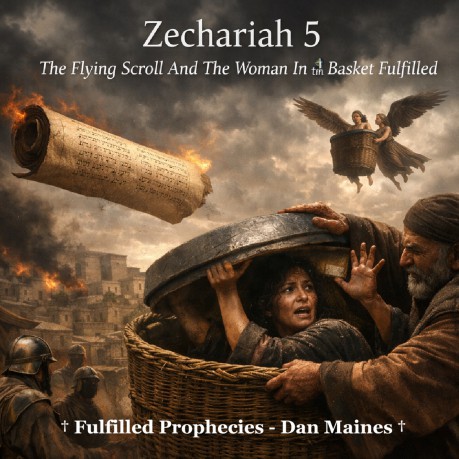
Zechariah 5 The Flying Scroll
And The Woman In The Basket Fulfilled Introduction † Zechariah 5 reveals two visions, the flying
scroll and the woman in the basket, both showing God's judgment and
removal of wickedness from the land. Zechariah 5:1-2 † The flying scroll represents the law going
forth in judgment, the same law Israel broke (Deuteronomy 28:15). Zechariah 5:3-4 † This curse is directly tied to the law,
specifically violations like theft and false swearing (Exodus
20:15-16). Zechariah 5:5-6 † The ephah is a measuring basket, symbolizing
the measure of Israel's sin being filled up (Genesis 15:16). Zechariah 5:7-8 † The woman represents wickedness personified,
Israel's corruption embodied (Hosea 4:1-2). Zechariah 5:9-11 † Wickedness is removed from the land and
carried to Shinar, the place associated with Babylon (Genesis
11:2). Historical References † Josephus describes the corruption, theft, and
false swearing in Jerusalem before its destruction, confirming the
fulfillment of this vision. How It Applies To Us Today † The law exposed sin, but Christ removed
condemnation (Romans 8:1). Q & A Appendix Q What is the flying scroll? Q Who is being judged in this vision? Q What does the ephah symbolize? Q Who is the woman in the basket? Q What does Shinar represent? † This is the fulfilled perspective we proclaim at
Fulfilled Prophecies † Source Index † Zechariah 5
By Dan Maines
† These
are not future mysteries, they were fulfilled in the judgment of
Israel leading up to AD 70.
† The law, the
curse, and the removal of sin all point to the end of the Old
Covenant system.
† What Zechariah saw, Jesus
and the apostles said would happen in their generation (Matthew
23:36).
Then I lifted up my eyes
again and looked, and behold, a flying scroll. And he said to me,
What do you see? And I answered, I see a flying scroll; its length is
twenty cubits and its width ten cubits.
†
Its large size shows the fullness and visibility of the curse,
nothing hidden, everything exposed (Hebrews 4:13).
†
This is covenant enforcement, not random judgment, God is holding
Israel accountable to the covenant they broke (Deuteronomy 28:15).
Then he said to me, This is
the curse that is going forth over the face of the whole land; surely
everyone who steals will be purged away according to the writing on
one side, and everyone who swears will be purged away according to
the writing on the other side. I will make it go forth, declares the
Lord of armies, and it will enter the house of the thief and the
house of the one who swears falsely by My name; and it will spend the
night within that house and consume it with its timber and stones.
† The phrase whole land refers to
Israel, not the entire world, this is covenant judgment on that
nation (Deuteronomy 28:15).
† The curse
entering homes shows personal accountability, no one escapes (Luke
12:2-3).
† Jesus echoed this when He
pronounced judgment on that generation (Matthew 23:35-36).
Then the angel who was
speaking with me went out and said to me, Lift up now your eyes and
see what this is going forth. I said, What is it? And he said, This
is the ephah going forth. Again he said, This is their appearance in
all the land
†
Jesus said the same thing, Fill up, then, the measure of the guilt of
your fathers (Matthew 23:32).
† This vision
shows that judgment comes when sin reaches its fullness, not randomly
or prematurely (Genesis 15:16).
and behold, a lead cover was
lifted up; and this is a woman sitting inside the ephah. Then he
said, This is Wickedness! And he threw her down into the middle of
the ephah and cast the lead weight on its opening.
†
The sealing of the basket shows that judgment is fixed, there is no
escape once the measure is full (Revelation 22:11).
†
This parallels the sealing of judgment in Jesus' time, when their
fate was set before AD 70 (Matthew 23:32).
Then I lifted up my eyes
and looked, and there two women were coming out with the wind in
their wings; they had wings like the wings of a stork, and they
lifted up the ephah between the earth and the heavens. I said to the
angel who was speaking with me, Where are they taking the ephah? Then
he said to me, To build a temple for her in the land of Shinar; and
when it is prepared, she will be set there on her own pedestal.
† This shows the transfer of judgment
and the complete removal of sin from God's covenant land (Hebrews
8:13).
† In fulfilled perspective, this
points to the end of the Old Covenant system and the removal of its
corruption (Hebrews 8:13).
† Babylon becomes
the symbol of judgment, just as Jerusalem became spiritually called
Babylon (Revelation 11:8).
† Eusebius
records the judgment that came upon Jerusalem, showing the curse
entering and consuming the land.
† Tacitus
writes about the internal wickedness and collapse of Jewish society,
aligning with the removal of wickedness seen here.
† We're no longer
under the curse of the law, because it was fulfilled and judged
(Galatians 3:13).
† God still sees
everything, nothing is hidden, and He calls us to walk in truth
(Hebrews 4:13).
† Wickedness was removed from
the covenant people, and now we live in a kingdom where righteousness
dwells (2 Peter 3:13).
A
It represents the law and its curse going out in judgment
(Deuteronomy 28:15)
A
Israel under the Old Covenant (Matthew 23:35-36)
A
The measure of sin being filled to completion (Matthew 23:32)
A
Wickedness personified within Israel (Hosea 4:1-2)
A
A place of rebellion and Babylonian identity (Genesis 11:2)
© Fulfilled Prophecies - Dan
Maines.
†
Josephus Antiquities of the Jews, Eusebius Ecclesiastical History,
Tacitus Histories
Links