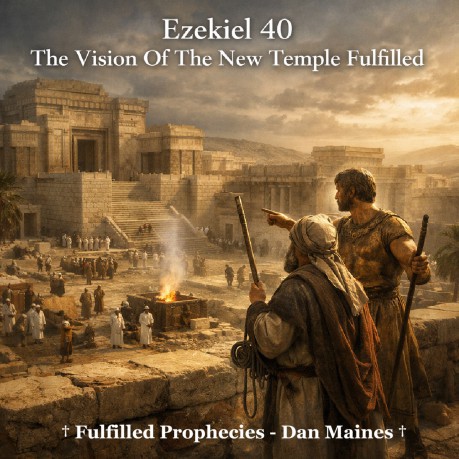
Ezekiel 40 The Vision Of The
New Temple Fulfilled Introduction † Ezekiel 40 opens a new section where God
shows a detailed vision of a temple, this isn't about a future
physical building, it's about the restoration of God's presence among
His people (Ezekiel 40:1-2) † This vision comes after judgment, showing
that restoration follows the fall of the old covenant system (Ezekiel
39:25-29) † From the fulfilled perspective, this points
directly to Christ and the establishment of the true temple, the
church, completed in the first century (John 2:19-21) Ezekiel 40:1-4 † The vision is dated after Jerusalem's fall,
so it's pointing forward to restoration, not backward to the old
temple (2 Chronicles 36:19) † The high mountain shows a prophetic,
spiritual setting, not a literal construction site (Isaiah 2:2) † The measuring begins immediately, showing God
is establishing something precise and complete (Revelation 11:1) Ezekiel 40:5-16 † The wall shows separation, God defining His
people as holy and set apart (Leviticus 20:26) † The east gate points to where God's glory
enters later, showing this is about divine presence (Ezekiel 43:2) † Palm trees represent victory and life,
showing the temple is about life, not death (John 12:13) Ezekiel 40:17-27 † The outer and inner courts show structured
access, pointing to Christ as the only way (John 14:6) † The repetition shows consistency and order in
God's plan (1 Corinthians 14:33) † This contrasts with the corrupted temple
system in Jesus' time (Matthew 21:13) Ezekiel 40:28-37 † The repeated gates show equal access from all
directions, pointing to the inclusion of all nations in Christ
(Isaiah 56:7) † The steps upward show movement toward God,
fulfilled through Christ (Hebrews 10:22) † The symmetry shows perfection, unlike the
system that was judged in AD 70 (Matthew 24:2) Ezekiel 40:38-48 † The sacrifices in the vision point to
Christ's once-for-all sacrifice, not a return to animal offerings
(Hebrews 10:10) † The sons of Zadok represent faithful
priesthood, fulfilled in Christ and believers (1 Peter 2:9) † The altar shows access to God is through
sacrifice, fulfilled completely in Christ (Hebrews 9:12) Historical References † Josephus records the destruction of the
second temple in AD 70, confirming the end of the old system † Eusebius wrote that the church became the
dwelling place of God after Jerusalem's fall † Irenaeus connected temple imagery to Christ
and His body How It Applies To Us Today † God doesn't dwell in physical buildings, He
dwells in His people (1 Corinthians 3:16) † We're part of this temple, meaning we belong
to Him and are set apart (1 Peter 2:5) † Access to God is fully open through Christ
(Hebrews 10:19-22) † The old system is gone, we're living in the
fulfilled reality now † Everything Ezekiel saw has already been
established in Christ Q & A Appendix Q Is this a future physical temple Q Why are sacrifices mentioned Q When was this fulfilled Q What do the measurements represent Q Who are the sons of Zadok † This is the fulfilled perspective we proclaim at
Fulfilled Prophecies † Source Index † Ezekiel 40
By Dan Maines
In the twenty-fifth year of
our exile, at the beginning of the year, on the tenth of the month,
in the fourteenth year after the city was struck down, on that very
day the hand of the Lord was upon me, and He brought me there. In
visions of God He brought me into the land of Israel and set me on a
very high mountain, and on it to the south there was a structure like
a city. So He brought me there, and behold, there was a man whose
appearance was like the appearance of bronze, with a line of flax and
a measuring rod in his hand, and he was standing in the gateway. The
man said to me, Son of man, see with your eyes, hear with your ears,
and pay attention to everything that I am going to show you, for you
have been brought here in order to show it to you. Declare to the
house of Israel everything that you see.
And behold, there was a wall
on the outside of the temple all around, and in the man's hand was a
measuring rod of six cubits, each of which was a cubit and a
handbreadth, so he measured the thickness of the wall, one rod, and
the height, one rod. Then he came to the gate which faced east, and
went up its steps, and measured the threshold of the gate, one rod in
width, and the other threshold was one rod in width. Each guardroom
was one rod long and one rod wide, and the space between the
guardrooms was five cubits, and the threshold of the gate by the
porch of the gate facing inward was one rod. Then he measured the
porch of the gate facing inward, one rod. He measured the porch of
the gate, eight cubits, and its side pillars, two cubits, and the
porch of the gate faced inward. The guardrooms of the gate toward the
east were three on this side and three on that side, the three of
them were of the same measurement, and the side pillars had the same
measurement on this side and on that side. And he measured the width
of the gateway entrance, ten cubits, and the length of the gate,
thirteen cubits. There was a barrier in front of the guardrooms, one
cubit on this side and one cubit on that side, and the guardrooms
were six cubits on this side and six cubits on that side. Then he
measured the gate from the roof of one guardroom to the roof of the
other, a width of twenty-five cubits, doorway opposite doorway. He
made the side pillars sixty cubits high, and the courtyard reached to
the side pillars, all around the gate. From the front of the entrance
gate to the front of the inner porch of the gate was fifty cubits.
There were shuttered windows looking toward the guardrooms and toward
their side pillars within the gate all around, and likewise there
were windows in the porches all around inside, and palm tree
decorations were on each side pillar.
Then he brought me into the
outer courtyard, and behold, there were chambers and a pavement made
for the courtyard all around, thirty chambers faced the pavement. And
the pavement was by the side of the gates, corresponding to the
length of the gates, this was the lower pavement. Then he measured
the width from the front of the lower gate to the front of the inner
courtyard outside, a hundred cubits on the east and on the north. As
for the gate of the outer courtyard which faced north, he measured
its length and its width. And it had three guardrooms on each side,
and its side pillars and its porches were of the same measurement as
the first gate, its length was fifty cubits and its width twenty-five
cubits. Its windows, its porches, and its palm tree decorations were
of the same measurement as the gate which faced east, and it was
reached by seven steps, and its porch was in front of them. And the
inner courtyard had a gate opposite the gate on the north as well as
on the east, and he measured from gate to gate a hundred cubits.
Then he brought me to the
inner courtyard by the south gate, and he measured the south gate
according to those same measurements. Its guardrooms, its side
pillars, and its porches were according to those same measurements,
and it had windows and porches all around, it was fifty cubits long
and twenty-five cubits wide. And there were porches all around,
twenty-five cubits long and five cubits wide. Its porches faced the
outer courtyard, and palm tree decorations were on its side pillars,
and its stairway had eight steps. Then he brought me to the inner
courtyard toward the east, and he measured the gate according to
those same measurements. Its guardrooms, its side pillars, and its
porches were according to those same measurements, and it had windows
and porches all around, it was fifty cubits long and twenty-five
cubits wide. Its porches faced the outer courtyard, and palm tree
decorations were on its side pillars on this side and on that side,
and its stairway had eight steps. Then he brought me to the north
gate, and he measured it according to those same measurements, with
its guardrooms, its side pillars, its porches, and its windows all
around, the length was fifty cubits and the width twenty-five cubits.
A chamber with its doorway
was by the side pillars at the gates, there they rinse the burnt
offering. In the porch of the gate were two tables on each side, on
which to slaughter the burnt offering, the sin offering, and the
guilt offering. On the outer side, as one went up to the entrance of
the north gate, were two tables, and on the other side which belonged
to the porch of the gate were two tables. Four tables were on each
side next to the gate, eight tables on which they slaughter
sacrifices. There were also four tables of cut stone for the burnt
offering, a cubit and a half long, a cubit and a half wide, and one
cubit high, on which they placed the utensils with which they
slaughtered the burnt offering and the sacrifice. The double hooks,
one handbreadth in length, were installed in the house all around,
and on the tables was the flesh of the offering. Outside the inner
gate were chambers for the singers in the inner courtyard, one at the
side of the north gate with its front toward the south, and one at
the side of the east gate facing toward the north. He said to me,
This chamber which faces south is for the priests who are responsible
for the temple, and the chamber which faces north is for the priests
who are responsible for the altar. These are the sons of Zadok, who
from the sons of Levi come near to the Lord to serve Him. He measured
the courtyard, a hundred cubits long and a hundred cubits wide,
square, and the altar was in front of the temple. Then he brought me
to the porch of the temple and measured each side pillar of the
porch, five cubits on each side, and the width of the gate was three
cubits on each side. The length of the porch was twenty cubits and
the width eleven cubits, and by the steps which they went up to it,
and there were pillars by the side pillars, one on each side.
A
No, it is fulfilled in Christ and His body, the church (John 2:19-21)
A
They point to Christ's sacrifice, not future offerings (Hebrews
10:10)
A
Fulfilled in Christ and completed by AD 70 (Matthew 24:2)
A
Perfection, order, and completeness in God's plan (Hebrews 8:6)
A
The faithful priesthood fulfilled in Christ and believers (1 Peter
2:9)
© Fulfilled Prophecies - Dan
Maines.
†
Josephus, Wars of the Jews Book 6, Eusebius, Ecclesiastical History
Book 3, Irenaeus, Against Heresies Book 4
Links