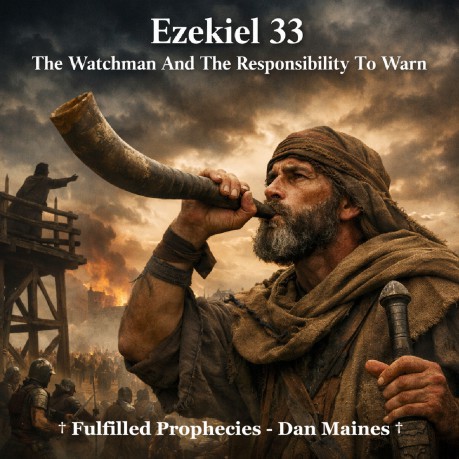
Ezekiel 33 The Watchman And
The Responsibility To Warn Introduction † Ezekiel 33 is a turning point, God lays out
personal responsibility, no one can hide behind another man's actions
anymore, each person stands accountable before Him. † This chapter comes right before the fall of
Jerusalem is confirmed, showing that God warned them again and again
before judgment came. † From the fulfilled perspective, this is
exactly what we see leading up to AD 70, repeated warnings through
prophets, through Christ, and through the apostles, yet the people
refused to listen. Scripture Ezekiel 33:1-3 † God establishes the role of a watchman,
someone responsible to warn others of coming judgment. † This isn't optional, if God gives the
warning, it must be spoken. † This directly connects to the prophets and
ultimately to Christ and the apostles warning Israel before its
destruction (Matthew 24:33). Ezekiel 33:4-5 † Responsibility shifts to the hearer, if they
hear and reject, it's on them. † This destroys the idea that people are judged
without warning, God always gives warning first. † Jesus said the same thing, they saw, they
heard, yet refused (John 12:37-40). Ezekiel 33:6 † The watchman is accountable if he stays
silent. † This shows why the prophets were so bold,
they knew silence meant guilt. † This applies directly to those who knew
judgment was coming on that generation but failed to speak (Matthew
23:36). Ezekiel 33:7 † Ezekiel is directly commissioned by God, not
speaking his own message. † This is the same pattern with Christ, He
spoke what the Father gave Him (John 12:49). † The apostles carried that same responsibility
leading up to AD 70. Ezekiel 33:8-9 † The focus is warning people to turn, not
forcing them to change. † God doesn't hold the watchman responsible for
their response, only for delivering the message. † This matches the ministry of Jesus, He
warned, yet many refused (Luke 13:34). Ezekiel 33:10-11 † God reveals His heart, He desires repentance,
not destruction. † The call to turn back was repeated all the
way to the time of Christ. † Jesus echoed this exact plea before
Jerusalem's fall (Luke 19:41-44). Ezekiel 33:12-16 † God shows individual accountability, not
inherited righteousness. † This exposes the false confidence many had in
being part of Israel. † This is exactly what Jesus confronted,
trusting in heritage instead of obedience (Matthew 3:9). Ezekiel 33:17-20 † People blamed God instead of taking
responsibility. † This same accusation was made in Jesus' time. † Judgment came exactly as God said, proving
His ways are right. Ezekiel 33:21 † This marks the historical fall of Jerusalem
to Babylon. † It's proof that everything God warned came to
pass. † This becomes a pattern pointing forward to
the final destruction in AD 70. Ezekiel 33:23-24 † They trusted in Abraham instead of obedience. † This same argument was made in the first
century. † Jesus directly refuted this thinking (John
8:39). Ezekiel 33:30-32 † They loved hearing truth but refused to live
it. † This describes the crowds that followed Jesus
but didn't obey Him. † This is one of the clearest warnings about
empty religion. Ezekiel 33:33 † God guarantees fulfillment, what He speaks
will happen. † This is exactly what happened when Jerusalem
fell, they knew the warnings were true. † Jesus said the same thing, when these things
happen, then you'll know (Luke 21:31). Historical References † Josephus, Wars of the Jews 6.2.5, records
that warnings were given before Jerusalem's destruction, yet the
people ignored them. † Eusebius, Ecclesiastical History 3.5, notes
that believers fled Jerusalem after recognizing the warnings, showing
the watchman message was heard by some. † Tacitus, Histories 5.13, records signs and
warnings before the fall, confirming that judgment didn't come
without notice. How it applies to us today † We can't rely on past righteousness, it's
about walking faithfully now. † Hearing truth isn't enough, we must actually
live it. † God still expects His people to speak truth,
silence isn't an option. † Responsibility is personal, we can't blame
others or hide behind group identity. Q & A Appendix Q When was this fulfilled? Q Who is the watchman today? Q Does God want to destroy people? Q Why were the people judged? Q What is the main lesson of this chapter? † This is the fulfilled perspective we proclaim at
Fulfilled Prophecies † Source Index † Ezekiel 33
By Dan Maines
Then the word of the LORD
came to me, saying, Son of man, speak to the sons of your people and
say to them, If I bring a sword upon a land, and the people of the
land take one man from among them and make him their watchman, and he
sees the sword coming upon the land and blows the trumpet and warns
the people,
then the one who hears the
sound of the trumpet and does not take warning, and a sword comes and
takes him away, his blood will be on his own head. He heard the sound
of the trumpet but did not take warning, his blood will be on
himself. But had he taken warning, he would have saved his life.
But if the watchman sees the
sword coming and does not blow the trumpet and the people are not
warned, and a sword comes and takes a person from them, he is taken
away in his wrongdoing, but I will require his blood from the
watchman's hand.
Now as for you, son of man, I
have appointed you as a watchman for the house of Israel, so you will
hear a message from My mouth and give them warning from Me.
When I say to the wicked, O
wicked person, you will certainly die, and you do not speak to warn
the wicked from his way, that wicked person will die for his
wrongdoing, but I will require his blood from your hand. But if you
on your part warn a wicked person to turn from his way and he does
not turn from his way, he will die for his wrongdoing, but you have
saved your life.
Now as for you, son of man,
say to the house of Israel, Thus you have spoken, saying, Surely our
offenses and our sins are upon us, and we are rotting away in them,
how then can we survive? Say to them, As I live! declares the Lord
GOD, I take no pleasure in the death of the wicked, but rather that
the wicked turn from his way and live. Turn back, turn back from your
evil ways! Why then will you die, house of Israel?
And you, son of man, say to
your fellow citizens, The righteousness of a righteous person will
not save him on the day of his wrongdoing, and as for the wickedness
of the wicked, he will not stumble because of it on the day when he
turns from his wickedness; whereas a righteous person will not be
able to live by his righteousness on the day when he commits sin.
When I say to the righteous that he will certainly live, and he so
trusts in his righteousness that he commits wrongdoing, none of his
righteous deeds will be remembered; but he will die for his
wrongdoing which he has committed. But when I say to the wicked, You
will certainly die, and he turns from his sin and practices justice
and righteousness, if a wicked person restores a pledge, pays back
what he has taken by robbery, walks by the statutes which ensure life
without committing wrongdoing, he will certainly live; he shall not
die. None of his sins that he has committed will be remembered
against him. He has practiced justice and righteousness; he will
certainly live.
Yet your fellow citizens
say, The way of the Lord is not right, when it is their own way that
is not right. When the righteous turns from his righteousness and
commits wrongdoing, then he will die in it. But when the wicked turns
from his wickedness and practices justice and righteousness, he will
live by them. Yet you say, The way of the Lord is not right. House of
Israel, I will judge each of you according to his ways.
Now in the twelfth year of our
exile, on the fifth of the tenth month, those who had escaped from
Jerusalem came to me, saying, The city has been taken.
Then the word of the LORD
came to me, saying, Son of man, they who live in these waste places
in the land of Israel are saying, Abraham was only one, yet he
possessed the land, so to us who are many the land has been given as
a possession.
But as for you, son of man,
your fellow citizens who talk about you by the walls and in the
doorways of the houses, speak to one another, each to his brother,
saying, Come now and hear what the message is which comes forth from
the LORD. They come to you as people come, and sit before you as My
people and hear your words, but they do not do them, for they do the
lustful desires expressed by their mouth, and their heart goes after
their gain. Behold, you are to them like a sensual song by one who
has a beautiful voice and plays well on an instrument, for they hear
your words but they do not practice them.
So when it comes to pass, as
it certainly will, then they will know that a prophet has been among
them.
A
The immediate fulfillment was in the fall of Jerusalem to Babylon
around 586 BC, but the full covenantal pattern was fulfilled again in
AD 70 when Jerusalem and the temple were destroyed, exactly as Jesus
warned (Luke 21:20-22).
A
Those who know the truth are responsible to speak it, just like the
apostles were before AD 70 (Acts 20:26-27).
A
No, Ezekiel 33:11 shows He desires repentance, the same message Jesus
preached (Luke 5:32).
A
Because they heard and refused to obey, just like Jesus said in
Matthew 23:37.
A
Personal responsibility, hearing isn't enough, obedience is required
(James 1:22).
© Fulfilled Prophecies - Dan
Maines.
†
Josephus, Wars of the Jews; Eusebius, Ecclesiastical History;
Tacitus, Histories
Links