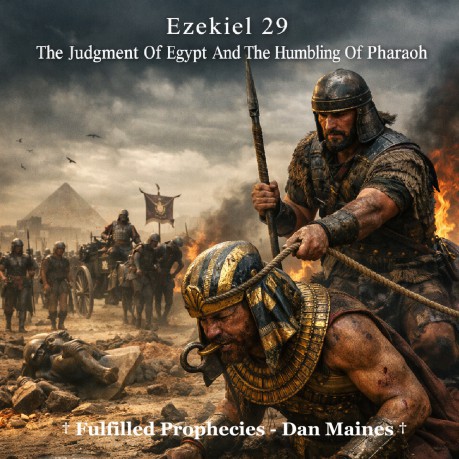
Ezekiel 29 The Judgment Of
Egypt And The Humbling Of Pharaoh Introduction † Ezekiel 29 shifts from Tyre to Egypt, showing
that God's judgment wasn't limited to one nation, it extended to all
who exalted themselves against Him (Ezekiel 29:1-2) Ezekiel 29:1-2 † God directly confronts Pharaoh, showing no
ruler stands above His authority (Ezekiel 29:2) Ezekiel 29:3 † Pharaoh claims ownership of creation, this is
open rebellion against God (Ezekiel 29:3) Ezekiel 29:4-5 † God removes Pharaoh from his place of power,
showing His total control (Ezekiel 29:4) Ezekiel 29:6-7 † Egypt failed Israel, proving worldly
alliances can't save (Ezekiel 29:6) Ezekiel 29:8-9 † Judgment comes because of pride and false
claims of self-sufficiency (Ezekiel 29:9) Ezekiel 29:10-12 † The desolation shows total judgment, not
partial discipline (Ezekiel 29:10) Ezekiel 29:13-16 † Restoration is limited, Egypt returns but
never regains former glory (Ezekiel 29:15) Ezekiel 29:17-20 † God uses Babylon as an instrument of judgment
(Ezekiel 29:20) Ezekiel 29:21 † Even in judgment, God promises restoration
for His people (Ezekiel 29:21) Historical References † Josephus records Egypt's weakening and
decline under foreign powers, aligning with Ezekiel's prophecy How It Applies To Us Today † We can't trust worldly systems, governments,
or power, they'll fail just like Egypt did (Psalm 20:7) Q & A Appendix Q: Why was Egypt judged? Q: What did Egypt represent? Q: Was Egypt completely destroyed? Q: Who carried out the judgment? Q: When was this fulfilled? Q: How does this connect to fulfillment in the
New Testament period? † This is the fulfilled perspective we proclaim at
Fulfilled Prophecies † Source Index † Ezekiel 29
By Dan Maines
†
Egypt represented worldly power and false security, something Israel
trusted instead of God, and that's why judgment was necessary
(Ezekiel 29:6-7)
† From the fulfilled
perspective, this points forward to the complete removal of Old
Covenant reliance on earthly powers, fulfilled in the destruction of
Jerusalem in AD 70 (Luke 21:20-22)
In the tenth year, in the
tenth month, on the twelfth of the month, the word of the LORD came
to me, saying, Son of man, set your face against Pharaoh king of
Egypt and prophesy against him and against all Egypt
†
Egypt isn't just political power, it represents rebellion and pride
against God (Ezekiel 29:2)
† This sets the
tone, judgment begins with leadership and extends to the whole nation
Speak and say, This is what the
Lord GOD says: Behold, I am against you, Pharaoh king of Egypt, The
great monster that lies in the midst of his rivers, That has said, My
Nile is mine, and I myself have made it
†
Pride is the root issue, just like Israel trusting in Egypt instead
of God (Ezekiel 29:3)
† This mirrors the same
pride judged in Jerusalem, claiming covenant privilege while
rejecting God (Matthew 23:37-38)
And I will put hooks in your
jaws And make the fish of your rivers cling to your scales. And I
will bring you up out of the midst of your rivers, And all the fish
of your rivers will cling to your scales. And I will abandon you to
the wilderness, you and all the fish of your rivers, You will fall on
the open field, you will not be brought together or gathered. I have
given you for food to the animals of the earth and to the birds of
the sky
†
The imagery shows humiliation, Egypt won't be honored but discarded
(Ezekiel 29:5)
† This is consistent with
covenant judgment language later applied to Jerusalem (Luke 19:43-44)
Then all the inhabitants of
Egypt will know that I am the LORD, Because they have been only a
staff made of reed to the house of Israel. When they took hold of you
with the hand, You broke and tore all their hands, And when they
leaned on you, You broke and made all their backs shake
†
Israel's trust in Egypt was misplaced, leading to greater judgment
(Ezekiel 29:7)
† This exposes the danger of
trusting anything outside of God (Jeremiah 17:5)
Therefore this is what the
Lord GOD says: Behold, I am going to bring a sword upon you and cut
off from you human and animal life. The land of Egypt will become a
desolation and a waste. Then they will know that I am the LORD.
Because you said, The Nile is mine, and I have made it
†
The purpose of judgment is recognition of God, not destruction alone
(Ezekiel 29:9)
† This same purpose appears in
Jerusalem's fall in AD 70 (Luke 21:22)
Therefore, behold, I am
against you and against your rivers, and I will make the land of
Egypt an utter waste and desolation, from Migdol to Syene and even to
the border of Ethiopia. A human foot will not pass through it and the
foot of an animal will not pass through it, and it will not be
inhabited for forty years. So I will make the land of Egypt a
desolation in the midst of desolated lands, and her cities in the
midst of cities that are laid waste will be desolate forty years, and
I will scatter the Egyptians among the nations and disperse them
among the lands
† The
scattering mirrors Israel's own exile, showing God judges all nations
consistently (Ezekiel 29:12)
† This
reinforces that no nation escapes accountability (Acts 17:31)
For this is what the Lord
GOD says: At the end of forty years I will gather the Egyptians from
the peoples among whom they were scattered. And I will restore the
fortunes of Egypt and make them return to the land of Pathros, to the
land of their origin, and there they will be a lowly kingdom. It will
be the lowest of the kingdoms, and it will never again lift itself up
above the nations, and I will make them so small that they will not
rule over the nations. And it will never again be the confidence of
the house of Israel, bringing to mind the wrongdoing of their having
turned to Egypt. Then they will know that I am the Lord GOD
†
God removes Egypt as a source of false hope for Israel (Ezekiel
29:16)
† This ensures Israel won't repeat the
same error (Isaiah 30:1-3)
Now in the twenty-seventh
year, in the first month, on the first of the month, the word of the
LORD came to me, saying, Son of man, Nebuchadnezzar king of Babylon
made his army labor hard against Tyre, every head was made bald and
every shoulder was rubbed bare, but he and his army had no wages from
Tyre for the labor that he had performed against it. Therefore this
is what the Lord GOD says: Behold, I am going to give the land of
Egypt to Nebuchadnezzar king of Babylon, and he will carry off her
wealth and capture her spoil and seize her plunder, and it will be
wages for his army. I have given him the land of Egypt for his labor
which he performed, because they acted for Me, declares the Lord GOD
† Nations act, but God is the
one directing outcomes (Ezekiel 29:20)
† This
same pattern appears in Rome being used in AD 70 (Luke 21:20)
On that day I will make a horn
sprout for the house of Israel, and I will open your mouth in their
midst. Then they will know that I am the LORD
† The horn
represents strength and authority restored (Ezekiel 29:21)
†
From the fulfilled perspective, this finds its completion in Christ
and the establishment of the New Covenant (Luke 1:68-69)
†
Herodotus describes Egypt's loss of dominance and reduced status
among nations
† Eusebius notes how God's
judgments on nations demonstrated His sovereignty over history
†
Pride always leads to judgment, whether individual or national
(Proverbs 16:18)
† God is in control of
history, even when nations rise and fall (Daniel 2:21)
†
The fulfilled reality shows Christ is the only true kingdom that
lasts (Hebrews 12:28)
A:
Because of pride and false claims of self-sufficiency (Ezekiel 29:3,
9)
A:
Worldly power and false security that Israel trusted instead of God
(Ezekiel 29:6-7)
A:
No, it was restored but as a lowly kingdom (Ezekiel 29:14-15)
A:
Nebuchadnezzar and Babylon, used by God (Ezekiel 29:19-20)
A:
It was fulfilled historically through the Babylonian campaigns
against Egypt around 568-567 BC, when Nebuchadnezzar struck Egypt and
reduced its power just as prophesied (Ezekiel 29:17-20)
A: It shows the same
pattern of God judging prideful nations, which was fully demonstrated
again in AD 70 when Jerusalem was destroyed (Luke 21:20-22)
© Fulfilled Prophecies - Dan
Maines.
†
Josephus, Antiquities of the Jews; Herodotus, Histories; Eusebius,
Ecclesiastical History
Links