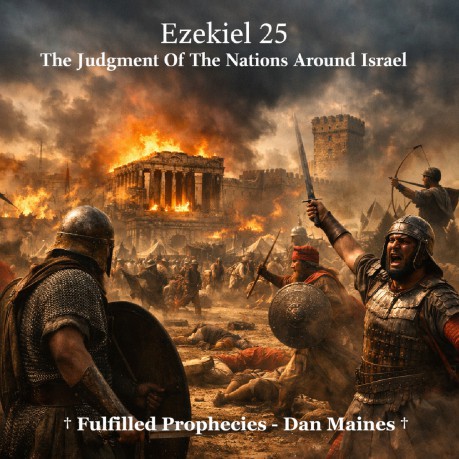
Ezekiel 25 The Judgment Of
The Nations Around Israel Introduction † Ezekiel 25 shifts the focus from Jerusalem to
the surrounding nations who rejoiced over her fall. Prophecy Against Ammon Ezekiel 25:1-3 † Ammon rejoiced over the destruction of the
temple and the exile of Judah, showing hatred toward what God had
established (Ezekiel 25:3) Ezekiel 25:4-5 † God turns their land over to invaders, the
same kind of destruction they celebrated (Ezekiel 25:4) Ezekiel 25:6-7 † Their celebration of Israel's fall exposed
their heart of hatred (Ezekiel 25:6) Prophecy Against Moab Ezekiel 25:8-9 † Moab denied that Judah was distinct, treating
God's chosen people as nothing special (Ezekiel 25:8) Ezekiel 25:10-11 † Moab joins Ammon in destruction, showing
shared guilt and shared judgment (Ezekiel 25:10) Prophecy Against Edom Ezekiel 25:12-13 † Edom acted in vengeance against Judah,
showing deep hostility (Obadiah 1:10-12) Ezekiel 25:14 † God uses Israel as an instrument of judgment
against Edom (Ezekiel 25:14) Prophecy Against Philistia Ezekiel 25:15-16 † The Philistines carried long-standing hatred
and acted on it (Ezekiel 25:15) Ezekiel 25:17 † God's vengeance is described as great and
undeniable (Ezekiel 25:17) Historical References † Josephus records the destruction and
subjugation of surrounding nations during the rise of Babylon and
later powers, showing these prophecies unfolding in history How It Applies To Us Today † God sees how people respond to His truth, and
He holds them accountable Q & A Appendix Q When were these judgments fulfilled? Q Why did God judge these nations? Q What does it mean that they would know the
Lord? Q Does this apply only to ancient nations? Q How does this connect to AD 70? † This is the fulfilled perspective we proclaim at
Fulfilled Prophecies † Source Index † Ezekiel 25
By Dan Maines
†
God is not only judging His own people, He's also judging those who
mocked, hated, and took advantage of her destruction.
†
This chapter shows that no nation escapes God's justice, especially
those who oppose His covenant people.
Now the word of the Lord came
to me, saying, Son of man, set your face toward the sons of Ammon and
prophesy against them, and say to the sons of Ammon, Hear the word of
the Lord God! This is what the Lord God says, Because you said, Aha!
against My sanctuary when it was profaned, and against the land of
Israel when it was made desolate, and against the house of Judah when
they went into exile
† This reveals
that their sin was not just political, it was spiritual opposition to
God Himself (Psalm 137:7)
† God takes
personally how nations respond to His people and His sanctuary
therefore, behold, I am going
to hand you over to the sons of the east as a possession, and they
will set their encampments among you and make their dwellings among
you; they will eat your fruit and drink your milk. I will make Rabbah
a pasture for camels and the sons of Ammon a resting place for
flocks. Thus you will know that I am the Lord
†
Their capital becomes a place of ruin and animals, showing complete
humiliation (Isaiah 34:13)
† The purpose is
clear, they will know that He is the Lord
For this is what the Lord God
says, Because you have clapped your hands and stamped your feet and
rejoiced with all the contempt of your soul against the land of
Israel, therefore, behold, I have stretched out My hand against you
and will hand you over as plunder to the nations. And I will
eliminate you from the peoples and cut you off from the lands; I will
destroy you. Thus you will know that I am the Lord
† God
responds with total judgment, cutting them off from among the nations
(Jeremiah 49:2)
† This shows that mocking
God's judgment brings judgment on yourself
This is what the Lord God
says, Because Moab and Seir say, Behold, the house of Judah is like
all the nations, therefore, behold, I am going to deprive the flank
of Moab of its cities, of its cities which are on its frontiers, the
glory of the land, Beth-jeshimoth, Baal-meon, and Kiriathaim
†
This is a rejection of God's covenant identity and purpose
(Deuteronomy 7:6)
† Their cities, once
strong, are opened up to invasion and loss
and I will give it for a
possession along with the sons of Ammon to the sons of the east, so
that the sons of Ammon will not be remembered among the nations. So I
will execute judgments on Moab, and they will know that I am the Lord
†
Their identity as a nation fades, fulfilling God's word against them
(Jeremiah 48:42)
† Again, the goal is
recognition of the Lord's authority
This is what the Lord God
says, Because Edom has acted revengefully against the house of Judah
and has incurred grievous guilt, and avenged themselves upon them,
therefore this is what the Lord God says, I will also stretch out My
hand against Edom and eliminate human and animal life from it. And I
will make it a desolation; from Teman even to Dedan they will fall by
the sword
†
Their betrayal during Israel's suffering brings direct judgment from
God
† Their land becomes desolate, showing
complete reversal of their pride
And I will lay My vengeance on
Edom by the hand of My people Israel. So they will deal with Edom in
accordance with My anger and in accordance with My wrath; so they
will know My vengeance, declares the Lord God
† This fulfills
the principle that what they did to others will be done to them
(Galatians 6:7)
† The result is that they
experience God's vengeance directly
This is what the Lord God
says, Because the Philistines have acted in revenge and have taken
vengeance with malice of soul to destroy in everlasting hostility,
therefore this is what the Lord God says, Behold, I am going to
stretch out My hand against the Philistines, even eliminate the
Cherethites and destroy the remnant of the seacoast
† Their
desire to destroy Israel brings their own destruction (Zephaniah
2:5)
† God removes even the remnant, leaving
nothing behind
And I will execute great
vengeance on them with wrathful punishments; and they will know that
I am the Lord when I lay My vengeance on them
† His judgment
serves as a revelation of His authority
†
Every nation that opposed Him comes to the same conclusion, He is the
Lord
†
Eusebius notes the disappearance and absorption of these nations into
other peoples, confirming their loss of identity
†
Irenaeus speaks of God's consistent judgment on those who oppose His
people, showing this pattern across time
† Rejoicing over
the downfall of others, especially God's people, is a serious offense
before Him
† Pride, revenge, and hatred
always lead to destruction
† God is
consistent, what He judged then, He still judges now
†
We are called to humility, not arrogance, recognizing that all
authority belongs to Him
A
These judgments began with the Babylonian conquests in the 6th
century BC and continued through later empires, with the complete
disappearance of these nations by the first century, aligning with
the broader judgment leading up to AD 70 (Jeremiah 49; Obadiah 1;
Ezekiel 25)
A
Because they rejoiced over Israel's fall, took vengeance, and opposed
God's people (Ezekiel 25:3, 6, 12, 15)
A It means they would recognize His
authority through judgment (Ezekiel 25:5, 7, 11, 17)
A
No, the principle remains that God judges pride, hatred, and
opposition to His truth (Galatians 6:7)
A
These earlier judgments establish the pattern of covenant judgment
that culminates in the destruction of Jerusalem in AD 70, showing
God's consistent dealing with sin (Matthew 23:38; Luke 21:22)
© Fulfilled Prophecies - Dan
Maines.
†
Josephus, Antiquities of the Jews; Eusebius, Ecclesiastical History;
Irenaeus, Against Heresies
Links