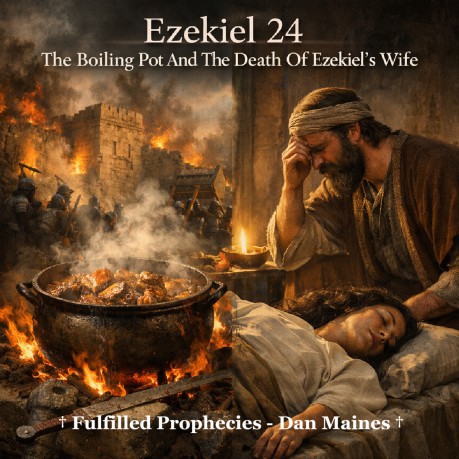
Ezekiel 24 The Boiling Pot
And The Death Of Ezekiel's Wife Introduction † Ezekiel 24 brings us to the exact day the
siege of Jerusalem began, this is a real historical moment tied
directly to covenant judgment (Ezekiel 24:1-2) Ezekiel 24:1-2 † God anchors this prophecy to an exact day,
proving this is not symbolic speculation but real historical judgment
(Ezekiel 24:2) Ezekiel 24:3-5 † The pot represents Jerusalem, and the people
are the contents inside, trapped in the coming judgment (Ezekiel
24:3) Ezekiel 24:6-8 † The rust represents sin that remains, their
corruption has not been removed (Ezekiel 24:6) Ezekiel 24:9-14 † God gave opportunity for cleansing, but they
refused, now only judgment remains (Jeremiah 6:29-30) Ezekiel 24:15-18 † Ezekiel's wife represents the desire of the
people, just as Jerusalem was the desire of their eyes (Ezekiel
24:16) Ezekiel 24:19-24 † The temple, which they trusted in, would be
destroyed, proving their confidence was misplaced (Jeremiah 7:4) Ezekiel 24:25-27 † A survivor would confirm the destruction,
showing the certainty of the prophecy (Ezekiel 33:21) Historical References † Josephus records the siege and destruction of
Jerusalem, showing the horror and silence that followed How It Applies To Us Today † God is patient, but when judgment comes, it
comes exactly as He said, we can't ignore His warnings (2 Peter
3:9-10) Q & A Appendix Q What does the boiling pot represent Q Why was Ezekiel not allowed to mourn Q What is the rust in the pot Q What happens to the temple in this chapter Q When was this judgment fulfilled Q What does this teach us about God † This is the fulfilled perspective we proclaim at
Fulfilled Prophecies † Source Index † Ezekiel 24 † Josephus, Wars of the Jews; Eusebius,
Ecclesiastical History; Tacitus, Histories
By Dan Maines
†
God gives two signs, the boiling pot and the death of Ezekiel's wife,
showing judgment is certain, complete, and unavoidable (Ezekiel
24:3-27)
† From the fulfilled perspective,
this points to the covenant judgment that reached its full expression
in the first century
In the ninth year, in the
tenth month, on the tenth day of the month, the word of the Lord came
to me, saying, Son of man, write down the name of the day, this very
day. The king of Babylon has laid siege to Jerusalem this very day.
† This marks the beginning of
the siege, showing God declares events before they happen and brings
them to pass (Isaiah 46:10)
† It shows God's
timing is precise, nothing happens outside His control (Ecclesiastes
3:1)
Speak a parable to the
rebellious house and say to them, This is what the Lord God says: Put
on the pot, put it on and also pour water in it; put in it the
pieces, every good piece, the thigh and the shoulder. Fill it with
choice bones. Take the choicest of the flock, and pile wood under the
pot. Make it boil vigorously. Also seethe its bones in it.
† What they trusted in, the city,
becomes the place of their destruction (Ezekiel 11:3-7)
†
The boiling shows intense and unavoidable judgment, nothing escapes
the fire (Malachi 4:1)
Therefore, this is what the
Lord God says: Woe to the bloody city, to the pot in which there is
rust and whose rust has not gone out of it. Take out of it piece
after piece, without making a choice. For her blood is in her midst;
she placed it on the bare rock; she did not pour it on the ground to
cover it with dust. So that it may cause wrath to come up to take
vengeance, I have put her blood on the bare rock, that it may not be
covered.
†
Their guilt is exposed before God, nothing is hidden or covered
(Genesis 4:10)
† Judgment is impartial, piece
after piece, no one escapes accountability (Romans 2:6)
Therefore, this is what the
Lord God says: Woe to the bloody city. I will also make the pile
great. Heap on the wood, kindle the fire, boil the flesh well and mix
in the spices, and let the bones be burned. Then set it empty on its
coals so that it may be hot and its bronze may glow and its
filthiness may be melted in it, its rust consumed. She has wearied Me
with toil, yet her great rust has not gone from her; let her rust be
in the fire. In your filthiness is lewdness. Because I would have
cleansed you, yet you are not clean, you will not be cleansed from
your filthiness again until I have spent My wrath on you. I, the
Lord, have spoken; it is coming and I will act. I will not relent,
and I will not pity, and I will not be sorry; according to your ways
and according to your deeds I will judge you, declares the Lord God.
†
The fire represents complete purification through destruction,
nothing is left untouched (Isaiah 1:25)
†
God's judgment is according to their deeds, exactly as warned in the
covenant (Deuteronomy 32:35)
And the word of the Lord
came to me, saying, Son of man, behold, I am about to take from you
the desire of your eyes with a blow; but you shall not mourn and you
shall not weep, and your tears shall not come. Groan silently; make
no mourning for the dead. Bind on your turban and put on your shoes
on your feet, and do not cover your mustache and do not eat the bread
of men. So I spoke to the people in the morning, and in the evening
my wife died. And in the morning I did as I was commanded.
† The command not to mourn shows the
overwhelming shock of the coming destruction (Ezekiel 24:17)
†
This sign shows judgment would leave them speechless and unable to
respond normally (Lamentations 2:10)
The people said to me, Will
you not tell us what these things that you are doing mean for us?
Then I said to them, The word of the Lord came to me, saying, Speak
to the house of Israel, This is what the Lord God says: Behold, I am
about to profane My sanctuary, the pride of your power, the desire of
your eyes and the delight of your soul; and your sons and your
daughters whom you have left behind will fall by the sword. You will
do as I have done; you will not cover your mustache and you will not
eat the bread of men. Your turbans will be on your heads and your
shoes on your feet; you will not mourn and you will not weep, but you
will rot away in your iniquities and you will groan to one another.
Thus Ezekiel will be a sign to you; according to all that he has done
you will do. When it comes, then you will know that I am the Lord
God.
†
Their grief would be so overwhelming that normal mourning would stop
(Ezekiel 24:23)
† This shows outward religion
without obedience cannot prevent judgment (Isaiah 29:13)
As for you, son of man,
will it not be on the day when I take from them their stronghold, the
joy of their pride, the desire of their eyes and their heart's
delight, their sons and their daughters, that on that day he who
escapes will come to you with information for your ears? On that day
your mouth will be opened to him who escaped, and you will speak and
be mute no longer. Thus you will be a sign to them, and they will
know that I am the Lord.
†
Ezekiel's silence ending shows the transition from warning to
fulfillment (Ezekiel 3:26-27)
† When it
happens, they will know the Lord has spoken, judgment proves His word
is true (Numbers 23:19)
†
Eusebius connects these events with the fulfillment of prophetic
warnings about Jerusalem
† Tacitus describes
the devastation of the city, confirming the completeness of the
judgment
† Trusting in outward religion
without obedience leads to destruction, just like those who trusted
the temple (Matthew 7:21-23)
† We now live in
the fulfilled kingdom, not waiting for this judgment, but
understanding it has already been completed (Hebrews 12:28)
A
It represents Jerusalem under judgment, where the people are trapped
and consumed (Ezekiel 24:3-5)
A
To show the overwhelming shock and silence that would come upon the
people (Ezekiel 24:16-17)
A
It represents persistent sin that would not be removed (Ezekiel 24:6)
A
God declares it will be profaned and destroyed (Ezekiel 24:21)
A
It was fulfilled in 586 BC when Babylon destroyed Jerusalem and the
temple (2 Kings 25:9)
A
That He judges according to deeds and fulfills His word exactly
(Ezekiel 24:14)
© Fulfilled Prophecies - Dan
Maines.
Links