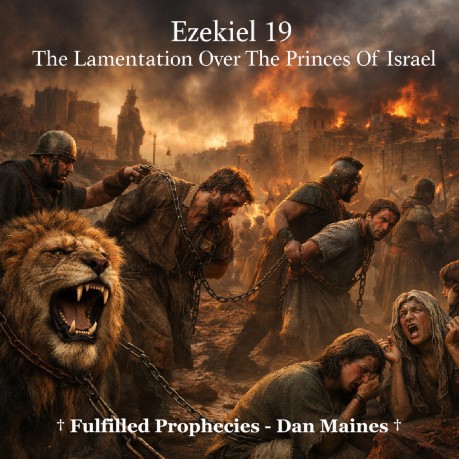
Ezekiel 19 The Lamentation
Over The Princes Of Israel Introduction † Ezekiel 19 is a lament, a funeral song over
the fall of Israel's leadership, showing the rise and fall of kings
like lions who devoured but were ultimately captured and judged
(Ezekiel 19:1-2) † This chapter shows the failure of Israel's
rulers under the old covenant, leading directly to judgment and
removal (Matthew 23:38) † It proves that power without obedience to God
ends in destruction, no matter how strong it appears (Proverbs 16:18) Ezekiel 19:1-2 As for you, take up a lamentation for the princes of Israel, † Israel is pictured as a lioness, strong among
the nations, yet raising rulers who would become destructive (Genesis
49:9) † The princes are the kings of Judah, raised in
power but lacking righteousness (2 Kings 23:31-32) † This shows corruption in leadership, not
weakness, but strength used wrongly bringing judgment (Jeremiah
22:13-17) Ezekiel 19:3-4 When she brought up one of her cubs, † This refers to Jehoahaz, who ruled in
violence and was taken captive by Egypt (2 Kings 23:33-34) † His strength became his downfall because it
was used for oppression instead of justice (Ezekiel 22:27) † God used the nations as instruments of
judgment against him (Habakkuk 1:6) Ezekiel 19:5-7 When she saw, as she waited, † This points to Jehoiakim, another corrupt
ruler who brought destruction on the land (2 Kings 24:1) † His reign increased oppression and violence,
showing a repeated pattern of failure (Micah 3:1-3) † The devastation reflects covenant judgment
exactly as warned (Deuteronomy 28:49-52) Ezekiel 19:8-9 Then nations set against him on every side from the provinces, † This shows the Babylonian captivity where
Judah's kings were removed and silenced (2 Kings 24:12) † The silencing of his voice marks the end of
that corrupt leadership (Lamentations 2:9) † This fulfills covenant judgment for
disobedience (Leviticus 26:33) Ezekiel 19:10-11 Your mother was like a vine in your vineyard, † Israel is now pictured as a vine, once
fruitful under covenant blessing (Psalm 80:8-9) † The strong rods represent kings and rulers
given authority (Genesis 49:10) † The fall came not from lack of blessing, but
misuse of it (Isaiah 5:1-5) Ezekiel 19:12-14 But it was uprooted in fury, † The vine being uprooted shows total judgment
and exile fulfilled in Babylon (2 Chronicles 36:19-20) † The fire from within shows their own
leadership caused their destruction (Hosea 13:9) † No strong rod remaining shows the end of that
royal power, pointing to the need for the true King, Christ (Luke
1:32-33) Historical References † Josephus records the destruction of Jerusalem
and the consequences of corrupt leadership leading to national ruin
(Josephus, Wars of the Jews Book 6) † Eusebius identifies these judgments as
fulfillment of prophetic warnings against Israel (Eusebius,
Ecclesiastical History Book 3) † Irenaeus connects the fall of Israel's
leadership to the transition into the new covenant through Christ
(Irenaeus, Against Heresies Book 4) How It Applies To Us Today † Leadership without obedience to God leads to
destruction regardless of strength (Proverbs 29:2) † God holds leaders accountable for how they
use authority (James 3:1) † Christ is the true and righteous King unlike
the failed rulers of Israel (John 18:37) † Covenant unfaithfulness leads to loss, but
restoration is found in Christ (Hebrews 8:6-7) Q & A Appendix Q Who are the lions in Ezekiel 19 Q What does the lioness represent Q What does the vine symbolize Q Why were these rulers taken by other nations Q What is the main message of Ezekiel 19 † This is the fulfilled perspective we proclaim at
Fulfilled Prophecies † Source Index † Ezekiel 19 † Josephus, Wars of the Jews Book 6; Eusebius,
Ecclesiastical History Book 3; Irenaeus, Against Heresies Book 4
By Dan Maines
and
say, What was your mother? A lioness among lions!
She lay down
among young lions,
she reared her cubs.
he became a lion,
and
he learned to tear his prey;
he devoured people.
Then
nations heard about him;
he was captured in their pit,
and
they brought him with hooks
to the land of Egypt.
that her hope was lost,
she
took another of her cubs
and made him a lion.
And he walked
about among the lions;
he became a lion,
and he learned to
tear his prey;
he devoured people.
He destroyed their
fortified towers
and devastated their cities;
and the land
and its fullness were appalled
because of the sound of his
roaring.
and
they spread their net over him;
he was captured in their
pit.
They put him in a cage with hooks
and brought him to
the king of Babylon;
they brought him into strongholds
so
that his voice would no longer be heard
on the mountains of
Israel.
planted by the
waters;
it was fruitful and full of branches
because of
abundant waters.
And it had strong branches fit for scepters of
rulers,
and its height was raised above the clouds;
so it
was seen in its height
with the mass of its branches.
it was thrown down to the
ground;
and the east wind dried up its fruit.
Its strong
branch was torn off
so that it withered;
the fire consumed
it.
And now it is planted in the wilderness,
in a dry and
thirsty land.
And fire has gone out from its branch;
it has
consumed its shoots and fruit,
so that there is not on it a
strong branch,
a scepter to rule.
This is a lamentation,
and has become a lamentation.
A
They are the kings of Judah such as Jehoahaz and Jehoiakim who ruled
violently and were judged, 2 Kings 23:31-34; 2 Kings 24:1
A
It represents Israel as the nation producing rulers, Genesis 49:9
A
It represents Israel under covenant blessing that later came under
judgment, Psalm 80:8-9; Isaiah 5:1-5
A
Because of covenant disobedience and God's use of foreign nations for
judgment, Deuteronomy 28:49-52
A
Corrupt leadership brings destruction and true hope is found in God's
appointed King, Luke 1:32-33
© Fulfilled Prophecies - Dan
Maines.
Links