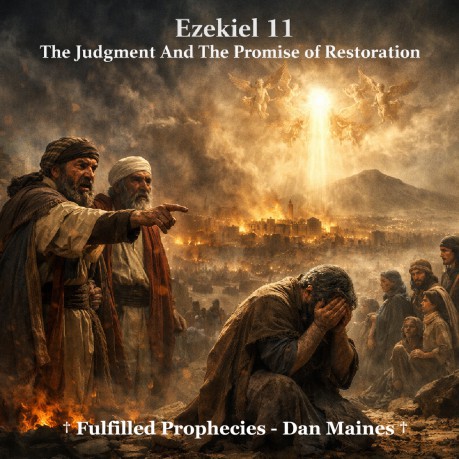
Ezekiel 11 The Judgment And
The Promise Of Restoration Introduction † Ezekiel 11 brings us into the final stage of
the departure of God's presence from Jerusalem, showing both judgment
on corrupt leadership and a promise of restoration for a faithful
remnant (Ezekiel 10:18-19; Ezekiel 11:22-23). Ezekiel 11:1-4 † These leaders mocked the idea of coming
judgment, claiming safety within Jerusalem, but their confidence was
false (Jeremiah 6:14; Ezekiel 13:10). Ezekiel 11:5-12 † God exposes that their sin was not hidden, He
knew their thoughts and actions completely (Psalm 139:1-4; Hebrews
4:13). Ezekiel 11:13 † The sudden death of Pelatiah confirmed the
certainty of God's judgment (Acts 5:1-5). Ezekiel 11:14-21 † God promises restoration, not based on
physical location, but on transformation of the heart (Jeremiah
31:33; Ezekiel 36:26-27). Ezekiel 11:22-25 † The departure of God's glory marks the
complete judgment upon Jerusalem, His presence leaving the temple (1
Samuel 4:21-22; Matthew 23:38). Historical References † Josephus records the corruption of
Jerusalem's leadership and the judgment that followed in AD 70,
confirming the pattern seen in Ezekiel. How it applies to us today † We can't rely on outward identity or
association, God looks at the heart (Romans 2:28-29). Q & A Appendix Q: Who were the leaders in Ezekiel 11? Q: What does the pot represent? Q: What is the new heart and new spirit? Q: What does the departure of God's glory
mean? Q: When was this ultimately fulfilled? † This is the fulfilled perspective we proclaim at
Fulfilled Prophecies † Source Index † Ezekiel 11:1-25 † Josephus, Wars of the Jews; Eusebius,
Ecclesiastical History; Tacitus, Histories
By Dan Maines
†
This chapter exposes false confidence among the leaders who believed
they were safe, while God declares that judgment is already at the
door (Jeremiah 7:4; Micah 3:11).
† From the
fulfilled perspective, this sets the pattern that carried forward
into the first century, where leadership rejected truth, and judgment
came upon that generation just as Jesus said (Matthew 23:36; Luke
19:41-44).
Moreover, the Spirit lifted
me up and brought me to the east gate of the LORD'S house which faced
eastward. And behold, there were twenty-five men at the entrance of
the gate, and among them I saw Jaazaniah the son of Azzur and
Pelatiah the son of Benaiah, leaders of the people. He said to me,
Son of man, these are the men who devise wrongdoing and give bad
advice in this city, who say, The time is not near to build houses.
This city is the pot and we are the meat. Therefore prophesy against
them, prophesy, son of man!
† Their
statement shows they believed judgment was far off, just like those
in Jesus' day who said everything would continue as normal (Matthew
24:38-39).
† God commands Ezekiel to speak
against them, showing that leadership carries responsibility, and
false teaching brings severe consequences (James 3:1; Ezekiel 34:2).
Then the Spirit of the LORD
fell upon me, and He said to me, Say, This is what the LORD says: So
you have said, house of Israel, for I know your thoughts. You have
multiplied your slain in this city and filled its streets with them.
Therefore this is what the Lord GOD says: Your slain whom you have
laid in the midst of the city are the meat, and this city is the pot;
but I will bring you out of it. You have feared a sword, so I will
bring a sword upon you, the Lord GOD declares. And I will bring you
out of the city and hand you over to strangers and execute judgments
against you. You will fall by the sword. I will judge you to the
border of Israel; so you shall know that I am the LORD. This city
will not be a pot for you, nor will you be meat in the midst of it; I
will judge you to the border of Israel. And you will know that I am
the LORD, because you have not walked in My statutes nor executed My
ordinances, but have acted in accordance with the ordinances of the
nations around you.
† The imagery of the caldron is
reversed, what they thought was protection becomes the place of
exposure and judgment (Ezekiel 24:3-6).
†
This mirrors Jesus exposing the hypocrisy of the leaders in His day,
who outwardly appeared righteous but were full of corruption (Matthew
23:27-28).
Now it came about, as I was
prophesying, that Pelatiah the son of Benaiah died. Then I fell on my
face and cried out with a loud voice and said, Oh Lord GOD! Will You
bring the remnant of Israel to a complete end?
†
Ezekiel's response shows the heart of a true servant, grieving over
judgment rather than celebrating it (Romans 9:1-3; Jeremiah 9:1).
†
Even in judgment, God preserves a remnant, showing His faithfulness
to His covenant promises (Isaiah 10:20-22).
Then the word of the LORD
came to me, saying, Son of man, your brothers, your relatives, your
fellow exiles, and the entire house of Israel, all of them, are those
to whom the inhabitants of Jerusalem have said, Go far away from the
LORD; this land has been given to us as a possession. Therefore say,
This is what the Lord GOD says: Though I had removed them far away
among the nations and though I had scattered them among the
countries, yet I was a sanctuary for them for a little while in the
countries where they had gone. Therefore say, This is what the Lord
GOD says: I will gather you from the peoples and assemble you from
the countries among which you have been scattered, and I will give
you the land of Israel. When they come there, they will remove all
its detestable things and all its abominations from it. And I will
give them one heart, and put a new spirit within them. And I will
remove the heart of stone from their flesh and give them a heart of
flesh, so that they may walk in My statutes and keep My ordinances
and do them. Then they will be My people, and I shall be their God.
But as for those whose hearts pursue their detestable things and
abominations, I will bring their conduct down on their heads,
declares the Lord GOD.
† The new heart and
new spirit point directly to the work of Christ and the establishment
of the New Covenant (Hebrews 8:10; 2 Corinthians 5:17).
†
This was fulfilled in the first century, where the faithful remnant
received the Spirit and became the true people of God (Acts 2:1-4;
Galatians 3:28-29).
Then the cherubim lifted up
their wings with the wheels beside them, and the glory of the God of
Israel hovered over them. And the glory of the LORD went up from the
midst of the city and stood over the mountain which is east of the
city. And the Spirit lifted me up and brought me in a vision by the
Spirit of God to the exiles in Chaldea. So the vision that I had seen
left me. Then I told the exiles all the things that the LORD had
shown me.
† This
foreshadows the final judgment in AD 70, where the temple was left
desolate because of rejection (Luke 21:20-22).
†
God's presence is no longer tied to a physical building, but to His
people through the Spirit (John 4:21-24; 1 Corinthians 3:16).
†
Eusebius notes that believers fled Jerusalem before its destruction,
preserving the remnant just as God promised.
†
Tacitus describes the internal corruption and violence within
Jerusalem before its fall, matching the prophetic warnings.
†
False security will always lead to destruction, only obedience and
faith in Christ bring life (Matthew 7:21-23).
†
God's presence is with His people now, not tied to a building or
location (Ephesians 2:19-22).
A:
They were corrupt leaders of Jerusalem who gave wicked counsel and
led the people astray (Ezekiel 11:1-2).
A:
It represents false security, thinking Jerusalem would protect them
from judgment (Ezekiel 11:3-7).
A:
It is the transformation God gives through the New Covenant in Christ
(Ezekiel 11:19; Hebrews 8:10).
A: It means judgment and the removal of
God's presence from the temple (Ezekiel 11:23; Matthew 23:38).
A:
It was fulfilled in the first century with the coming of Christ and
the destruction of Jerusalem in AD 70 (Luke 21:20-22).
© Fulfilled Prophecies - Dan
Maines.
Links